

A bench can feel stable while the athlete slowly slides. A grippy cover can resist sliding while a soft or mobile support still deforms. A rigid, high-friction surface can still produce inconsistent lifts if eye position, feet, grip and touch point change from set to set. These are not semantic details. Stability, traction and setup repeatability are separate variables with different measurements and different evidence.
Direct bench-press research mainly compares stable benches with intentionally unstable supports such as Swiss balls, balance cushions or unstable loads. Those studies show that instability can reduce force, power or six-repetition maximum under some protocols, yet at least one study found no difference in one-repetition maximum or selected muscle activation [1][2][3]. Stable-support evidence therefore clarifies task constraints, and reliability research shows how to standardize the comparison. Upholstery friction is a separate design variable until friction-specific bench trials measure drift and performance directly.
- Stability concerns support motion and deformation; traction concerns resistance to sliding; repeatability concerns reproducing the setup and repetition.
- Deliberately unstable conditions often reduce force, power or load capacity, but results depend on load, device and population.
- Swiss-ball, balance-cushion and oscillating-load studies describe support instability; upholstery effects require a friction-specific comparison.
- A useful setup audit records equipment, rack height, eye position, grip, feet, body contacts, touch standard and visible drift.
- Launch Pad outcomes belong to the complete tested interface. Joint Ops claims require Joint Ops-specific testing.
Measure displacement, tilt, stiffness and damping. Do not grade it by feel alone.
Explore the measurement →Measure sliding resistance and torso drift under a defined material pair and load.
Explore the measurement →Measure setup error and rep-to-rep variability across familiarized sessions.
Explore the measurement →Did the base or pad move or deform?
Did the athlete slide relative to the bench?
Did touch point, path or velocity become less repeatable?
Three variables, three measurement plans
AMM Research · Visual 16 · measurement concepts
Separate support motion, sliding and setup variability
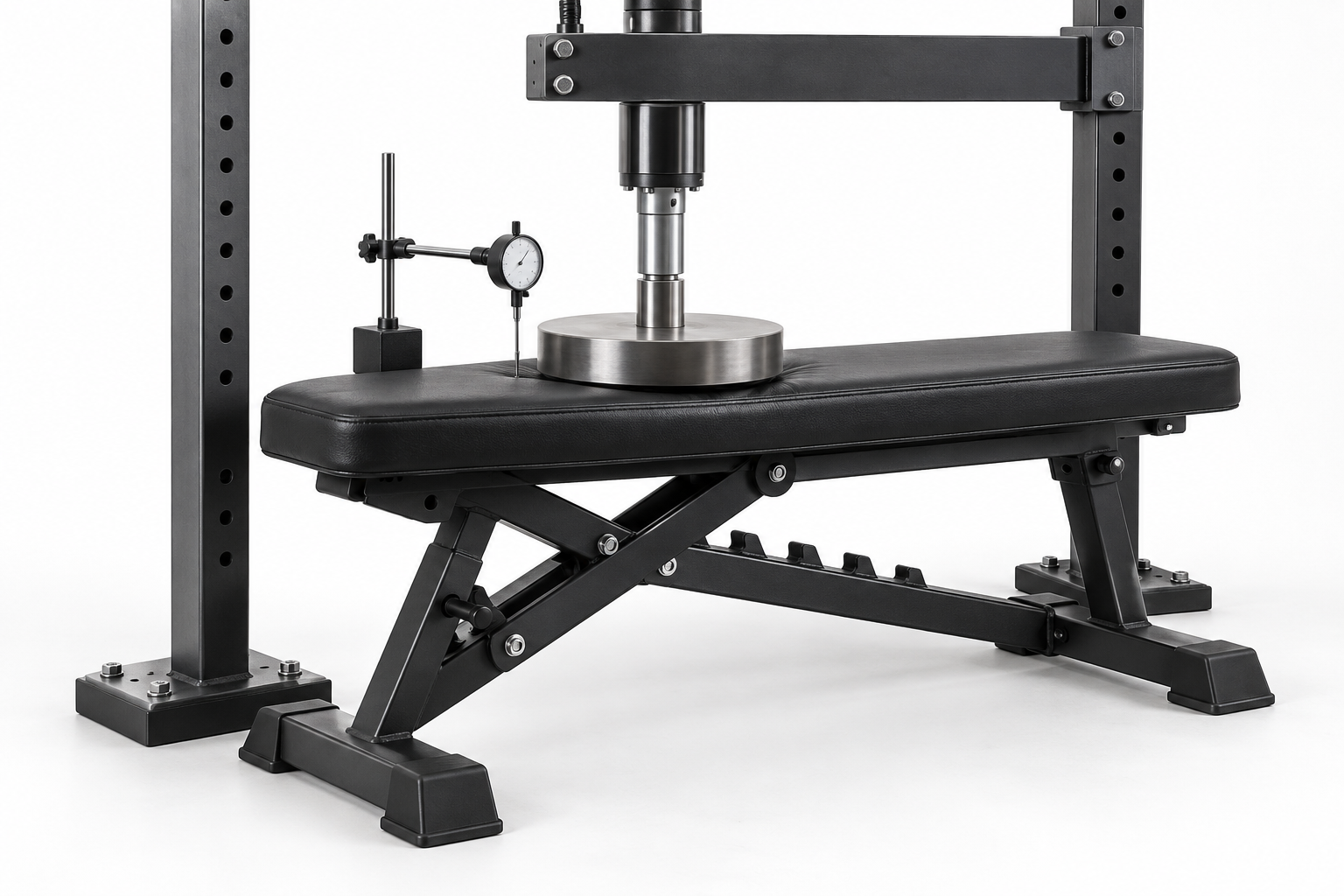
01 · Support
Stability
Does the support move or deform?
Record: Displacement, tilt and deformation under a defined load.
02 · Interface
Traction
How strongly does the material pair resist sliding?
Record: Friction under controlled contact conditions; athlete drift in a separate task.
03 · Setup
Repeatability
How closely do repeated setups align?
Record: Head, grip, torso and foot coordinates across trials.
Compare the complete definitions, measurements and non-equivalent claims
| Variable | Operational question | Possible measures | Do not substitute |
|---|---|---|---|
| Stability | Does the support move, tilt or deform under the athlete and load? | Support displacement, angular motion, stiffness, damping and load rating. | A lifter saying the surface feels firm. |
| Traction | How much tangential force is required before sliding begins or continues? | Static and kinetic friction under defined materials, pressure and contamination; torso drift under load. | Stable-versus-Swiss-ball performance. |
| Repeatability | Can the same athlete reproduce the setup and repetition? | Landmark error, touch-point spread, bar-path variability, velocity reliability and within-athlete error. | One visually clean repetition. |
These measurements interact. More torso drift can change the shoulder-to-bar relationship, and a deformable support can alter both position and timing. Each variable still keeps its own measurement identity: a traction conclusion requires friction or torso drift to be manipulated or measured.
Direct: multiple studies manipulate support or load instability and measure performance. Mechanically plausible: greater friction can resist sliding at a given normal force. Unresolved: whether a specific bench upholstery meaningfully improves strength, clinical outcomes or long-term adaptation.
What stable-versus-unstable studies show
Instability changes the task. It may require more correction while reducing the load or speed that can be expressed through the prime movers. The size and even direction of an effect depend on how instability is introduced.
Read across protocols
Instability is a condition—not a single intervention
Support is changed
Koshida: lower peak outputs on a Swiss ball at 50% 1RM. See the three outcomes below.
The result can be null
Goodman: no meaningful 1RM, elbow-ROM or selected-EMG difference in 13 participants.
Load can move instead
Ostrowski and Lawrence studied unstable loads and their muscle-activation or bar-path consequences.
Read the stable-support studies and contrasting findings
Koshida and colleagues compared dynamic bench pressing on stable and unstable support. Peak force, power and velocity were lower under the unstable condition—approximately 5.9%, 9.9% and 9.1%, respectively [1]. Saeterbakken and Fimland tested sixteen resistance-trained men using a stable bench, balance cushion and Swiss ball. Stable pressing supported a higher six-repetition maximum and greater pectoralis and triceps activation, while rectus-abdominis activity was higher on the Swiss ball [3]. The finding is a tradeoff, not evidence that instability is universally “bad”: the task shifted toward stabilization while limiting heavy pressing.
Marquina and colleagues tested 30 men (15 trained and 15 untrained) across stable, asymmetric-load, unstable-load, fitball and Bosu conditions at 40%, 60% and 80% 1RM. They measured mean propulsive speed, maximum speed and power; the size of the effect depended on the condition and load [4]. By contrast, Goodman and colleagues found no meaningful difference in one-repetition maximum, elbow range of motion or selected muscle activation between stable-bench and exercise-ball conditions in thirteen participants [2]. Protocols, familiarization, instability magnitude and measurement choices help explain why a single slogan cannot represent this literature.
Unstable loads are another exposure
Moving the instability from the support to the bar creates a different problem. Trained men pressing an unstable load showed altered activation of stabilizing musculature despite using a lower absolute load [5]. Analysis of the same general task showed a more variable and less predictable bar path in the mediolateral and anteroposterior directions [6]. Those studies support program-specific use of unstable loads. Bench-pad traction requires a separate direct comparison.
Pivotal study: instability can tax output, not just balance
Koshida et al. · 2008 · reported results
Three outputs from the same support comparison
- 20 male collegiate athletes
- 50% 1RM
- 3 single-repetition sets
Peak force
SD 150.8 N
SD 148.0 N
N · means shown by bars; SD printed separately
Peak power
SD 86.2 W
SD 65.1 W
W · means shown by bars; SD printed separately
Peak velocity
SD 16.7 cm/s
SD 13.4 cm/s
cm/s · means shown by bars; SD printed separately
Read the interpretation, limits and contrasting protocols
The Koshida study is useful because it measured outputs lifters care about—force, power and velocity—during dynamic pressing rather than inferring difficulty from appearance. The unstable support reduced all three on average [1]. That result illustrates a task constraint: some of the system’s capacity is spent controlling an uncertain base, and the athlete expresses less external output under that protocol.
The study directly shows that an intentionally unstable support reduced acute force, power and velocity under its tested protocol. Its boundary is specific: that support condition differs from conventional changes in foam, texture or width, acute output is distinct from long-term adaptation, and athlete–pad friction was not measured.
Read beside Goodman’s null findings and the later studies, the pivotal lesson is methodological: define the instability, load and outcome before generalizing. “Stable” is not a product superlative; it is a condition that needs an operational definition.
A 2026 training signal—with an unequal-load caveat
Zhu et al. · 2026 · Table 2
A training signal with different loading conditions
Smith-machine 1RM
SD 4.78 kg
SD 9.30 kg
SD 5.09 kg
SD 6.13 kg
kg · means shown by bars; SD printed separately
Maximal isometric test
SD 28.00 kg
SD 23.69 kg
SD 19.52 kg
SD 12.27 kg
kg · means shown by bars; SD printed separately
| Group | Weeks 1–4 | 5–8 | 9–12 |
|---|---|---|---|
| Unstable load | 55% | 65% | 75% |
| Smith machine | 65% | 75% | 85% |
Read the longitudinal finding and its limitations
Zhu and colleagues assigned 18 untrained men to 12 weeks of unstable-load or Smith-machine bench training. The unstable-load group progressed through nominal intensities of 55%, 65% and 75% 1RM; the Smith group used 65%, 75% and 85%. A group-by-time interaction favored unstable loading for the study’s 1RM outcome (p = .033; reported d = .82). The result is a preliminary longitudinal signal, not a clean demonstration that instability is superior: training loads were not matched, the sample was small and untrained, and transfer depends on the test selected (1RM was assessed on a Smith machine in both groups) [7].
The study adds a small longitudinal signal to the acute evidence base while preserving the broader task-specific finding that instability often limits immediate external output. Traction remains a separate research question.
Traction: clear mechanics, incomplete outcome evidence
The contact mechanics: friction, fabric, pressure and moisture
At an interface, static friction resists the start of sliding up to a limit that depends on the materials, normal force and local conditions. Sweat, clothing fabric, cleaning products, upholstery wear, contour and pressure distribution may all alter the real contact. A laboratory coefficient measured with one material pair should not be treated as an athlete outcome.
In the bench press, sliding can matter because it changes coordinates that organize the lift: eyes relative to the bar, shoulders relative to the rack, pelvis on the pad and the timing of leg effort. A higher-traction surface is therefore rationally designed to resist drift. That is a design-intent claim unless a comparative test measures friction or torso displacement.
The stable-versus-unstable studies changed support conditions rather than cover material alone. Effects of a grippier pad on bar velocity, force transfer, shoulder load or injury outcomes remain direct test questions.
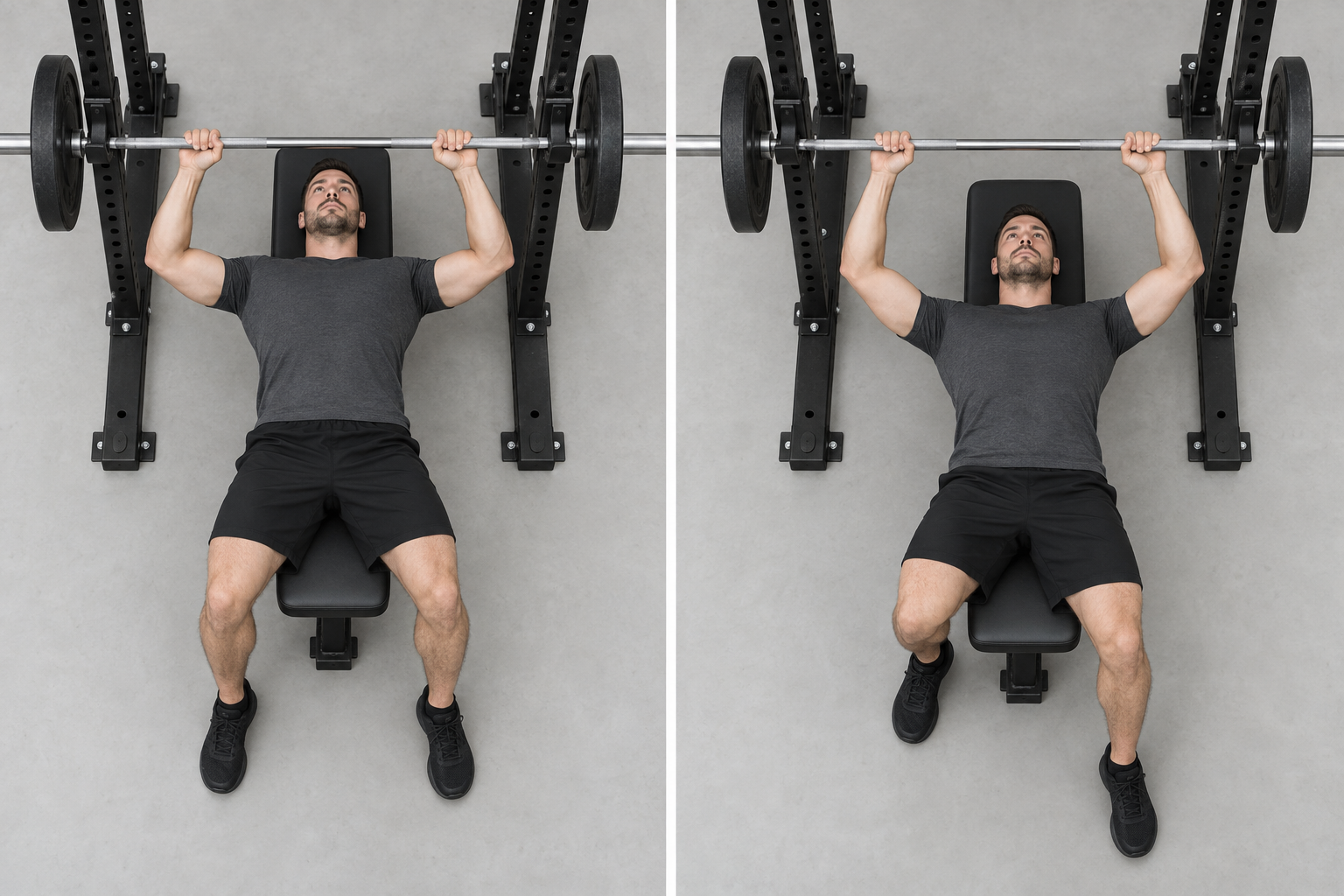
Setup comparison · illustrative scenarios
Repeatability begins before the bar moves
Reference setup
Record body position relative to the bench and rack, grip location and both feet.
Changed setup
A shifted torso and repositioned foot change several inputs before the bar moves.
Concept illustration, not measured trials. Multiple coordinates vary here; the image does not isolate friction or assign a performance effect. Keep the reference frame fixed when collecting real measurements.
Proposed direct test · material and athlete stages
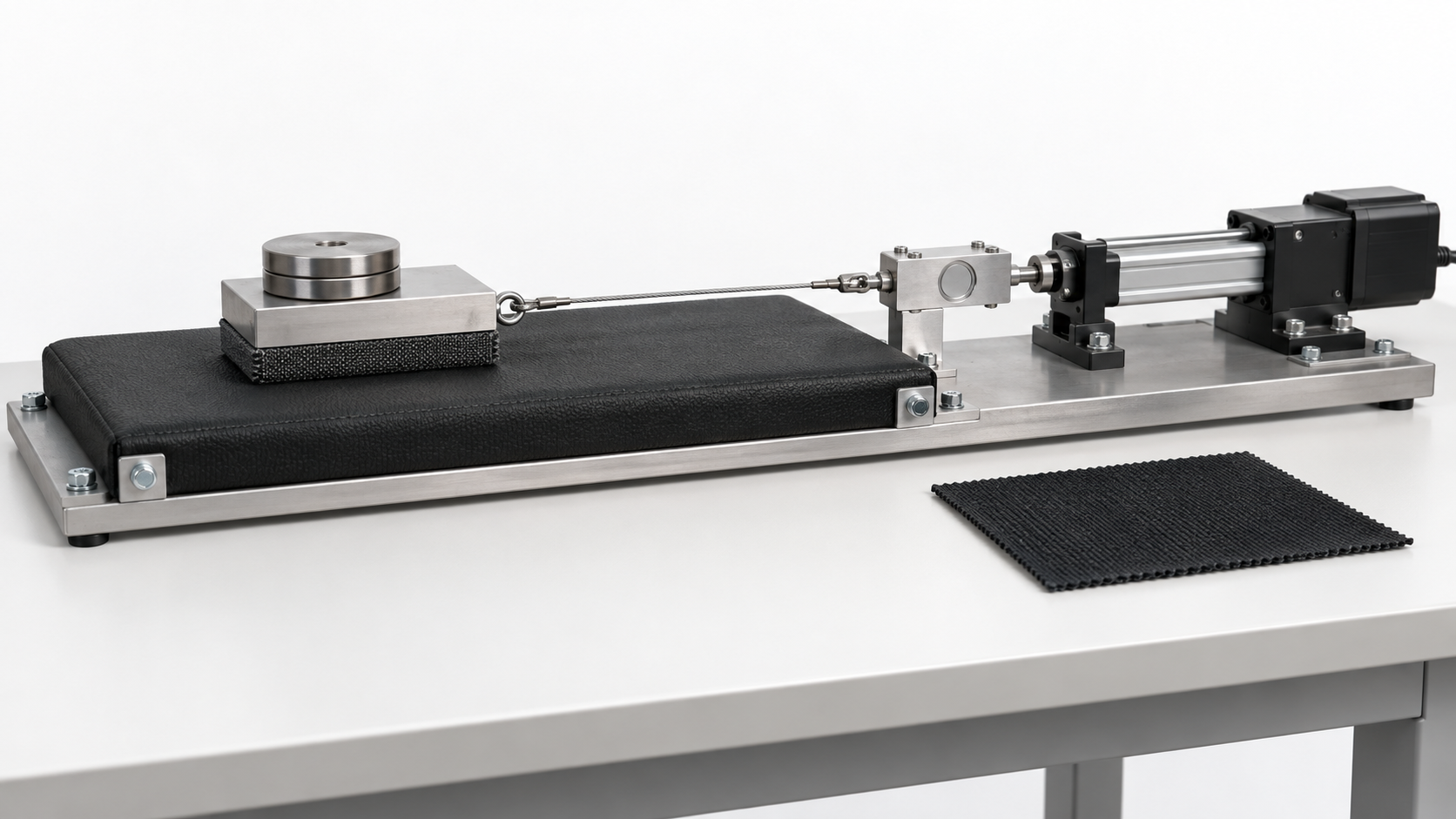
Friction-isolation rig
Stage A · material pair
A controlled sled test can measure resistance to starting and continuing sliding. Define contact load, fabric, cover condition and pulling speed.
Stage B · athlete response
A separate crossover test records torso drift, touch-point spread and bar-path variability. A material coefficient alone does not establish a training benefit.
- Hold pad geometry, foam, clothing, load and setup constant.
- Measure static and kinetic friction under dry and standardized moist conditions.
- Track torso landmarks, touch-point spread and bar-path variability.
- Randomize cover order and blind video analysis.
- Repeat across familiarized sessions; report absolute error.
Repeatability determines what a test can detect
Read a measurement in three ways
Repeatability, agreement and validity answer different questions
Does the ranking repeat?
Relative reliability describes consistency across repeated tests.
How large is the error?
Absolute error describes how much measurements vary in practical units.
Was the right thing measured?
Validity links the instrument to the variable claimed—not to every possible mechanism.
Read the velocity, power and instrumentation studies
A measurement must have less noise than the change we want to interpret. Stock and colleagues tested free-weight bench-press velocity in trained men on two occasions. Reliability was moderate to high at lighter and moderate loads, but error increased at 80% and 90% of one-repetition maximum [8]. Heavy single-repetition velocity is therefore a noisy place to declare an equipment effect from one trial.
Zemková and colleagues compared chest-press power assessment on stable and unstable surfaces. Stable-bench measures were highly reliable, while reliability deteriorated for some unstable, heavy conditions; reported standard errors approached roughly one-fifth for some 80% measures [9]. The support condition can influence not only performance but measurement quality.
Instrumentation does not remove the need for protocol control. A linear position transducer showed high validity and reliability for bench and squat measures in trained men, but power variables carried more error than velocity [10]. Bar kinematics also drift with fatigue within a bench-press set [11]. Warm-up, load, rest, intent, pause, grip, touch point and repetition number must therefore be standardized.
Reliability is not the same as agreement—or validity
Read the technical distinction and a practical repeated-test protocol
A device can rank athletes similarly across sessions while still giving values that differ enough to matter for an individual. That is why a reliability coefficient should be read beside absolute error, such as a standard error of measurement or limits of agreement. A small equipment difference that sits inside normal test–retest variation should not be promoted as a meaningful response simply because one repetition was higher.
Validity asks another question: did the method measure what the claim says? A transducer that validly measures bar velocity does not measure scapular motion, torso friction or internal joint load. Video landmarks can reveal drift but not the force required to prevent it. Pressure mapping can show contact distribution but not long-term adaptation. Each tool earns only the claim attached to its measured variable.
For a practical single-athlete comparison, collect several technically acceptable repetitions across at least two familiarized sessions per condition. Report the mean, spread and any excluded trials, and keep the repetition number consistent. Randomize condition order when feasible so that fatigue and learning do not always favor the same surface. If athletes and coaches cannot be blinded to the pad, outcome processing can still be blinded. These steps do not turn a gym comparison into a clinical trial, but they make the conclusion auditable.
Repeatability should never be confused with desirability. A lifter can reproduce a poor match to the task, and a new technique may be variable while it is being learned. The question is whether variability is acceptable for the intended use and whether it decreases with familiarization.
When two conditions differ by less than ordinary session-to-session error, the honest result is inconclusive rather than “no effect” or “the same.” More familiarization, more repeated trials or a more sensitive outcome may be needed. That language protects athletes from chasing noise and protects useful equipment ideas from being judged by an underpowered one-day comparison.
A weight-room repeatability audit
Use a simple audit before comparing programs, pads or techniques. The goal is not to freeze every athlete into one setup; it is to know what was held constant and what changed.
- Identify the hardware. Log bench, pad configuration, bar, rack height, safety height and any attachment. Competition testing should use the applicable equipment and commands [12].
- Record the athlete coordinates. Index eyes or forehead to the racked bar, grip marks, foot locations, head/shoulder/pelvis contacts and torso midline.
- Define the repetition. Specify touch point, pause or touch-and-go standard, depth, intent and acceptable assistance from a handoff.
- Control the test context. Match warm-up, load calculation, rest, time of day where practical, clothing at the interface and fatigue state.
- Measure drift. Film from fixed views or use position sensors. Track head and pelvis displacement, touch-point spread, path variability and velocity across repeated sets.
- Repeat before deciding. Compare multiple exposures. Report typical error or at least the range of repeated values, not only the best repetition.
When traction is the research question, hold foam, contour, dimensions, clothing and load constant; vary the cover condition; quantify static/kinetic friction and torso displacement; and blind outcome analysis where possible. That design can separate a real interface effect from expectation or setup variation.
Launch Pad relevance and the Joint Ops research path
Published Launch Pad studies evaluated a complete interface. In a randomized crossover study of ten resistance-trained men, five repetitions at 70% of one-repetition maximum on the novel pad condition produced higher measured pectoralis surface electromyography, bar velocity and range of motion; the power difference was not statistically significant [13]. The study measured the complete interface rather than isolating upholstery friction.
Kidwell et al. · 2026 · Table 1
Measured outcomes of the complete interface
Vertical bar displacement
SD 7 cm
SD 4 cm
cm · means shown by bars; SD printed separately
Mean bar velocity
SD 0.09 m/s
SD 0.09 m/s
m/s · means shown by bars; SD printed separately
Peak bar velocity
SD 0.11 m/s
SD 0.09 m/s
m/s · means shown by bars; SD printed separately
Concentric power
SD 103 W
SD 93 W
W · means shown by bars; SD printed separately
Read the four-week and eight-week training studies
In a four-week supervised eccentric-overload program, intermediate-trained men improved one-repetition maximum more in the Launch Pad condition than on a flat bench [14]. In an eight-week supervised program with male collegiate football players, the Launch Pad group improved tested strength, repetitions and medicine-ball performance more than the flat-bench group [15]. These are complete-condition training outcomes, not proof that traction, stability or any single component caused the differences.
Joint Ops is an active research-and-development program whose working prototype was publicly debuted at CSCCa in May 2026; it is not a published outcome study. The evidence plan should quantify cover friction, pressure distribution, torso drift, bar-path variability, force and velocity reliability, tolerance and training outcomes while holding other geometry constant. No Joint Ops performance, rehabilitation or injury-prevention outcome has been published or is claimed here.
Standardize first, compare second
Use the Research Hub to examine measured findings, methods and null results before assigning an outcome to the surface beneath the athlete.
Research and education only. This article does not provide medical diagnosis, guarantee injury prevention or establish a universally optimal surface. Introduce unfamiliar instability or equipment progressively and use appropriate spotters, safeties and professional guidance.
References
- Koshida, S., Urabe, Y., Miyashita, K., Iwai, K., & Kagimori, A. (2008). Muscular outputs during dynamic bench press under stable versus unstable conditions. Journal of Strength and Conditioning Research, 22(5), 1584–1588. https://doi.org/10.1519/JSC.0b013e31817b03a1 ↩
- Goodman, C. A., Pearce, A. J., Nicholes, C. J., Gatt, B. M., & Fairweather, I. H. (2008). No difference in 1RM strength and muscle activation during the barbell chest press on a stable and unstable surface. Journal of Strength and Conditioning Research, 22(1), 88–94. https://doi.org/10.1519/JSC.0b013e31815ef6b3 ↩
- Saeterbakken, A. H., & Fimland, M. S. (2013). Electromyographic activity and 6RM strength in bench press on stable and unstable surfaces. Journal of Strength and Conditioning Research, 27(4), 1101–1107. https://doi.org/10.1519/JSC.0b013e3182606d3d ↩
- Marquina, M., Lorenzo-Calvo, J., García-Sánchez, C., de la Rubia, A., Rivilla-García, J., & Ferro-Sánchez, A. (2023). How does instability affect bench press performance? Acute effect analysis with different loads in trained and untrained populations. Sports, 11(3), 67. https://doi.org/10.3390/sports11030067 ↩
- Ostrowski, S. J., Carlson, L. A., & Lawrence, M. A. (2017). Effect of an unstable load on primary and stabilizing muscles during the bench press. Journal of Strength and Conditioning Research, 31(2), 430–434. https://doi.org/10.1519/JSC.0000000000001497 ↩
- Lawrence, M. A., Leib, D. J., Ostrowski, S. J., & Carlson, L. A. (2017). Nonlinear analysis of an unstable bench press bar path and muscle activation. Journal of Strength and Conditioning Research, 31(5), 1206–1211. https://doi.org/10.1519/JSC.0000000000001610 ↩
- Zhu, S., She, A., & Tao, H. (2026). A study on the effect of 12-week unstable bench press barbell training on improving upper limb muscle strength of college students. Frontiers in Physiology, 17, 1826652. https://doi.org/10.3389/fphys.2026.1826652 ↩
- Stock, M. S., Beck, T. W., DeFreitas, J. M., & Dillon, M. A. (2011). Test–retest reliability of barbell velocity during the free-weight bench press. Journal of Strength and Conditioning Research, 25(1), 171–177. https://doi.org/10.1519/JSC.0b013e318201bdf9 ↩
- Zemková, E., Jeleň, M., Kováčiková, Z., Ollé, G., Vilman, T., & Hamar, D. (2015). Reliability and methodological issues of power assessment during chest presses on an unstable surface with different weights. Journal of Sports Medicine and Physical Fitness, 55(9), 922–930. PubMed record ↩
- Garnacho-Castaño, M. V., López-Lastra, S., & Maté-Muñoz, J. L. (2015). Reliability and validity assessment of a linear position transducer. Journal of Sports Science & Medicine, 14(1), 128–136. Official full text ↩
- Duffey, M. J., & Challis, J. H. (2007). Fatigue effects on bar kinematics during the bench press. Journal of Strength and Conditioning Research, 21(2), 556–560. https://doi.org/10.1519/R-19885.1 ↩
- International Powerlifting Federation. (2026). Technical Rules Book 2026. Official rulebook ↩
- Kidwell, J. A., Yamamoto, T., Hetherton, K. J., Truneh, N., Bright, J. J., Blatney, A. E., et al. (2026). Acute effects of thoracic-spinal elevation via a novel bench press pad on sEMG and barbell kinetics in resistance-trained males. International Journal of Exercise Science, 19(1), 1003. https://doi.org/10.70252/IJES2026103 ↩
- Goldman, P., Taylor, J., Yamamoto, T., Blatney, A. E., Sahni, T. K., Lechner, R. J., et al. (2025). Eccentrically overloaded bench press training: Augmenting strength gains via a novel bench press pad. Scientific Journal of Sport and Performance, 4(4), 480–490. https://doi.org/10.55860/JCDL3612 ↩
- Blatney, A. E., Kidwell, J. A., Yamamoto, T., Goldman, P., Hetherton, K. J., & Dolezal, B. A. (2026). Effects of an eight week training regimen with a novel bench press pad compared to a traditional bench on upper body strength and performance in collegiate American football players. Scientific Journal of Sport and Performance, 5(1), 10–21. https://doi.org/10.55860/RNUB8627 ↩