

A strength bench is often sold as a frame, a load rating and a pad. The athlete encounters something more consequential: a floor height, a rack relationship, a sequence of support zones, a compressible surface, a set of edges and—on an adjustable model—a mechanism that must lock and return to position.
A bench can be structurally excellent and still fit only part of its intended population. It can offer many angles while making the selected angle hard to identify.
It can conform perfectly to a competition specification and still be mismatched to dumbbell work, rapid team transitions or a different training task. The equipment is not “good” or “bad” in the abstract. It is either well specified for a defined athlete, task and environment—or it is not.
What Must the Bench Support During Use?
- Users
- Body-size range, training age, mobility constraints, clothing and footwear, assisted-transfer needs.
- Tasks
- Competition practice, barbell or dumbbell pressing, flat or inclined work, testing, team turnover.
- Environment
- Rack geometry, floor, spotting access, storage, maintenance, cleaning and available footprint.
- Claims
- Structural safety, fit, usability, acute mechanics, training outcomes and clinical outcomes require different tests.
Design rule 01The first specification is not pad width or back angle. It is the use case the bench must reliably accommodate.
Turn Athlete and Training Needs Into Design Requirements
The International Powerlifting Federation’s current rulebook defines a flat, level bench at least 1.22 m long, 29–32 cm wide and 42–45 cm high when the padded surface is not depressed or compacted. It also specifies upright and bar-rest relationships.[1] Those dimensions standardize a sport task. They are essential for competition specificity; they are not a universal optimum for every athlete or exercise.
ISO 20957-1:2024 addresses general safety requirements and test methods for stationary training equipment.[2] ISO 9241-210:2019 addresses human-centered design for interactive systems rather than benches, but its cycle—understand context, specify requirements, evaluate with users, iterate—offers a useful process analogy.[3]
Neither standard determines the best support geometry for a particular press. Safety compliance, sport compliance and human accommodation are separate specifications.
AMM Research · Visual 40 · Bench design concept
The bench specification map
Top view: flat configuration. Side view: raised backrest and rack relationship.

- Width, usable support & edge clearance
- Overall pad width is only the outside boundary. Usable support depends on the athlete, pose and contour; shoulder clearance must be checked during motion.
- Effective height & compression
- Catalog height describes the unloaded surface. Record how the pad compresses and where the athlete sits relative to the floor and bar rests under load.
- Back angle, seat angle & hinge gap
- Specify the selected angles and the transition between pads. Record where the head, thorax and pelvis receive support.
- Traction & rack relationship
- Test resistance to sliding and the user’s relationship to the bar rests. The rendering shows geometry; it does not measure grip, pressure or load capacity.
Reading the drawing: catalog dimensions describe unloaded geometry. The athlete experiences effective height, usable support, friction, compression and edges under load.
Generic equipment concept. Proportions and positions are illustrative, with no recommended dimensions. This is not a depiction of The Launch Pad or Joint Ops.
Design for Athlete Accommodation, Not an Average Body
Height is a floor-and-rack relationship
Height affects foot reach, knee and hip position, pelvic control and the athlete’s vertical relationship to the bar rests. Because the IPF dimension is measured before the pad is depressed, foam compression and upholstery tension can make equal catalog heights feel different under load.
Width is not usable support
A wider pad can support more of one torso while placing an edge nearer another athlete’s upper arm. A narrower pad can increase edge clearance while reducing support beneath a broad athlete.
Contour, athlete breadth, scapular pose, grip and arch define the working boundary. The dedicated Bench Pad Width & Shoulder Mechanics article owns the deeper width analysis.
Length contains functional zones
Total length does not reveal where the head, thorax and pelvis are supported. Adjustable-benches add hinge gaps and seat transitions that can relocate pressure. Drawings and fit trials should identify functional zones, not only overall length.
Settings must be perceptible and repeatable
Anthropometric percentiles help define a population range, but a setting only improves accommodation when users can distinguish it, select it and return to it. Garneau and Parkinson show how just-noticeable-difference modeling can make product sizing more robust to variability in user perception and preference.[4]
Targeted correction-pass literature review
What the Bench-Design Literature Can Tell Us
Direct experimental literature on fitness-bench design is sparse compared with research on programming, grip, technique and muscle activity. That scarcity is a reason to validate design decisions, not a reason to elevate adjacent evidence beyond its methods.
A 2024 human-centered design study examined traditional fitness benches through literature review, surveys and design development. Its participant work was exploratory and concentrated largely in younger users; reported needs included clearer use, stability, adaptable fit, support and assistance features.[5]
Engineering use: translate recurring user concerns into requirements and usability tests.
Boundary: preference data and a proposed concept do not establish biomechanical superiority, injury reduction or training benefit.
- 5th
- Female model
- 50th
- Male model
- 95th
- Male model
Three anthropometric cases · BMI-based model selection
Three digital anthropometric cases—a fifth-percentile female and 50th- and 95th-percentile males—were modeled on an adjustable seated-row machine. The machine appeared to accommodate the three cases, but software limitations prevented useful muscle-force and contraction outputs.[6]
Engineering use: test multiple body cases early and document model limits.
Boundary: a seated-row model does not validate a bench, and digital accommodation does not replace physical fit or loaded-use testing.
Design rule 02Use anthropometry to choose whom to test; use representative athletes to learn whether the equipment actually accommodates them.
Treat the Surface as a Mechanical Assembly
Upholstery, foam, substrate and edge geometry are components. Friction affects resistance to sliding. Compliance affects pressure distribution, sink and effective height. Edge shape determines how abruptly support ends. These properties can be measured with material tests, pressure mapping, displacement tracking and controlled user trials.
AMM Research · Visual 07 · Concept illustration
The surface is an assembly, not just a shape
Read the four layers from top to bottom.

- 01 · Cover
- Material pair + surface condition. Identify the upholstery, clothing contact and conditions when testing resistance to sliding.
- 02 · Cushioning
- Thickness + compression. Record loaded sink, recovery and the resulting effective support height.
- 03 · Support shape
- Contour + edge geometry. Specify the supporting profile and where support ends, rather than relying on overall width.
- 04 · Structure
- Deflection + load capacity. Test the load-bearing assembly, including its connections and locking mechanisms.
Generic assembly diagram, not a drawing of The Launch Pad’s construction. Material behavior and structural response must be specified as well as catalog dimensions.
Concept illustration. The materials and exploded spacing are illustrative; they are not product specifications. Article synthesis; see the references below.
AMM Research · Visual 41 · Concept illustration
Two support conditions, three measured outcomes
Goodman et al. (2008) · 13 participants
- 1RM strength
- Recorded muscle activity
- Elbow range of motion
No difference was detected in these outcomes under the tested protocol. The shapes identify the conditions; their size does not represent a measured result or prove that all support surfaces are equivalent. Study [7].
A feature name is not an outcome. Goodman and colleagues tested 13 participants on a flat bench and an exercise ball and found no difference in 1RM, recorded muscle activity or elbow range of motion under their protocol.[7]
The result does not prove that every support surface is equivalent. It shows why “stable” or “unstable” cannot substitute for a measured mechanical description.
Each arrow is a hypothesis. A higher-friction cover may be described as intended to resist sliding. Improved force transfer needs force or performance data. Comfort, pressure, setup repeatability, performance and clinical outcomes remain different questions.
Make the Adjustments Work Together
Back angle, seat angle, translation, rack height and lumbar position can expand accommodation. Range is only the first requirement. The athlete or coach must reach the control, understand the index, confirm full engagement, avoid pinch zones and return to a recorded setting.
AMM Research · Visual 22Equipment photograph
An adjustment needs a reproducible setting
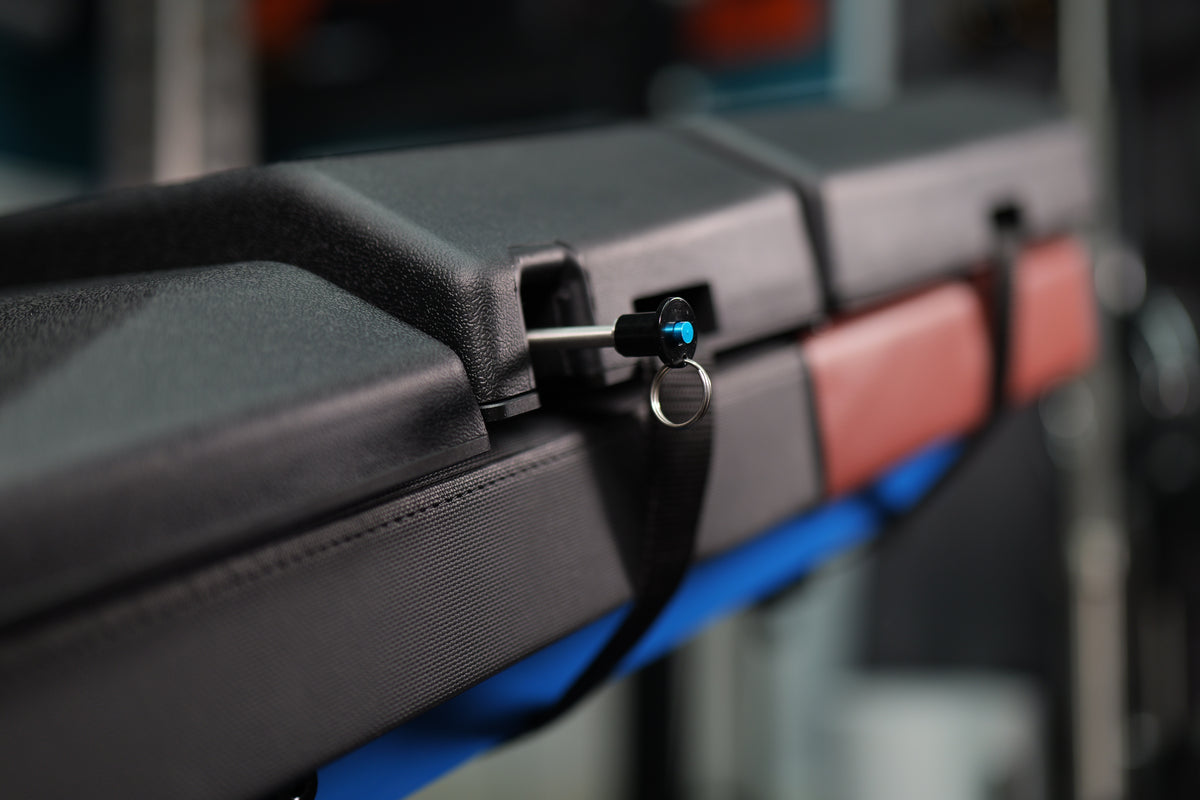
A visible adjustment and locking mechanism belongs in the setup record. This product photograph illustrates the hardware; it is not evidence of load capacity, correct engagement or a clinical benefit.
Advanced Muscle Mechanics product-image archive. Original image, unaltered.
AMM Research · Visual 42 · Concept illustration
Make the chosen angle a repeatable condition
Lauver et al. (2016) · Four tested bench angles
14 trained men · six repetitions per condition · 65% 1RM. The diagrams show the study settings, not an activation ranking or a recommended adjustment range. Red lines identify the backrest angle; the dashed line is horizontal. Study [8].
Lauver and colleagues made bench angle an explicit condition: 14 resistance-trained men completed six repetitions at 65% 1RM at −15°, 0°, 30° and 45°. Full-phase and time-window sEMG results differed by muscle and angle rather than identifying one universal “best” position.[8]
The engineering implication is direct: if a nominal angle cannot be identified and repeated, training records become less comparable.
How Bench Design and Lifting Technique Interact
A bench does not meet an athlete in a single neutral pose. Grip, touch point, arch, scapular instruction, rack height and lateral force strategy change the body’s relationship to the surface. A product validated on one average user and one nominal technique can therefore miss intended use cases.
Mausehund et al. · 2022
Lateral force belongs in the record
- 35
- Strength-trained adults
- 4
- Grip-and-elbow conditions
Mausehund and colleagues showed why vertical load is an incomplete design record. In 35 strength-trained adults, four grip-and-elbow conditions produced load differences of up to 12%, shoulder net-moment differences of up to 43% and elbow-moment differences of up to 26%. Including mediolateral bar force materially changed the joint-moment calculation.[12]
For equipment development, the implication is not that one grip should be built into the bench. It is that representative technique conditions belong in the validation plan.
Cudlip et al. · 2022
The torso setup changes the support relationship
- 20
- Experienced men
- 3
- Tested relative loads
Torso technique changes the support relationship as well. In 20 experienced men pressing at 25%, 50% and 75% of self-reported 1RM, Cudlip and colleagues found that the powerlifting arch increased latissimus dorsi activity, while the standardized technique produced approximately 8% larger integrated shoulder moments.[13]
A bench should therefore be assessed with the setups it is expected to support rather than assuming that every athlete occupies the pad identically.
Noteboom et al. · 2024
Measured movement informs a shoulder-load model
- 10
- Experienced athletes
- 21
- Technique combinations
- 16 kg
- Bar load
Noteboom and colleagues made the posterior question still more explicit. Ten experienced athletes performed 21 combinations of grip width, shoulder-abduction target and scapular instruction with a 16 kg bar. Selected model-estimated shoulder loads changed across technique conditions, while the released and neutral scapular conditions did not differ in modeled joint-reaction force.[14]
The study legitimizes clearance and support as design questions; it does not validate a production bench or establish injury prevention. the shoulder-mechanics article owns the full shoulder-method interpretation.
Validate the Bench at the Level of the Claim
01 · Safety
Can the bench be used as intended?
- Representative measures
- Static/dynamic load, stability, lock engagement, pinch and shear hazards
- Stop before claiming
- Fit, biomechanics, performance
02 · Fit
Whom does it accommodate?
- Representative measures
- Foot reach, torso support, edge clearance, control reach, entry and exit
- Stop before claiming
- Training adaptation
03 · Usability
Can users configure it repeatably?
- Representative measures
- Setup time, setting error, lock confirmation, setting recall
- Stop before claiming
- Joint loading, clinical benefit
04 · Mechanics
How does the measured repetition change?
- Representative measures
- Pressure, position, bar motion, force, sEMG, displacement
- Stop before claiming
- Long-term or clinical outcomes
05 · Training
What changes after repeated exposure?
- Representative measures
- Strength, endurance, power, hypertrophy, skill
- Stop before claiming
- Injury prevention or treatment
06 · Clinical
Does health status change?
- Representative measures
- Pain, function, time loss, injury incidence, return to training
- Stop before claiming
- Requires its own clinical design
The published Launch Pad studies provide an example of moving through selected gates. A randomized acute crossover found that one tested support intervention changed pectoralis sEMG, mean and peak bar velocity and vertical displacement; concentric power did not differ statistically (p = .071).[9]
Separate randomized four- and eight-week trials reported larger performance improvements under their matched Launch Pad conditions.[10][11]
Those product-specific results do not identify which feature caused each outcome, transfer to another bench or establish a clinical effect.
Release decisionFreeze geometry only after safety, fit and usability are demonstrated for the intended population. Escalate mechanical, training and clinical claims only when the corresponding evidence exists.
Next in the research sequence · the athlete-to-bench interface articleFollow the finished bench into the Feet → Floor, Hands → Bar and Torso → Bench systemReferences
- International Powerlifting Federation. (2026). Technical Rules Book, effective March 1, 2026. Official rulebook. ↩
- International Organization for Standardization. (2024). ISO 20957-1:2024—Stationary training equipment: General safety requirements and test methods. ISO record. ↩
- International Organization for Standardization. (2019). ISO 9241-210:2019—Ergonomics of human-system interaction: Human-centred design for interactive systems. ISO record. ↩
- Garneau CJ, Parkinson MB. (2013). Considering just noticeable difference in assessments of physical accommodation for product design. Ergonomics, 56(11), 1777–1788. doi:10.1080/00140139.2013.838308. ↩
- Shi S, Sethi S, Sethi S. (2024). Human-Centered Design in Optimizing Fitness Benches. Applied Human Factors and Ergonomics International, 155, 130–140. doi:10.54941/ahfe1005398. ↩
- Nolte K, Krüger PE, Els PS. (2013). Three-dimensional musculoskeletal modelling of the seated row resistance-training exercise. South African Journal of Sports Medicine, 25(3), 67–73. doi:10.7196/SAJSM.470. ↩
- Goodman CA, Pearce AJ, Nicholes CJ, Gatt BM, Fairweather IH. (2008). No difference in 1RM strength and muscle activation during the barbell chest press on a stable and unstable surface. Journal of Strength and Conditioning Research, 22(1), 88–94. doi:10.1519/JSC.0b013e31815ef6b3. ↩
- Lauver JD, Cayot TE, Scheuermann BW. (2016). Influence of bench angle on upper extremity muscular activation during bench press exercise. European Journal of Sport Science, 16(3), 309–316. doi:10.1080/17461391.2015.1022605. ↩
- Kidwell JA, Yamamoto T, Hetherton KJ, et al. (2026). Acute effects of thoracic-spinal elevation via a novel bench press pad on sEMG and barbell kinetics in resistance-trained males. International Journal of Exercise Science, 19(1), 1003. doi:10.70252/IJES2026103. ↩
- Goldman P, Taylor J, Yamamoto T, et al. (2025). Eccentrically overloaded bench press training: Augmenting strength gains via a novel bench press pad. Scientific Journal of Sport and Performance, 4(4), 480–490. doi:10.55860/JCDL3612. ↩
- Blatney AE, Kidwell JA, Yamamoto T, Goldman P, Hetherton KJ, Dolezal BA. (2026). Effects of an eight week training regimen with a novel bench press pad compared to a traditional bench on upper body strength and performance in collegiate American football players. Scientific Journal of Sport and Performance, 5(1), 10–21. doi:10.55860/RNUB8627. ↩
- Mausehund L, Werkhausen A, Bartsch J, Krosshaug T. (2022). Understanding bench press biomechanics—The necessity of measuring lateral barbell forces. Journal of Strength and Conditioning Research, 36(10), 2685–2695. doi:10.1519/JSC.0000000000003948. ↩
- Cudlip AC, Maciukiewicz JM, Pinto BL, Dickerson CR. (2022). Upper extremity muscle activity and joint loading changes between the standard and powerlifting bench press techniques. Journal of Sports Sciences, 40(9), 1055–1063. doi:10.1080/02640414.2022.2046937. ↩
- Noteboom L, Belli I, Hoozemans MJM, Seth A, Veeger HEJ, van der Helm FCT. (2024). Effects of bench press technique variations on musculoskeletal shoulder loads and potential injury risk. Frontiers in Physiology, 15, 1393235. doi:10.3389/fphys.2024.1393235. ↩