

A program may record load, grip width, and tempo precisely while saying little about the bench. Yet its height, width, contour, firmness, and traction help define the task the lifter performs.
That omission turns equipment into invisible context. The athlete exchanges force through three boundaries: the feet meet the floor, the hands meet the bar and the posterior torso meets a surface with a particular height, width, contour, edge, friction and compression. Change any boundary and the task may change—even if the exercise name does not.
The central AMM interface framework
Three Contact Points Shape the Repetition

- 1 · Hands / barGrip and external load
- 2 · Torso / benchShape, contact and support
- 3 · Feet / floorPosition and contact
The bench is one of three contacts that define the repetition. Numbered markers locate interfaces; their size does not encode force, pressure or a product benefit. Contact map, not a force measurement.
Position · contact · friction · ground reaction
Grip · wrist · vertical and horizontal force
Support · geometry · pressure · friction
Path · force · range · velocity · activation · repeatability
The framework does not make the bench the cause of every outcome. It makes the support condition visible enough to document and test. Article 02 owns the engineering specification. This article owns the complete interface model and the direct evidence progression.
Feet → Floor
Foot position, contact and floor friction influence lower-body tension and pelvic position. Gardner and colleagues compared standard, leg-drive and feet-up conditions in 27 participants at 75% of the standard-condition 1RM. Ground-reaction-force data confirmed that the lower-body conditions differed, but recorded upper-body EMG did not differ significantly.[1]
The null result matters. A visible setup change does not guarantee a change in every endpoint. The feet-to-floor interface should be verified with measures relevant to the question: foot pressure or ground force for the base, bar and body motion for technique, and performance for output.
Hands → Bar
Mausehund and colleagues tested 35 strength-trained adults across four grip-and-elbow conditions. Conditions differed by as much as 12% in load; shoulder net moments increased by as much as 43% with wider grips, while elbow moments increased by as much as 26% as grip narrowed.[2]
Larsen and colleagues separately compared 1RM presses at grip widths of 1.0, 1.4 and 1.7 times bi-acromial width in 14 experienced men. Mean loads were 103.7, 108.9 and 109.8 kg from narrow to wide, vertical displacement increased as grip narrowed and horizontal force direction changed across conditions.[3] The bar travels mainly upward, but the interface has direction as well as magnitude.
Torso → Bench
The posterior boundary combines contact location, contour, width, edge clearance, friction, compliance and effective height. A surface can support one region, leave another free, resist sliding or compress differently under different athletes. Those properties can be documented directly.
Goodman and colleagues provide a useful restraint on automatic surface claims. In 13 participants, replacing a flat bench with an exercise ball did not change 1RM, recorded muscle activation or elbow range of motion under the tested protocol.[4] “Different surface” is a design description, not a result.
The question is not whether a surface looks different.It is whether a defined change produces a measured difference under a defined protocol.
Observation → hypothesis → controlled test
What to Record About the Bench Surface
During Launch Pad development, AMM used a clear acrylic flat-bench demonstration to make posterior contact easier to see. The demonstration can reveal where an athlete appears to contact or clear a surface and can help designers formulate questions about contour, edges and torso position.
AMM Research · Visual 20Equipment photograph
Locate the interface in an actual pressing setup
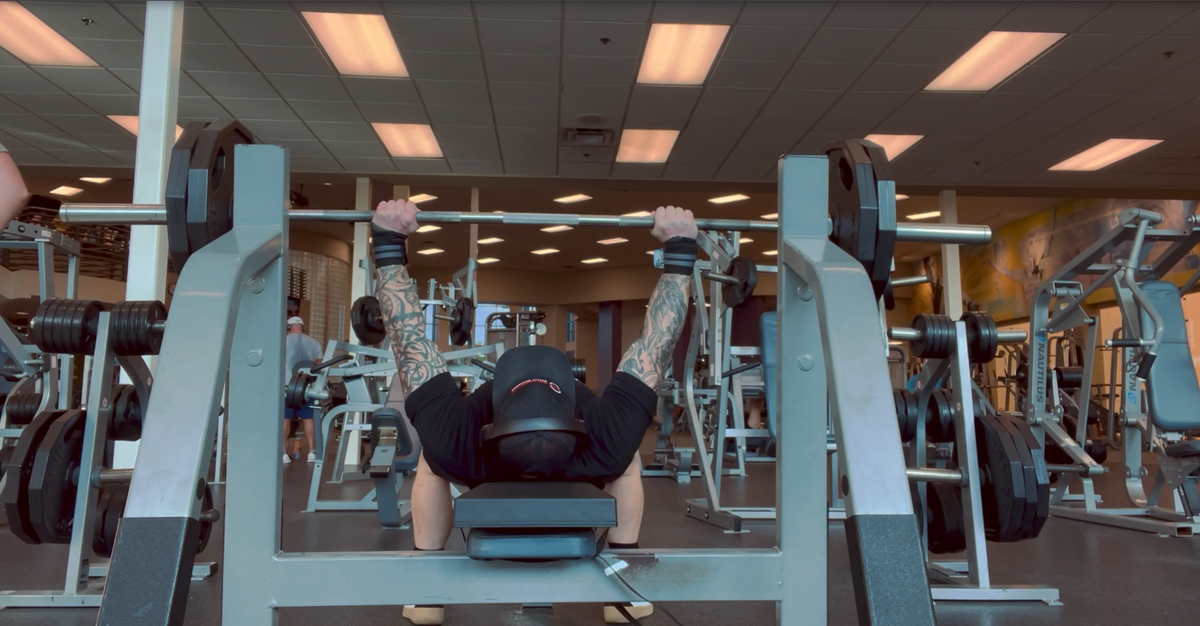
The photograph locates the upper-back support beneath the lifter. It does not measure contact pressure, scapular motion or the forces transmitted through the interface.
Advanced Muscle Mechanics product-image archive. Original image, unaltered.
What an acrylic bench can show—and what it cannot
From a visible boundary to a measurable condition
When Support Fits the Lifter—and When It Does Not
Constraint is not a synonym for harm. A competition bench intentionally narrows variation so performances can be compared. Familiar geometry may make a setup easier to reproduce. The same edge or contour can be irrelevant to one athlete and intrusive for another. The judgment depends on the task, the athlete and the measured outcome.
Friction illustrates the point. A surface that resists sliding may help an athlete hold a selected position, but the word “grippy” does not establish repeatability or force transfer. Test the proposition by recording setup error, position drift, pressure distribution or bar outcomes across repeated trials. Compliance should be treated the same way: measure unloaded thickness, compression under representative loads, recovery and athlete-to-athlete variation before attributing an effect to “softness” or “support.”
A useful interface record can be short: surface or insert, bench height, pad angle, rack height, contact configuration, grip, foot position and any setup cue that materially affects the repetition. Recording that context does not make every variable causal. It makes later comparison possible.
Direct evidence · stage 01
The Acute Crossover: Did the Repetition Change?
Kidwell and colleagues recruited 10 resistance-trained men (23 ± 3 years) for a randomized, single-blind crossover. In separate sessions approximately 48 hours apart, participants performed five repetitions on a conventional flat bench and with the Launch Pad at 70% of each participant’s established 1RM. Hand position was standardized to 150% of bi-acromial width.[5]
AMM Research · Study results · Kidwell et al. (2026)
Six acute outcomes, shown side by side
Bars show condition means; error bars show SD, not uncertainty of the paired difference. Each outcome uses its own units; all axes start at zero. Study source [5].
Right pectoralis sEMG
Flat bench: 70.2 ± 24.8 % MVC · Launch Pad: 87.3 ± 20.1 % MVC
p < .001 · d = .76
Left pectoralis sEMG
Flat bench: 68.3 ± 23.4 % MVC · Launch Pad: 86.8 ± 20 % MVC
p < .001 · d = .85
Mean bar velocity
Flat bench: 0.40 ± 0.09 m/s · Launch Pad: 0.47 ± 0.09 m/s
p < .001 · d = .74
Peak bar velocity
Flat bench: 0.57 ± 0.11 m/s · Launch Pad: 0.66 ± 0.09 m/s
p < .001 · d = .98
Vertical displacement
Flat bench: 38 ± 7 cm · Launch Pad: 44 ± 4 cm
p = .005 · d = 1.02
Concentric power
Flat bench: 249 ± 103 W · Launch Pad: 271 ± 93 W
p = .071 · d = .23
Not statistically significantThe raw condition means are shown to keep the numerical record auditable. Percent changes sometimes used to summarize these results are derived from those means, not separately measured outcomes. The study found different acute repetition characteristics; it did not measure scapular kinematics, shoulder reaction force, pain, injury or long-term adaptation.
Direct evidence · stages 02 and 03
Repeated Exposure: Two Randomized Training Trials
42 intermediate-trained men were randomized to eccentric-overload training with the Launch Pad or a matched flat condition. Both groups used the same CARE machine protocol.
AMM Research · Training trial · Visual 26
Strength gain after four weeks
Bars show mean changes from baseline; error bars show SD. Both groups followed the same eccentric-overload protocol. Study source [6].
1RM change
Control: +11.1 ± 2.4 kg · Launch Pad: +18.4 ± 4.3 kg
7.3 kg between-group difference · p < .001 · g = 3.85
The Launch Pad group’s mean gain was approximately 66% larger. That percentage is derived from the two raw group means.[6]
30 male collegiate football players were randomized in the off-season to Launch Pad or conventional-bench training within the same program.
AMM Research · Training trial · Visual 27
Strength and performance after eight weeks
Bars show mean changes from baseline. The 1RM error bars show SD; the other two charts show means only. Study source [7].
1RM change
Control: +9.7 ± 3.4 kg · Launch Pad: +19.4 ± 4.3 kg
p < .001 · g = 3.99
NFL-225 repetitions
Control: +4 reps · Launch Pad: +7 reps
Between-group p < .001
Group mean changes; error bars not shown.
Seated medicine-ball throw
Control: +2.0 m · Launch Pad: +2.7 m
Between-group p < .001
Group mean changes; error bars not shown.
These are separate randomized trials in different populations, training contexts and time frames. They support product-specific performance outcomes under their protocols. They do not establish that an acute EMG, velocity or displacement change caused a later strength gain.
How the evidence fits together
How the Studies Relate—and What They Do Not Establish
- ObservationNot proof
Make contact visible
Acrylic demonstration documents visible contact and helps form hypotheses.
- Acute testDirect acute evidence
Change one support condition
Crossover protocol measures same-participant differences in selected repetition outcomes.
- Four-week trialDirect training evidence
Repeat exposure
Randomized eccentric-overload program tests short-term 1RM adaptation.
- Eight-week trialDirect training evidence
Replicate in a team setting
Randomized football program tests strength, repetition and throw outcomes.
- UnansweredFuture evidence
Mechanism and clinical outcomes
Feature isolation, mediation, pain and injury require purpose-built studies.
Published:three Launch Pad studies report acute and longitudinal outcomes under defined protocols.Active:the Joint Ops working prototype is being evaluated directly.Unpublished:no Joint Ops outcome may be treated as a finding, and Launch Pad results do not transfer automatically.
Joint Ops moves the posterior interface from an added support condition into the bench architecture itself: selectable torso surfaces, shoulder-clearance intent, adjustable lumbar positioning, seat geometry, traction, stability and mechanical indexing. The prototype makes those variables directly testable. Existing biomechanics explains why the questions matter; it does not supply Joint Ops results. The project page carries the current research status.
In practice, record the support condition alongside load, grip, angle, rack height and other variables that affect repeatability. If the goal is to learn what changed, avoid simultaneously changing the bar interface, lower-body setup, range, volume and surface. If a result changes, identify which boundary was altered before assigning a mechanism.
Next in the research sequence · the shoulder-mechanics articleMove from the interface record to anatomy, kinematics, kinetics, muscle activity and clinical meaningReferences
- Gardner JK, Chia JT, Miller KL. (2019). Leg-drive does not affect upper extremity muscle activation during a bench press exercise. International Journal of Human Movement and Sports Sciences, 7(1), 12–17. doi:10.13189/saj.2019.070103. ↩
- Mausehund L, Werkhausen A, Bartsch J, Krosshaug T. (2022). Understanding bench press biomechanics—The necessity of measuring lateral barbell forces. Journal of Strength and Conditioning Research, 36(10), 2685–2695. doi:10.1519/JSC.0000000000003948. ↩
- Larsen S, Gomo O, van den Tillaar R. (2021). A biomechanical analysis of wide, medium, and narrow grip width effects on kinematics, horizontal kinetics, and muscle activity on the sticking region in recreationally trained males during 1-RM bench pressing. Frontiers in Sports and Active Living, 2, 637066. doi:10.3389/fspor.2020.637066. ↩
- Goodman CA, Pearce AJ, Nicholes CJ, Gatt BM, Fairweather IH. (2008). No difference in 1RM strength and muscle activation during the barbell chest press on a stable and unstable surface. Journal of Strength and Conditioning Research, 22(1), 88–94. doi:10.1519/JSC.0b013e31815ef6b3. ↩
- Kidwell JA, Yamamoto T, Hetherton KJ, et al. (2026). Acute effects of thoracic-spinal elevation via a novel bench press pad on sEMG and barbell kinetics in resistance-trained males. International Journal of Exercise Science, 19(1), 1003. doi:10.70252/IJES2026103. ↩
- Goldman P, Taylor J, Yamamoto T, et al. (2025). Eccentrically overloaded bench press training: Augmenting strength gains via a novel bench press pad. Scientific Journal of Sport and Performance, 4(4), 480–490. doi:10.55860/JCDL3612. ↩
- Blatney AE, Kidwell JA, Yamamoto T, Goldman P, Hetherton KJ, Dolezal BA. (2026). Effects of an eight week training regimen with a novel bench press pad compared to a traditional bench on upper body strength and performance in collegiate American football players. Scientific Journal of Sport and Performance, 5(1), 10–21. doi:10.55860/RNUB8627. ↩