

“Ergonomic” is often used as a visual adjective: a curved handle, thicker pad or sculpted seat looks more fitted to the body, so the product is assumed to be safer or more effective. Ergonomics does not permit that shortcut. It asks whether a system accommodates its intended users, supports the intended task, communicates its settings clearly and controls predictable error. Then it tests those requirements.
In strength training, the distinction is consequential. Equipment must remain structurally secure while an athlete produces high forces, yet safety certification does not establish performance. A setting can improve fit without changing muscle activation. A support condition can change acute velocity without proving a long-term adaptation. A more comfortable surface can be preferred without reducing injury incidence.
The strongest equipment claims therefore move through an evidence sequence: safety and reliability, population fit, usability, acute biomechanics, longitudinal performance and, only when directly studied, clinical outcomes. This article explains that sequence and applies it to the bench press, where athlete-equipment contact is unusually visible and increasingly testable.
Key Takeaways
- Ergonomics is compatibility, not comfort alone. It integrates user characteristics, task demands, controls, feedback, physical interfaces and context.
- Adjustment count is not the same as accommodation. Useful settings must cover the intended population, engage securely and be easy to identify and reproduce.
- Safety and efficacy require different evidence. A structurally compliant product has not thereby proved better mechanics, performance or injury outcomes.
- Equipment can change an exercise condition. Bench angle, stability, grip constraints and support geometry can affect what the athlete actually performs, but results are protocol-specific.
- Injury-reduction language requires prospective clinical evidence. Fit, comfort, modeled loading and acute performance cannot substitute for measured injury outcomes.
- The direct evidence belongs to the Launch Pad®. Joint Ops™ is in active prototype research with no published outcomes; it must be evaluated directly.
Start With the Claim, Not the Feature
THE HUMAN FACTORS FRAMEWORK
Karwowski describes ergonomics and human factors as a discipline concerned with human-compatible systems, spanning physical, cognitive and organizational dimensions [1].
THE EVALUATION PROCESS
ISO 9241-210 translates that idea into a human-centered process: understand users and context, specify requirements, produce design solutions, evaluate them with users and iterate [2].
The terms overlap, but they are not interchangeable with “comfortable.”
Physical
Physical ergonomics includes anthropometry, strength, reach, posture and contact.
Cognitive
Cognitive ergonomics includes how a person perceives labels, remembers settings and recognizes an error.
Organizational
Organizational ergonomics includes the workflow of a shared facility: supervision, transition time, maintenance and the consequences of a misconfigured station.
Ergonomics in strength training is the design and evaluation of equipment around defined athletes, exercises and environments so that fit, controls, contact and feedback are compatible with the intended task. It does not establish an outcome until that outcome is measured.
CLAIM DEFINITION · FOUR CONNECTED RECORDS
Turn a feature claim into a question that can be tested
Define the athletes
Training status, body dimensions, experience and intended user group.
Name the reference condition
Specify the alternative equipment or setup, and the variables held constant.
Identify the outcome
Fit, setup error, mechanics, performance or a directly measured clinical outcome.
State the task and exposure
Exercise, load, range, execution, setting and observation period.
Four Questions for Evaluating an Equipment Claim
Articles 01 and 02 own the human-centered design process and bench specification. This article takes the evaluator’s position: a manufacturer, facility owner, coach or researcher arrives with a claim and asks what evidence would make it credible.
AMM Research · Claim-to-evidence map
Match each claim to a test
A feature can pass one bay and fail another. Passing structural tests does not prove fit; fitting users does not prove a performance outcome.
Accommodation
Does the stated population fit the stated task at relevant settings and loads?
Evidence: dimensions + observed users.Configuration
Can users understand, set, verify and reproduce the intended state?
Evidence: error, time and repeatability data.Mechanical control
Do identified load, stability, entrapment and durability tests pass?
Evidence: named standard and test condition.Measured effect
Does the exact equipment condition change mechanics, performance or clinical outcomes?
Evidence: matched comparison at the claim level.- Fit → body dimensions and geometry
- Test whether intended users fit the equipment and task.
- Setup → errors and repeatability
- Test whether users can set and reproduce the intended state.
- Performance → a measured outcome
- Compare a defined task under matched conditions.
- Injury reduction → clinical outcomes
- Track the relevant outcome prospectively.
This is an evidence map, not a ranking of products. A geometric feature, a usability result and a performance result answer different questions; safety or clinical claims require their own evidence.
Article synthesis; see the references below.
The audit is deliberately equipment-agnostic. It can be applied to a rack, machine, bench, attachment, pad or complete platform.
1. Does the Equipment Fit Its Intended Users?
Body dimensions influence reach, clearance, support and joint alignment. Stature alone is inadequate: two athletes of the same height can differ in torso breadth, segment lengths, shoulder width and limb proportions. Equipment designed around an “average” user may therefore fit fewer people than expected.
Design detail: choosing adjustment or discrete sizes
The design response is not always continuous adjustment. Some dimensions can be fixed around a carefully defined population; others may require discrete sizes or indexed positions. Garneau and Parkinson showed how anthropometric data and the user’s just-noticeable difference can be incorporated into models of physical accommodation for adjustable and discretely sized products [3]. The practical lesson is that a setting must differ enough to matter while offering enough range to cover intended users.
Reach
Can the user operate pins, handles and safeties from a stable position?
Clearance
Does the equipment leave room for the intended joint and implement path?
Support
Do contact surfaces support the intended body regions without creating an avoidable mismatch?
Reproducibility
Can the athlete identify, record and return to the same setup?
Accommodation must also be tested during the exercise. Foam compresses under load. Clothing changes friction. A cable or lever may approach the body differently at the end of a range. Static measurements identify candidates; observed use confirms whether the task is actually accommodated.
Observed-use sequence
Check fit through the task
Identify the intended user, contact surfaces and settings.
Observe the movement path and the loaded support surface.
Record the settings and confirm that the configuration can be reproduced.
2. Can Users Set It Up Correctly and Repeatably?
A machine with many positions can still create poor outcomes if its controls are ambiguous. Good indexing shows where the equipment is set, communicates full engagement and lets another user reproduce the setup.
In a team facility, adjustment time affects workflow.
In maximal training, a partially engaged lock is a safety problem.
In research, an undocumented setting is a confounder.
Bench angle illustrates why settings are part of the exercise prescription. Lauver and colleagues found that upper-extremity muscle activation changed across bench inclinations [4]. If the back angle is not known or two benches use different nominal increments, the sessions are not mechanically identical. More adjustment is valuable only when the range serves a real task and users can select it consistently.
AMM Research · Visual 37 · Study design and findings
The setting and the measurement window both matter
Lauver and colleagues compared four bench angles in 14 trained men, using six repetitions per condition at the same absolute load.
- −15°Decline
- 0°Horizontal
- 30°Incline
- 45°Incline
Upper-pectoralis activation during the pressing phase
In the highlighted window, 30° and 45° produced greater upper-pectoralis sEMG than horizontal and decline conditions. The published abstract reports no difference across angles when the complete pressing phase was analyzed.
Feedback should be redundant where consequences are high: visible index numbers, tactile detents and positive mechanical engagement can each confirm the same state. The correct combination depends on environment, cleaning requirements, lighting, noise, gloves and supervision.
USABILITY · FROM ADJUSTMENT TO REPEATABILITY
A setting is useful when another session can reproduce it
See the setting
Visible indexing identifies the chosen position.
Check engagement
The locking mechanism provides a clear indication of full engagement.
Record the setup
A written setting record lets the next user or session reproduce the condition.
3. What Has Been Tested for Safety and Performance?
Structural safety
ISO 20957-1:2024 specifies general safety requirements, test methods and equipment classifications for indoor stationary training equipment [5]. Part 2 adds requirements specific to strength-training equipment [6]. Those requirements belong at the foundation of design. Capacity, stability, entrapment hazards, controls, instructions and foreseeable use all matter before an athlete begins evaluating performance.
A measured performance benefit
Performance claims sit above that foundation. A load test does not show that a machine produces more strength. A compliant pad does not show reduced shoulder loading. A secure adjustment does not show that athletes choose it correctly. Each statement needs a method matched to the endpoint.
AMM Research · Evidence checklist
Minimum evidence required for common ergonomic strength-equipment claims.
The lock is secure
- Minimum relevant evidence
- Specified mechanical and durability testing
- Appropriate wording
- Passed the identified test under identified conditions.
- Unsupported leap
- Therefore the exercise is more effective.
The station fits intended users
- Minimum relevant evidence
- Anthropometric analysis plus user accommodation testing
- Appropriate wording
- Accommodated the tested population and tasks.
- Unsupported leap
- Therefore all users are protected from injury.
The setup is repeatable
- Minimum relevant evidence
- Reliability, setting-recall and position-variability data
- Appropriate wording
- Reduced errors or variability in the tested workflow.
- Unsupported leap
- Therefore strength gains will be larger.
The interface changes mechanics
- Minimum relevant evidence
- Kinematic, kinetic, EMG or pressure comparison
- Appropriate wording
- Changed the named acute measure.
- Unsupported leap
- Therefore it causes long-term adaptation.
The product improves performance
- Minimum relevant evidence
- Controlled longitudinal trial
- Appropriate wording
- Produced a different outcome in the tested program.
- Unsupported leap
- Therefore it prevents injury.
The product reduces injury
- Minimum relevant evidence
- Prospective clinical injury-outcome research
- Appropriate wording
- Changed incidence or burden in the studied population.
- Unsupported leap
- Inference from comfort, mechanism or performance.
4. Does the Equipment Change the Measured Task or Outcome?
Read the named outcome first. Bar length shows a condition mean or an explicitly labeled relative index.
Whiskers labeled SD show participant variability. An injury-rate range spans reported values; it is not a confidence interval.
Keep the sample, task and comparison with the result. No detected difference does not establish equivalence.
The bench press demonstrates why ergonomics cannot stop at fit. Grip width, torso position, support, angle and stability can alter the work performed even when the exercise name stays the same.
35 participants · Grip and elbow position
In 35 strength-trained adults, Mausehund and colleagues measured net joint moments and EMG across grip widths and elbow positions. Wider grips increased shoulder moments, while narrower grips shifted more demand toward the elbow extensors and shoulder flexors [7].
34 participants · Training expertise and sex
A separate 34-person study found substantial technique differences between powerlifters and recreational lifters and differences in joint-moment distribution by sex [8]. Equipment that accommodates one technique may not fit every athlete identically.
Torso position matters as well. Cudlip and colleagues compared arched powerlifting and standardized techniques in 20 experienced men. The arch increased latissimus dorsi activation, while the standardized technique produced 8% larger integrated shoulder moments [9]. The bench did not act alone, but it provided the boundary against which the torso position was created.
AMM Research · Cudlip et al. (2022)
Torso technique changes the measured shoulder moment
20 experienced male lifters · arch and standardized techniques · 25%, 50% and 75% of self-reported 1RM.
Relative index · arch = 100
8% larger integrated shoulder moments with the standardized technique; reported p < .0001.
AMM Research · Measurement and meaning
Keep the measurement attached to its meaning
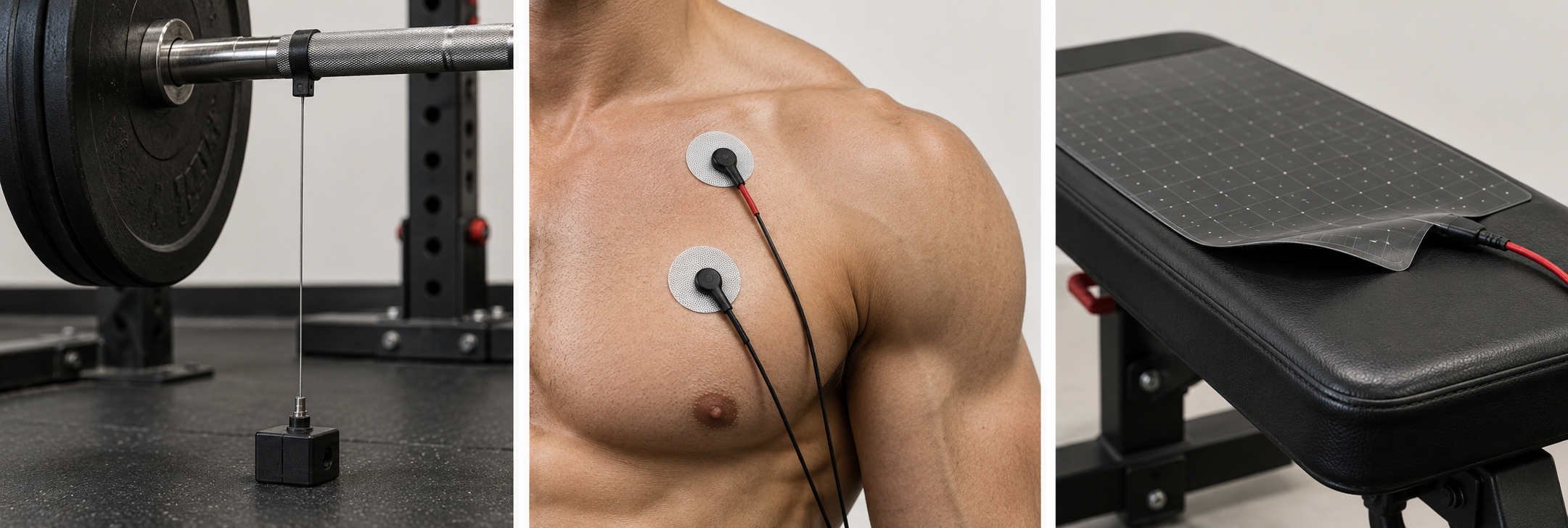
01 · Observation
Bar moves
- Measurement
- Position + time
- Interpretation
- Bar kinematics
02 · Observation
Muscle is active
- Measurement
- Surface EMG
- Interpretation
- Electrical activity
03 · Observation
Support changes
- Measurement
- Contact / pressure
- Interpretation
- Interface condition
Null Results Belong in the Audit
Goodman and colleagues asked whether replacing a flat bench with an exercise ball changed 1-RM, upper-body and trunk muscle activity or elbow ROM. Thirteen participants completed both conditions after familiarization, with tests separated by at least seven days [10].
No difference in the measured outcomes
The investigators reported no difference between the stable bench and exercise ball in 1-RM, recorded muscle activity or elbow range of motion.
- 1RMNo detected difference
- Muscle activityNo detected difference
- Elbow ROMNo detected difference
A nonsignificant comparison does not establish identical outcomes or a zero effect.
An intuitive design story can be wrong or incomplete
Instability may sound as though it must increase stabilizer demand, but that prediction did not appear in these measurements. Designers must test the exact surface, exercise, load and outcome instead of treating a plausible mechanism as validation.
This study should not be generalized into “surfaces never matter.” Its value is methodological. It shows that equipment changes can produce null results and that evidence-based design must publish and respect them.
A changed pad changed measured posture
Biscarini and colleagues compared a standard flat preacher-curl pad with an ergonomic thorax-stabilization pad in 15 participants. Three-dimensional motion capture and inclinometers showed lower shoulder protraction and thoracic kyphosis with the ergonomic pad (both p < .001). The study supports a posture claim for that task; its statements about injury prevention remained potential, not measured outcomes [11].
AMM Research · Visual 38 · Biscarini et al. (2016)
A pad comparison with measured posture outcomes
Fifteen participants used both pads during preacher curls. Bars show means; error bars show SD. These are posture measurements for a different exercise and product, not Launch Pad results.
Shoulder protraction
cm · condition mean
Flat pad: 12.0 ± 2.4 · Ergonomic pad: 7.9 ± 2.6 cm
Mean ± SD · p < .001
Thoracic kyphosis
degrees · condition mean
Flat pad: 35.5 ± 8.2 · Ergonomic pad: 29.6 ± 8.5 degrees
Mean ± SD · p < .001
The study also included a standing-curl reference posture, which is not plotted here. Injury incidence was not an outcome.
Equipment category alone did not dictate adaptation
In a matched eight-week study of 38 trained men, free-weight and machine-based programs produced similarly small between-group differences in strength (differences ≤1.8% when considering the eight tested exercises together), hypertrophy (differences ≤2%) and joint discomfort. The 2026 ACSM overview likewise found that equipment type did not consistently alter training outcomes. These findings argue against category-wide superiority while leaving room for product- and task-specific effects [12] [13].
Strength
Difference in percentage change across the eight tested exercises; p ≥ .216.
Muscle size
Differences in percentage change; p ≥ .208.
Joint discomfort
Between-group comparisons for stiffness, pain and disability; p ≥ .144.
Reported bounds are shown as bounds, rather than invented group means. 38 trained men · 8 weeks · 19 per group. Study [12].
Additional null-result example · defined protocol
A pronounced arch did not automatically raise 1RM
1RM in the Smith-machine comparison
SD 17.9 kg
SD 18.4 kg
kg · bars show means; SD printed separately
Keep the claim tied to the test
Posture contrast ≠ surface comparison
This study varied lifting technique on a Smith machine. It did not test a new support surface or establish spinal safety.
Compare the arch protocols →Study scope · intervention and mechanism
A support comparison is not a cover-friction test
Peak power
SD 86.2 W
SD 65.1 W
W · means shown by bars; SD printed separately
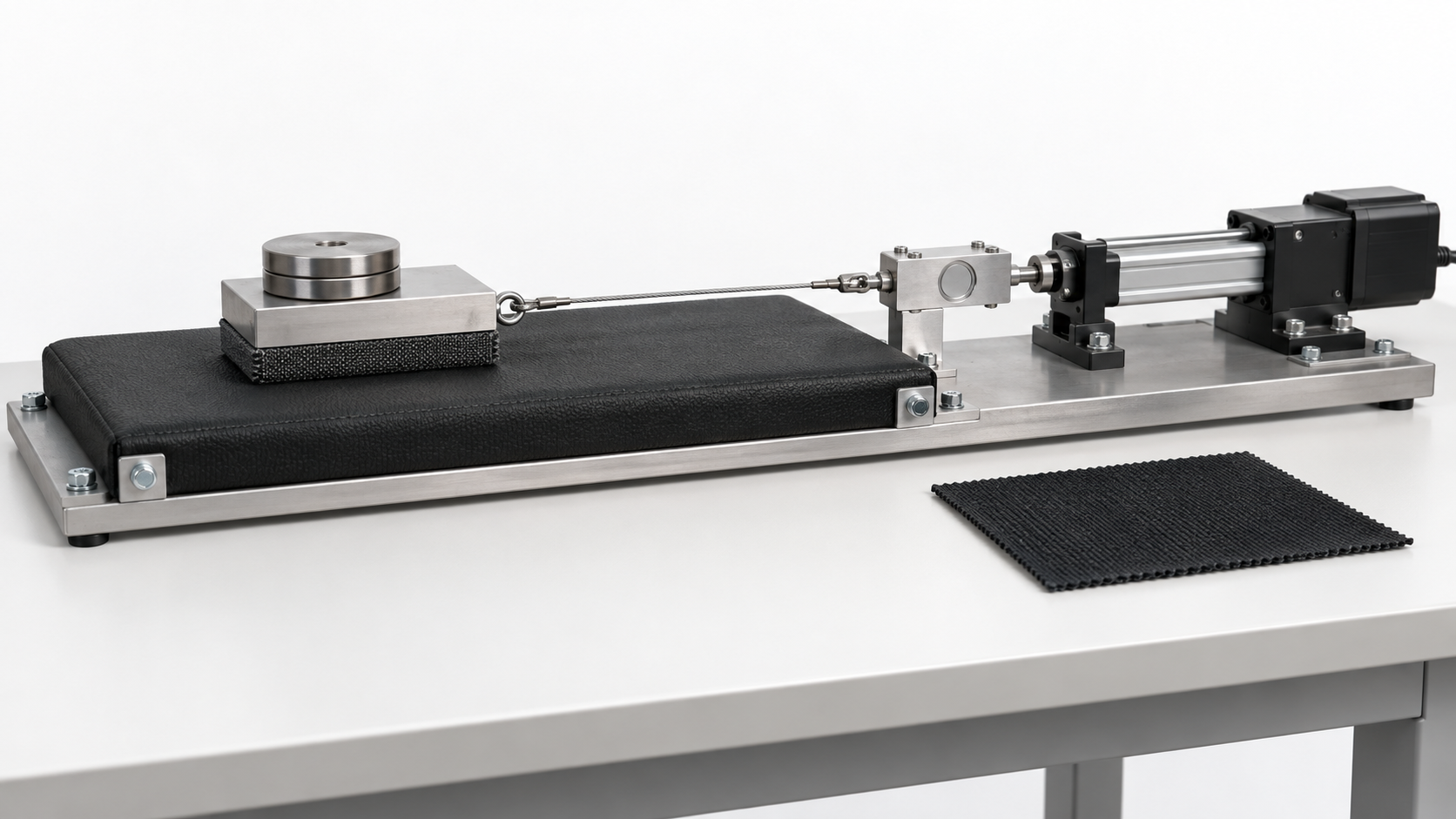
What would isolate the cover?
Hold geometry and foam constant, test the material pair, then separately measure athlete drift. This proposed rig illustrates the material question.
Explore the two-stage test →Modeled Mechanics and Injury Outcomes Are Different Evidence
Noteboom and colleagues tested 10 experienced strength athletes across 21 combinations of grip width, shoulder-abduction target and scapular pose. They recorded motion and hand forces and used an OpenSim model to estimate shoulder reaction forces and muscle activity. Grip width, scapular pose and lateral hand forces affected selected modeled loads [14].
AMM Research · Visual 39 · Evidence pathway
From recorded movement to estimated joint loads
Noteboom et al.: 10 athletes · 21 technique conditions · 16 kg bar
Recorded in the experiment
Body motion and forces applied to the bar, across grip widths, shoulder positions and scapular poses.
Estimated by the model
Shoulder joint reaction forces and muscle activity, calculated using the recorded inputs and model assumptions.
This experiment did not track injuries over time. A clinical claim needs a study designed to measure that outcome.
Noteboom et al. · Table 2 · study result
One model result, with its measurement context
Supraspinatus anterior
SD 0.17 relative activity
SD 0.17 relative activity
SD 0.16 relative activity
relative activity · mean with SD · zero-origin scale
Read the measurement level
- Compared
- Neutral, retracted and released scapular conditions.
- Calculated
- Peak activity of the modeled supraspinatus anterior, relative to a maximum of 1.
- Application
- A technique-dependent model result that can inform a testable design hypothesis.
The 16 kg protocol did not test equipment-specific injury prevention.
STUDY LIMITS: LOAD, SAMPLE AND CLINICAL INTERPRETATION
The study advances bench-press biomechanics, but its limits are central to ergonomic interpretation. Participants used a 16 kg bar; the sample was small; the “released” scapular condition used a pool noodle; and injury was not measured prospectively. Modeled load changes can support design hypotheses. They cannot establish that a bench or pad prevents an injury.
AMM Research · Visual 65 · Hickey et al. (2018)
An association belongs in the evidence record—not in a prevention claim
Future shoulder-pain relative risk
95% CI 1.05–1.93 · dashed line = RR 1.0
What this result cannot establish
The pooled cohorts did not test a bench, pad, or equipment intervention. Relative risk is not individual absolute risk, and association is not cause, diagnosis, or proof that changing a surface prevents pain.
Study detail: interpreting injury surveillance
An updated systematic review of 17 weightlifting and powerlifting injury reports reported powerlifting injury incidence estimates of 1.0–4.4 injuries per 1,000 training hours and identified the lower back/pelvis, shoulder and elbow/upper arm among the common sites. The authors also emphasized heterogeneous study designs and definitions [15]. Those epidemiological findings establish that injury is a relevant problem. They do not identify a bench feature as the cause or show that ergonomic equipment reduces incidence.
AMM Research · Tung et al. (2024)
Injury estimates vary across reports
Reported incidence ranges · injuries per 1,000 training hours
An ergonomic feature may improve fit, access, comfort or a measured acute variable. “Reduces injury risk” requires a prospective comparison that records injuries or a defensible clinical endpoint over time. No Launch Pad or Joint Ops study has yet established that claim.
AMM as a Worked Claim-Audit Example
The Launch Pad studies are relevant to ergonomics because they test a support condition rather than relying on appearance or testimonials. In the randomized crossover study, 10 resistance-trained men performed five repetitions at 70% 1-RM under flat and Launch Pad conditions.
AMM Research · Visual 34 · Kidwell et al. (2026)
Acute changes in the measured repetition
Paired condition means from 10 trained men. Bars start at zero; error bars show SD. sEMG is normalized to maximal voluntary contraction (MVC). Power was not statistically significant.
Right pectoralis sEMG
% MVC · condition mean
Flat bench: 70.2 ± 24.8 % MVC · Launch Pad: 87.3 ± 20.1 % MVC
p < .001 · d = .76
Left pectoralis sEMG
% MVC · condition mean
Flat bench: 68.3 ± 23.4 % MVC · Launch Pad: 86.8 ± 20 % MVC
p < .001 · d = .85
Mean bar velocity
m/s · condition mean
Flat bench: 0.40 ± 0.09 m/s · Launch Pad: 0.47 ± 0.09 m/s
p < .001 · d = .74
Peak bar velocity
m/s · condition mean
Flat bench: 0.57 ± 0.11 m/s · Launch Pad: 0.66 ± 0.09 m/s
p < .001 · d = .98
Vertical displacement
cm · condition mean
Flat bench: 38 ± 7 cm · Launch Pad: 44 ± 4 cm
p = .005 · d = 1.02
Concentric power
W · condition mean
Flat bench: 249 ± 103 W · Launch Pad: 271 ± 93 W
p = .071 · d = .23
Not statistically significantThe Launch Pad produced approximately 24–27% greater pectoralis activation, 15.8% greater peak velocity, 17.5% greater mean velocity and 15.8% greater vertical bar displacement. Power was approximately 8.8% greater but not statistically significant [16].
A four-week randomized parallel trial assigned 42 intermediate-trained men to the same supervised eccentric-overload program using either the Launch Pad or flat condition.
AMM Research · Visual 35 · Goldman et al. (2025)
Strength gains over four weeks
Mean 1RM changes after 12 sessions. Error bars show SD. Both groups used the same eccentric-overload program; the support condition differed.
1RM change
kg · group mean change
Control: +11.1 ± 2.4 kg · Launch Pad: +18.4 ± 4.3 kg
7.3 kg between-group difference · p < .001 · g = 3.85
Average 1-RM gain was 18.4 kg (40.6 lb) versus 11.1 kg (24.5 lb): a 7.3 kg (16.1 lb) absolute difference, approximately 66% greater average improvement, p < .001 [17].
An eight-week trial randomized 30 collegiate football players to the two support conditions within identical periodized training.
AMM Research · Visual 36 · Blatney et al. (2026)
Performance changes over eight weeks
Direction-only summary after 24 sessions. The publication reports greater improvement with the Launch Pad group across all three outcomes, with each between-group comparison p < .001. Because the source table contains internal inconsistencies between some endpoints, change scores, or variability entries, no questionable magnitude is encoded as bar length.
Bench-press 1RM
Greater improvement reported with Launch Pad
Between-group p < .001
NFL-225 repetitions
Greater improvement reported with Launch Pad
Between-group p < .001
Seated medicine-ball throw
Greater improvement reported with Launch Pad
Between-group p < .001
Data-integrity boundary: These tiles are deliberately unscaled. Consult the source table and resolve its internal inconsistencies before reusing numerical changes or variability values. The outcomes are performance measures, not pain, injury, or rehabilitation outcomes.
The Launch Pad group improved more in 1-RM, NFL-225 repetitions and seated medicine-ball throw distance; all reported between-group comparisons were p < .001 [18].
These studies provide direct acute and longitudinal product evidence. They do not establish clinical benefit, injury reduction or direct efficacy of Joint Ops. Nor do they prove that the acute activation, velocity or vertical-displacement differences caused the later performance changes. The responsible chain is a different interface, different acute repetition characteristics, repeated exposure and different longitudinal outcomes.
Run the Audit Where the Equipment Will Be Used
For athletes and coaches
- Record bench, angle, seat setting, rack height, grip and support condition when comparing performance.
- Match the apparatus to the goal: competition-standard equipment for specificity, alternative configurations for defined supplemental tasks.
- Use comfort as feedback, not proof. A preferred setup may still need velocity, ROM or reliability data before a performance claim is made.
- Stop treating an unclear adjustment as user error by default; labels, detents and lock feedback are design responsibilities.
For facility owners
- Evaluate the actual user population, including shortest and tallest intended athletes, mobility limitations and accessibility needs.
- Test transition time, cleaning, serviceability, floor stability and instruction comprehension before purchasing at scale.
- Require clear load ratings and standards information, but do not confuse those documents with outcome evidence.
For equipment designers and researchers
- Define a measurable requirement for every feature.
- Test fit and usability before using expensive biomechanical or longitudinal protocols.
- Report apparatus dimensions, upholstery, settings and instructions in enough detail to reproduce the condition.
- Publish null findings and limitations; they are part of a credible design program.
Relevance to The Launch Pad® and Joint Ops™
The Launch Pad®
The Launch Pad is a human-equipment interface with direct data for selected acute and performance outcomes. Its ergonomic rationale includes torso support, shoulder-clearance intent, traction and repeatable positioning, but claims should remain tied to what the published studies measured. Injury prevention and treatment are not established.
Joint Ops™
Joint Ops incorporates selectable surface configurations, adjustable lumbar positioning, torso support, seat geometry, multiple bench angles and repeatable indexing. Active prototype research is underway, but no published Joint Ops outcome is available. The complete platform must pass the four bays on its own; Launch Pad data cannot be relabeled as Joint Ops data.
What the Evidence Shows
Well established
Human-centered design requires defined users, tasks, requirements and iterative evaluation; stationary training equipment also requires direct safety testing.
Review fit and accommodationSupported by multiple studies
Bench angle, grip, torso technique, expertise and support conditions can influence acute mechanics, although some comparisons produce null results.
Explore measured task comparisonsEmerging product evidence
The Launch Pad changed selected acute measurements and produced different average performance gains in two controlled training trials.
Open the three Launch Pad studiesRequires direct testing
Injury reduction, universal superiority, clinical benefit and transfer of Launch Pad outcomes to Joint Ops or other equipment.
Match the claim to its required testEducational content only. Ergonomic design does not by itself establish injury prevention, diagnosis or treatment. Athletes with persistent symptoms or postoperative restrictions should work with an appropriate licensed clinician.
References
- Karwowski W. (2005). Ergonomics and human factors: The paradigms for science, engineering, design, technology and management of human-compatible systems. Ergonomics, 48(5), 436–463. doi:10.1080/00140130400029167. ↩
- International Organization for Standardization. (2019). ISO 9241-210:2019—Ergonomics of human-system interaction: Human-centred design for interactive systems. Official standard record. ↩
- Garneau CJ, Parkinson MB. (2013). Considering just noticeable difference in assessments of physical accommodation for product design. Ergonomics, 56(11), 1777–1788. doi:10.1080/00140139.2013.838308. ↩
- Lauver JD, Cayot TE, Scheuermann BW. (2016). Influence of bench angle on upper extremity muscular activation during bench press exercise. European Journal of Sport Science, 16(3), 309–316. doi:10.1080/17461391.2015.1022605. ↩
- International Organization for Standardization. (2024). ISO 20957-1:2024—Stationary training equipment: Part 1, general safety requirements and test methods. Official standard record. ↩
- International Organization for Standardization. (2024). ISO 20957-2:2024—Stationary training equipment: Part 2, strength training equipment, additional specific safety requirements and test methods. Official standard record. ↩
- Mausehund L, Werkhausen A, Bartsch J, Krosshaug T. (2022). Understanding bench press biomechanics—the necessity of measuring lateral barbell forces. Journal of Strength and Conditioning Research, 36(10), 2685–2695. doi:10.1519/JSC.0000000000003948. ↩
- Mausehund L, Krosshaug T. (2023). Understanding bench press biomechanics—training expertise and sex affect lifting technique and net joint moments. Journal of Strength and Conditioning Research, 37(1), 9–17. doi:10.1519/JSC.0000000000004191. ↩
- Cudlip AC, Maciukiewicz JM, Pinto BL, Dickerson CR. (2022). Upper extremity muscle activity and joint loading changes between the standard and powerlifting bench press techniques. Journal of Sports Sciences, 40(9), 1055–1063. doi:10.1080/02640414.2022.2046937. ↩
- Goodman CA, Pearce AJ, Nicholes CJ, Gatt BM, Fairweather IH. (2008). No difference in 1RM strength and muscle activation during the barbell chest press on a stable and unstable surface. Journal of Strength and Conditioning Research, 22(1), 88–94. doi:10.1519/JSC.0b013e31815ef6b3. ↩
- Biscarini A, Benvenuti P, Busti D, Zanuso S. (2016). A Scott bench with ergonomic thorax stabilisation pad improves body posture during preacher arm curl exercise. Ergonomics, 59(5), 665–670. doi:10.1080/00140139.2015.1077276. ↩
- Hernández-Belmonte A, Martínez-Cava A, Buendía-Romero Á, Franco-López F, Pallarés JG. (2023). Free-weight and machine-based training are similarly effective on strength and hypertrophy: Challenging a traditional myth. Medicine & Science in Sports & Exercise, 55(12), 2316–2327. doi:10.1249/MSS.0000000000003271. ↩
- Currier BS, D’Souza AC, Fiatarone Singh MA, Lowisz CV, Rawson ES, Schoenfeld BJ, et al. (2026). American College of Sports Medicine position stand: Resistance training prescription for muscle function, hypertrophy, and physical performance in healthy adults—an overview of reviews. Medicine & Science in Sports & Exercise, 58(4), 851–872. doi:10.1249/MSS.0000000000003897. ↩
- Noteboom L, Belli I, Hoozemans MJM, Seth A, Veeger HEJ, van der Helm FCT. (2024). Effects of bench press technique variations on musculoskeletal shoulder loads and potential injury risk. Frontiers in Physiology, 15, 1393235. doi:10.3389/fphys.2024.1393235. ↩
- Tung MJY, Lantz GA, Lopes AD, Berglund L. (2024). Injuries in weightlifting and powerlifting: An updated systematic review. BMJ Open Sport & Exercise Medicine, 10(4), e001884. doi:10.1136/bmjsem-2023-001884. ↩
- Kidwell JA, Yamamoto T, Hetherton KJ, Truneh N, Bright JJ, Blatney AE, et al. (2026). Acute effects of thoracic-spinal elevation via a novel bench press pad on sEMG and barbell kinetics in resistance-trained males. International Journal of Exercise Science, 19(1), 1003. doi:10.70252/IJES2026103. ↩
- Goldman P, Taylor J, Yamamoto T, Blatney AE, Sahni TK, Lechner RJ, et al. (2025). Eccentrically overloaded bench press training: Augmenting strength gains via a novel bench press pad. Scientific Journal of Sport and Performance, 4(4), 480–490. doi:10.55860/JCDL3612. ↩
- Blatney AE, Kidwell JA, Yamamoto T, Goldman P, Hetherton KJ, Dolezal BA. (2026). Effects of an eight week training regimen with a novel bench press pad compared to a traditional bench on upper body strength and performance in collegiate American football players. Scientific Journal of Sport and Performance, 5(1), 10–21. doi:10.55860/RNUB8627. ↩
- García-Ramos A, Pérez-Castilla A, Villar Macias FJ, Latorre-Román PÁ, Párraga JA, García-Pinillos F. (2021). Differences in the one-repetition maximum and load-velocity profile between the flat and arched bench press in competitive powerlifters. Sports Biomechanics, 20(3), 261–273. doi:10.1080/14763141.2018.1544662. ↩
- Koshida S, et al. (2008). Muscular outputs during dynamic bench press under stable versus unstable conditions. Journal of Strength and Conditioning Research, 22(5), 1584–1588. doi:10.1519/JSC.0b013e31817b03a1. ↩
- Hickey D, Solvig V, Cavalheri V, Harrold M, McKenna L. (2018). Scapular dyskinesis increases the risk of future shoulder pain by 43% in asymptomatic athletes: A systematic review and meta-analysis. British Journal of Sports Medicine, 52(2), 102–110. doi:10.1136/bjsports-2017-097559. ↩