

Strength equipment is usually introduced through the language of fabrication: steel dimensions, pad thickness, bearing type, adjustment count and rated capacity. Those specifications matter. None of them, by itself, explains the exercise the athlete will actually perform.
A rack can be exceptionally strong and still place the bar outside a shorter athlete’s reliable reach. A machine can offer a wide adjustment range while making the selected position difficult to see or reproduce. A bench can meet a competition rule and do that job perfectly, yet be poorly matched to a different exercise or a different population.
In each case, the hardware may be functioning exactly as built. The mismatch appears because the design question stopped at the equipment rather than following the task through the human body.
This is the central thesis of human-centered strength equipment: the athlete, the intended movement, the surrounding environment and every athlete-equipment contact point form one system. Good design defines that system before geometry is finalized, then tests whether the finished equipment accommodates its users, communicates its settings, controls avoidable error and produces the outcome being claimed.
The result is not a particular shape or feature. It is a more disciplined way to decide what should be built, how it should be evaluated and which conclusions the evidence can support.
Key Takeaways
If you have one minute, these are the conclusions that organize the article—and the larger AMM Research Ecosystem.
- Strength equipment is part of the exercise condition. Geometry, support surfaces, contact points and controls help define the movement the athlete can perform; they are not passive scenery around the load.
- Human-centered design starts upstream of features. It defines the athlete, task, environment and physical interfaces first, then develops equipment requirements from that system.
- Fit is multidimensional. Anthropometry matters, but so do reach, clearance, support, friction, control legibility, fatigue and the ability to reproduce a setting from session to session.
- The evidence must match the claim. Structural tests, usability studies, acute biomechanics, longitudinal training outcomes and clinical endpoints answer different questions; success in one category does not prove another.
- Bench-press mechanics respond to the conditions of the lift. Published research shows that technique, force strategy and support-related conditions can change the mechanical task, making equipment configuration a legitimate experimental variable.
- The interface has been tested directly. Three separate peer-reviewed Launch Pad studies found differences in selected acute repetition characteristics and longitudinal performance outcomes under their tested populations and protocols; those findings do not automatically transfer to another product or establish one untested causal mechanism.
Four ideas organize the entire Research Ecosystem
- Human-centered is a process, not a label. The work begins with defined users, tasks and environments and continues through evaluation and iteration.
- Fit is more than body size. Reach, clearance, support, friction, control logic, fatigue, experience and the ability to reproduce a setting all shape use.
- Equipment is part of the exercise condition. A bar, handle, pad, seat, rack or foot plate can change the constraint through which force is produced.
- Every claim has an evidence level. Structural safety, usability, acute biomechanics, training adaptation and clinical outcomes are separate questions that require separate tests.
Human-Centered Design Is an Engineering Process
Ergonomics and human factors provide the larger intellectual framework. ISO 26800 applies ergonomics principles to the design and evaluation of products, tools, equipment, systems, facilities and environments so they are compatible with human characteristics and capabilities (International Organization for Standardization, 2011). Karwowski describes the discipline in similarly broad terms: the object of design is a human-compatible system, not an artifact considered in isolation (Karwowski, 2005).
ISO 9241-210 is written for interactive systems, but its process is useful beyond screens and software: understand users and context; define requirements; create design solutions; evaluate them against those requirements; and repeat the cycle as evidence accumulates (International Organization for Standardization, 2019).
Applied to strength equipment, the “interaction” is physical and consequential. The user is creating force against an external load, often at high effort, and the quality of the interaction can change as fatigue rises.
Human-Centered Strength Equipment is equipment developed and evaluated around defined athletes, intended exercises, training environments, physical contact points, adjustment behavior and measurable outcomes. It asks the athlete to adapt where the task requires adaptation—not where the design failed to account for predictable human variation.
That definition deliberately avoids declaring one bench, machine or surface universally correct. A competition bench, a multi-angle collegiate bench and a rehabilitation-oriented press can all be human-centered while presenting different constraints. The requirements change because the users, rules and goals change.
Human-centered design does not remove specificity; it makes specificity explicit.
AMM Research · Visual 46 · Concept diagram
The human–task–equipment system
A closed loop replaces feature-first design. Athlete and task requirements lead to equipment and contact decisions; measured use determines what should be retained, changed or studied next.
- 01
Athlete
Body dimensions · strength
Next: define the task
Mobility · training history
Experience · fatigue · symptoms - 02
Task + environment
Exercise · load · range · goal
Next: specify the equipment
Rules · fatigue · supervision
Floor · rack · space · throughput - 03
Equipment
Geometry · structure · support
Next: map the contacts
Adjustments · locks · controls
Materials · service · durability - 04
Contact interfaces
Hands · feet · torso · seats
Next: observe the movement
Pads · handles · foot plates
Friction · pressure · clearance - 05
Movement + output
Position · path · range · force
Next: measure the outcome
Velocity · stability · activation
Setup and rep repeatability - 06
Measure + iterate
Fit · error · usability · mechanics
Return: revise the athlete and task brief
Acute performance · adaptation
Refine requirements and retest
Measured use feeds back into the brief. Retain, change or retest the design against the intended outcome.
Figure 1. AMM’s human-centered strength-equipment system. The equipment is one component inside a larger loop; its contact surfaces and controls shape the physical interaction through which movement is produced and measured.
A feature becomes evidence only when the relevant outcome is measured. The loop can stop at fit, usability, biomechanics, performance, adaptation, or clinical outcomes—each requires a different study.
The Athlete Is Not a Percentile
Anthropometry is the obvious starting point for physical equipment. Stature, limb length, shoulder breadth, hip breadth, reach and hand size can influence access to a control, alignment with a machine axis, foot contact, torso support and available clearance.
But designing around an “average athlete” is rarely sufficient. The person near the middle of one body dimension may be near an extreme of another, and the relevant combination changes with the task.
The problem is also dynamic. A body dimension tells a designer where the hand might reach; it does not show how the athlete reaches it while holding a dumbbell, maintaining a setup, working around a spotter or breathing hard after a set.
Strength, mobility, experience and fatigue can change how the same person uses the same hardware. Human-centered fit therefore includes physical accommodation, movement strategy and the conditions under which the equipment will be adjusted.
Adjustment range is only the first question
An adjustable product succeeds only when the intended user can find, understand and reproduce a useful setting. Garneau and Parkinson examined the role of “just noticeable difference” in physical accommodation: people can adapt to multiple configurations and may not reliably distinguish among settings that are technically different but functionally indistinguishable (Garneau & Parkinson, 2013).
Their model was not written for benches, but the design implication transfers cleanly. More increments do not guarantee better fit.
For strength equipment, a high-quality adjustment combines sufficient range with legible indexing, manageable operating force, positive lock engagement and a meaningful change between positions.
In a team weight room, transition time matters. In testing, setting recall matters. Under heavy load, ambiguity matters. A pin that is present but difficult to confirm is not the same design outcome as a pin that visibly and audibly seats.
This is why “ergonomic” cannot be reduced to comfortable. Comfort is one response and may be useful, but it does not establish alignment, control, repeatability, error resistance or performance.
A soft pad may feel comfortable and compress inconsistently. A broad handle may distribute pressure while forcing an awkward grip for smaller hands. A highly adjustable bench may accommodate more positions while increasing setup errors. The complete design has to be evaluated as used.
Equipment Is Part of the Exercise Prescription
Strength exercises are created by constraints. A barbell permits one set of movement solutions; independent dumbbells permit another. A Smith machine constrains the bar path. A cable establishes a line of resistance. A handle fixes grip orientation. A seat and pad establish where the body is supported.
These constraints are neither inherently good nor inherently harmful. They define the task being trained.
Coaches already manipulate many of them deliberately. They change stance, grip, bar, range, tempo, resistance curve and stability demand to serve a programming objective. The equipment surface belongs in the same record.
If a pad changes the athlete’s position, clearance, effective range or ability to reproduce the setup, the exercise condition has changed even when the load written on the program has not.
Mausehund and colleagues measured the forces most bench studies leave out
The investigators combined three-dimensional mechanics, net joint moments and surface EMG while 16 women and 19 men performed medium-, wide- and two narrow-grip bench-press variations. Their instrumented setup included the mediolateral forces athletes applied to the bar rather than assuming the bar was loaded only vertically (Mausehund et al., 2022).
AMM Research · Visual 48 · Study result summary
Grip changes the mechanical task
- Up to12%
- More external load with wide and medium grips than with narrow grips.
- Up to43%
- Higher shoulder net joint moments as grip widened.
- Up to26%
- Higher mean and peak elbow moments as grip narrowed.
The conditions changed the mechanical task materially. Wide and medium grips permitted up to 12% more load than the narrow grips. Shoulder net joint moments increased by as much as 43% as grip widened, while mean and peak elbow moments increased by as much as 26% as grip narrowed. Elbow position within the narrow grip changed the result again. Muscle activity did not behave as a simple proxy for all of those loading differences.
“Bench press at 80%” is not a complete mechanical description. Grip, elbow position, lateral force strategy and bar path help determine where muscular demand appears. Human-centered equipment analysis must describe the task with the same precision used to describe the hardware.
AMM Research · Visual 49 · Study comparison
Two support conditions, three measured outcomes
Stable flat bench
Exercise ball
- 1RM strength
- Upper-body + trunk EMG
- Elbow range of motion
A null result is equally valuable when a design story sounds obvious. Goodman and colleagues compared a stable flat bench with an exercise ball in 13 participants. Under their protocol, the support change did not alter 1-RM strength, recorded upper-body and trunk EMG, or elbow range of motion (Goodman et al., 2008). The point is not that support conditions never matter. The point is that a plausible mechanism—such as expecting instability to recruit more stabilizers—cannot substitute for measurement.
The shapes identify the tested support conditions; their sizes do not encode measured results.
This distinction protects both the athlete and the designer. It prevents a feature from being dismissed merely because it is unconventional, and it prevents that same feature from receiving claims its evidence has not earned.
Bench Research Shows Why the Interface Deserves Its Own Study
The bench press is an especially revealing case because the apparatus looks passive. The bar moves; the bench appears to stay out of the story. In practice, the bench fixes the surface beneath the head, thorax and pelvis, while the rack determines where the athlete must position relative to the bar. Width, height, compressibility, friction and support geometry establish boundaries around the torso before the first repetition begins.
Technique research shows that modest changes within those boundaries can alter the measured loading environment. In a second investigation, Mausehund and Krosshaug compared 12 powerlifters with 22 recreationally trained lifters during 6–8RM bench-press sets. Powerlifters used different bar paths and shorter joint ranges of motion; women and men also differed in normalized shoulder and elbow moment distribution and in the activity of selected muscles (Mausehund & Krosshaug, 2023).
A design evaluated around one average technique and one average body can therefore miss meaningful ways that experienced athletes solve the task.
Noteboom and colleagues tested 21 versions of the same named exercise
Participants completed three repetitions across combinations of grip width, shoulder-abduction target and scapular instruction. Motion capture and forces from an instrumented bar were entered into an OpenSim shoulder model to estimate glenohumeral and acromioclavicular reaction forces and rotator-cuff activity (Noteboom et al., 2024).
AMM Research · Visual 50 · Study analysis pathway
From recorded movement to estimated joint loads
- 01
Record movement + force
Motion capture and an instrumented bar record the repetition across grip widths, shoulder-abduction targets and scapular instructions.
Input: observed motion and bar forces - 02
Apply the shoulder model
Recorded inputs enter the OpenSim shoulder model. Model assumptions define how those inputs are translated into internal estimates.
Analysis: musculoskeletal model - 03
Compare estimated loads
Compare glenohumeral and acromioclavicular reaction forces and estimated rotator-cuff activity between conditions.
Output: condition-specific estimates
Grip width, scapular pose and mediolateral hand force changed selected model outputs. Increasing grip width raised several glenohumeral and acromioclavicular reaction-force components through much of the repetition.
Scapular retraction reduced total glenohumeral reaction force, compression and selected shear components relative to the neutral instruction during portions of the cycle. Inter-individual lateral-force strategies varied widely and materially influenced the modeled shoulder loads.
One result is especially important for claims governance: the “released” scapular condition, created with a pool noodle beneath the spine, did not differ from the neutral condition in joint reaction forces.
The experiment therefore supports the broader conclusion that technique and force strategy change modeled shoulder loading; it does not prove that simply creating more space beneath the scapula improves the shoulder environment.
The study used a small sample, a deliberately light load and a musculoskeletal model. It explains why grip, instruction, lateral force and support-related conditions deserve controlled experiments. It does not prospectively measure injury and it does not validate a commercial pad.
Together, these studies move the design conversation forward. They show that the visible exercise name is too coarse to describe the actual task and that athletes do not all interact with the same apparatus in the same way. They also set a demanding standard: if a designer believes a surface changes scapular position, force direction or joint loading, those variables should be measured directly rather than inferred from the surface’s appearance.
Match the Claim to the Evidence
Equipment development often collapses several questions into one. A product survives a load test, feels stable during a demonstration and is then described as improving mechanics, performance and safety. Each step may be reasonable to investigate. They are not the same endpoint.
ISO 20957-1:2024 supplies general safety requirements and test methods for stationary training equipment (International Organization for Standardization, 2024). Passing an applicable structural or stability requirement is foundational. It does not establish better shoulder mechanics.
In the same way, a biomechanics study can show an immediate change without revealing whether athletes become stronger after eight weeks, and a strength trial can favor one condition without measuring pain or injury.
AMM Research · Visual 47 · Evidence framework
The strength-equipment evidence ladder
Higher rungs do not make lower rungs unimportant. They answer different questions. The required rung is determined by the claim being made.
- Evidence level 01
Structure + reliability
Load, stability, locks, wear, failure modes
What the test can establishThe specified requirement passed under the stated test conditions.
Next questionCan intended users fit and operate it correctly?
- Evidence level 02
Fit + usability
Accommodation, setup, error, indexing
What the test can establishThe tested population could configure, use, and reproduce the intended setup.
Next questionDid the movement or mechanical output change?
- Evidence level 03
Acute biomechanics
Position, force, motion, EMG, velocity, ROM
What the test can establishThe tested condition immediately changed the measured repetition characteristic.
Next questionDoes repeated exposure change adaptation?
- Evidence level 04
Training adaptation
Strength, endurance, power, skill, hypertrophy
What the test can establishGroups changed differently under the tested program, population, and duration.
Next questionDid symptoms, time loss, or injury incidence change?
- Evidence level 05
Clinical outcomes
Pain, function, injury, return to training
What the test can establishThe tested intervention affected the specified clinical endpoint prospectively.
Next questionReplicate across products, populations, and settings.
Figure 2. Evidence requirements rise with the outcome claim. Surface EMG, for example, can describe an acute activation difference; it does not establish hypertrophy. A favorable training trial can establish a performance difference under that protocol; it does not establish injury prevention.
Standards establish a floor. Product claims require the rung that matches the promised outcome.
Competition standards illustrate the same distinction. The International Powerlifting Federation specifies a bench at least 1.22 m long, 29–32 cm wide and 42–45 cm high, among other requirements (International Powerlifting Federation, 2026).
Those dimensions make the competitive task consistent and define what an athlete must practice on for specificity. They are not a biological claim that the regulated geometry optimizes every athlete, exercise or outcome outside competition.
Launch Pad Case Study: Make the Interface the Experimental Variable
The athlete-to-bench surface had long been discussed through design rationale, coaching experience and adjacent shoulder research. The published Launch Pad research moved the question into direct comparison: hold the bench-press task and training framework as constant as practical, change the support condition and measure what follows.
AMM Research · Visual 23Equipment photograph
Describe the whole interface being compared
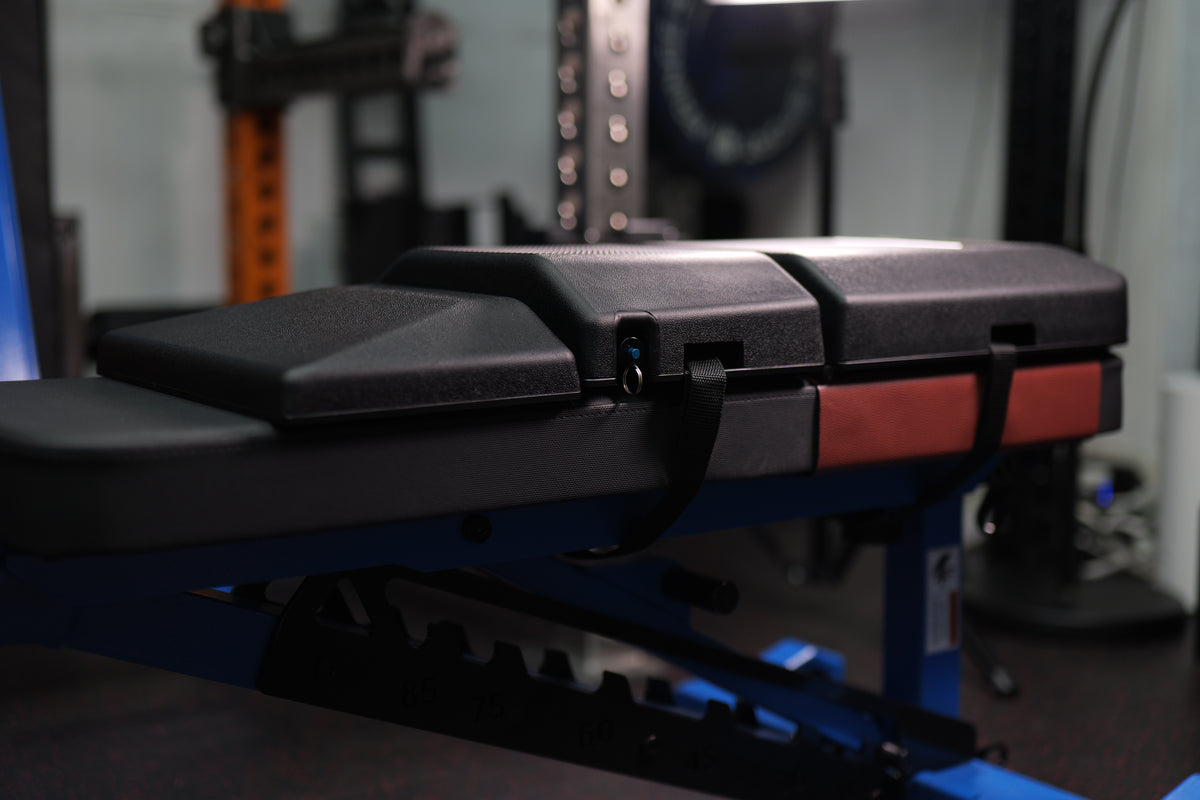
The installed system includes geometry, support regions, attachment and positioning. A whole-system comparison does not isolate one feature as the cause of an outcome. Current product photography may differ from research apparatus.
Advanced Muscle Mechanics product-image archive. Original image, unaltered.
Study 01 · Acute mechanics
Kidwell and colleagues used a randomized, single-blind crossover design in 10 resistance-trained men. Each participant performed five repetitions at 70% of the participant’s established 1-RM on a conventional flat bench and with The Launch Pad®. Bilateral pectoralis-major surface EMG and a linear position transducer captured activation, bar velocity, concentric power and vertical bar displacement (Kidwell et al., 2026).
AMM Research · Visual 43 · Study results
Six acute outcomes, shown side by side
Kidwell et al. · 10 men · five repetitions at 70% 1RM. Bars show raw condition means; error bars show ±1 standard deviation (SD). All axes start at zero; related outcomes share a scale. Study methods and source.
Right pectoralis sEMG
Flat bench: 70.2 ± 24.8 % MVC · Launch Pad: 87.3 ± 20.1 % MVC
p < .001 · d = .76
Left pectoralis sEMG
Flat bench: 68.3 ± 23.4 % MVC · Launch Pad: 86.8 ± 20 % MVC
p < .001 · d = .85
Mean bar velocity
Flat bench: 0.40 ± 0.09 m/s · Launch Pad: 0.47 ± 0.09 m/s
p < .001 · d = .74
Peak bar velocity
Flat bench: 0.57 ± 0.11 m/s · Launch Pad: 0.66 ± 0.09 m/s
p < .001 · d = .98
Vertical displacement
Flat bench: 38 ± 7 cm · Launch Pad: 44 ± 4 cm
p = .005 · d = 1.02
Concentric power
Flat bench: 249 ± 103 W · Launch Pad: 271 ± 93 W
p = .071 · d = .23
Not statistically significantFull acute results and derived differences
The raw means were higher in the Launch Pad condition for right pectoralis activation (87.3% vs 70.2% MVC), left pectoralis activation (86.8% vs 68.3% MVC), mean velocity (0.47 vs 0.40 m/s), peak velocity (0.66 vs 0.57 m/s) and vertical bar displacement (44 vs 38 cm). Those values correspond to derived relative differences of approximately 24.4%, 27.1%, 17.5%, 15.8% and 15.8%, respectively. All activation and velocity comparisons were reported at p < .001; vertical bar displacement was p = .005. Concentric power averaged 271 versus 249 W—approximately 8.8% higher—but the corrected comparison was not statistically significant (p = .071; d = 0.23).
The immediate finding is substantive without being stretched: the tested interface changed several characteristics of a submaximal five-repetition set. The experiment did not measure hypertrophy, pain, injury or long-term adaptation. Its proposed explanations—thoracic position, scapular position and length–tension effects—remain mechanisms to test directly.
Study 02 · Four-week strength trial
Goldman and colleagues randomized 42 intermediate-trained men to the Launch Pad or conventional condition while both groups completed the same one-month, thrice-weekly bench program using a connected adaptive resistance machine to deliver supramaximal eccentric overload. All 42 participants completed the 12 supervised sessions (Goldman et al., 2025).
AMM Research · Visual 44 · Study results
Four weeks: change in maximum strength
Goldman et al. · 42 men · 12 supervised sessions. Bars show mean 1RM gains with ±1 SD error bars on a zero-based axis. Study methods and source.
1RM change
Control: +11.1 ± 2.4 kg · Launch Pad: +18.4 ± 4.3 kg
7.3 kg between-group difference · p < .001 · g = 3.85
+7.3 kgBetween-group difference in mean 1RM gain
Mean 1-RM rose from 98.1 to 109.2 kg in the conventional group and from 97.4 to 115.8 kg in the Launch Pad group. The average gains were 11.1 kg (24.5 lb) and 18.4 kg (40.6 lb), an absolute between-group difference of 7.3 kg (16.1 lb).
The Launch Pad group’s mean improvement was therefore approximately 66% greater; the paper reported p < .001 and Hedges’ g = 3.85.
The effect size describes exceptionally large standardized separation in this sample. It is not a percentage and it does not mean the product was “3.85 times better.”
Study 03 · Eight-week collegiate football trial
Blatney and colleagues randomized 30 male collegiate football players to the two support conditions during an eight-week, two-block off-season program. The athletes completed three supervised sessions per week, for 24 sessions, while the researchers measured 1-RM bench press, repetitions on the NFL-225 test and seated medicine-ball throw distance (Blatney et al., 2026).
AMM Research · Visual 45 · Study results
Eight weeks: three performance outcomes
Blatney et al. · 30 collegiate football players · 24 supervised sessions. Bars show mean changes on separate scales with units. 1RM error bars show ±1 SD; SDs for the other two outcomes are listed below their charts. Study methods and source.
1RM change
Control: +9.7 ± 3.4 kg · Launch Pad: +19.4 ± 4.3 kg
p < .001 · g = 3.99
NFL-225 repetitions
Control: +4 ± 3 reps · Launch Pad: +7 ± 3.8 reps
Between-group p < .001
Values are mean ± SD. Bars show means only; error bars are not shown.
Seated medicine-ball throw
Control: +2.0 ± 3.0 m · Launch Pad: +2.7 ± 2.5 m
Between-group p < .001
Values are mean ± SD. Bars show means only; error bars are not shown.
Full eight-week results and derived differences
Both groups improved on all three outcomes. The Launch Pad group improved more: 1-RM increased 19.4 kg (42.8 lb) versus 9.7 kg (21.4 lb); NFL-225 performance increased seven versus four repetitions; and seated throw distance increased 2.7 versus 2.0 m (8.9 vs 6.6 ft). These were approximately 100%, 75% and 35% greater average changes, respectively. All three between-group comparisons were reported at p < .001, with Hedges’ g values of 3.99, 3.67 and 4.10.
Compare study designs, protocols and findings
Study 01
- Question
- Does the interface change one submaximal set?
- Design and sample
- Randomized single-blind crossover; n = 10 resistance-trained men
- Protocol
- Five reps at 70% of the participant’s established 1-RM
- Finding-first result
- Higher bilateral pectoralis sEMG, mean and peak velocity, and vertical bar displacement. Power was numerically higher but nonsignificant.
- Interpretive boundary
- Acute mechanics; no adaptation or clinical outcome.
Study 02
- Question
- Does the difference persist through a short strength block?
- Design and sample
- Four-week randomized parallel trial; n = 42 intermediate-trained men
- Protocol
- 12 supervised eccentric-overload sessions
- Finding-first result
- +18.4 vs +11.1 kg 1-RM. Difference 7.3 kg; approximately 66% greater mean gain; p < .001.
- Interpretive boundary
- One program, population, duration and primary outcome.
Study 03
- Question
- Does the pattern extend to trained football players and multiple outcomes?
- Design and sample
- Eight-week randomized parallel trial; n = 30 male collegiate football players
- Protocol
- 24 supervised sessions within an off-season program
- Finding-first result
- Larger changes in 1-RM, NFL-225 reps and seated throw. All between-group p < .001.
- Interpretive boundary
- Concurrent off-season training; no injury or mechanism test.
Different athlete-to-bench interface → different acute repetition characteristics → repeated exposure under that condition → different longitudinal performance outcomes.
This progression is more informative than an isolated product demonstration, but it is not one continuous causal experiment. The studies used separate samples and different protocols. No mediation analysis showed that greater activation, velocity or range caused the later performance differences. The collective conclusion is narrower and still important: the interface was a meaningful experimental variable across the tested conditions.
A Better Equipment Brief Starts With Seven Questions
Human-centered work becomes practical when it changes the order in which decisions are made. Instead of beginning with a feature and searching for a benefit, begin with a requirement and determine what would count as success.
AMM Research · Visual 08 · Concept diagram
Turn a design brief into a test-and-revise loop
- 01
Define intended users
Bodies · tasks · setting
Next: observe the intended use - 02
Observe actual use
Fit · errors · repeatability
Next: compare use with the brief - 03
Revise the requirements
Change what failed the test
Return: update the brief and test again
A design feature becomes useful when its intended job is tested.
Design-process illustration. The loop explains how a requirement can be revised after observing use; it does not establish that an individual product improves performance or safety.
Article synthesis; see the references below.
Define body-size range, training experience, relevant mobility or impairment, supervision and the population that should not use the product.
Name the exercise, load range, movement standard, ruleset, training goal and whether the product serves competition practice, supplemental training, testing or another use.
Map hands, feet, head, torso, pelvis, seats, pads, handles, controls and restraints. Contact location, pressure, friction and clearance are design variables.
Identify incomplete locks, unstable transitions, ambiguous settings, pinch exposures, incorrect orientation and setup states that become harder to detect under fatigue.
Use visible indexing, positive engagement and recordable settings so the same athlete—and the next coach—can rebuild the intended task.
Select fit, setup time, error rate, position drift, joint motion, force, velocity, strength, clinical status or another explicit endpoint. Do not allow one measure to stand in for all of them.
Set decision criteria before testing. Evidence should be capable of removing, resizing or relocating a feature—not merely decorating the finished product.
What this changes in the weight room
- Coaches: record bench angle, rack height, seat position, grip and support condition when they materially change the exercise. Equipment settings are part of the prescription.
- Athletes: separate specificity from variety. The apparatus required in competition may be indispensable for practice even when another condition serves a supplemental objective.
- Facility owners: evaluate accommodation, transition time, lock confirmation, cleanability, maintenance and serviceability alongside rated capacity and price.
- Clinicians: treat equipment as one modifiable exposure among load, range, volume, symptoms, recovery and capacity. A feature is not a diagnosis or treatment.
- Designers: test usability before asking an athlete to load the system heavily. A geometry that cannot be configured reliably contaminates every later performance comparison.
- Researchers: report the exact bench, pad, upholstery, rack position, angles, settings and setup instructions. “Flat bench” is often not enough detail for replication.
What This Means for The Launch Pad® and Joint Ops™
The Launch Pad is the directly studied example of the framework. The product begins with a design premise about the athlete-to-bench interface, but its defensible claims come from measured outcomes: selected acute activation, velocity and range differences; a larger 1-RM change in a four-week eccentric-overload program; and larger changes in strength, strength endurance and seated throwing performance in an eight-week collegiate-football program.
Those findings belong to the tested device, populations and protocols. They establish neither injury prevention nor clinical treatment.
Joint Ops extends that investigation from a removable athlete-to-bench interface to a complete bench platform. Selectable torso surfaces, shoulder-clearance intent, adjustable lumbar positioning, seat geometry, multiple back angles, repeatable indexing, stability and traction are design variables arising from the same human-centered brief. Unlike The Launch Pad®, Joint Ops does not yet have published outcome data.
It should not, however, be described as unstudied: direct research has been underway for some time evaluating the working Joint Ops prototype—the prototype AMM publicly debuted at the CSCCa National Conference in May 2026.
Joint Ops is the next active experimental platform
The expanded question is: what happens when the athlete-to-bench interface is no longer treated as an accessory placed on a conventional bench, but as part of the architecture of the bench itself? The ongoing study represents active research into that question.
Additional comparisons involving surface selection, shoulder clearance, lumbar and seat geometry, back angle, anthropometric accommodation, traction, setup reproducibility, force transfer and movement mechanics remain distinct questions whose evidence status depends on what is actually included in an active protocol.
Until findings are completed, approved for disclosure and published, the design rationale, adjacent literature and ongoing experimental program must remain separate from demonstrated Joint Ops outcomes.
The fact that research is underway describes where Joint Ops sits in development; it does not establish a numerical result, statistical significance or superiority.
The published Launch Pad research can inform the Joint Ops hypotheses, but its findings cannot be transferred to the complete bench platform as direct evidence.
The surface belongs in the record
Strength training has become increasingly precise about what happens above the athlete: load, bar path, velocity, range, tempo and fatigue. Human-centered equipment asks for the same precision below and around the athlete. What is supporting the body? Where does that support end? Which settings define the position? Can another athlete reproduce it? Which measurement would show whether the difference mattered?
Once those questions are asked, the equipment stops being scenery. It becomes what it has always been: part of the training environment, part of the experimental condition and part of the explanation for the movement that actually occurred.
Read the Evidence at Its Original Level
The AMM Research Hub separates published evidence, active research and future research questions so every Launch Pad and Joint Ops claim keeps its proper context.
Enter the Research HubEvidence boundary: This article is educational and does not provide medical advice. Human-centered design can establish requirements and testable hypotheses; product-specific performance, injury or clinical claims require direct evidence for the product, population, task and endpoint being described.
References
- Blatney, A. E., Kidwell, J. A., Yamamoto, T., Goldman, P., Hetherton, K. J., & Dolezal, B. A. (2026). Effects of an eight week training regimen with a novel bench press pad compared to a traditional bench on upper body strength and performance in collegiate American football players. Scientific Journal of Sport and Performance, 5(1), 10–21. https://doi.org/10.55860/RNUB8627.
- Garneau, C. J., & Parkinson, M. B. (2013). Considering just noticeable difference in assessments of physical accommodation for product design. Ergonomics, 56(11), 1777–1788. https://doi.org/10.1080/00140139.2013.838308.
- Goldman, P., Taylor, J., Yamamoto, T., Blatney, A. E., Sahni, T. K., Lechner, R. J., et al. (2025). Eccentrically overloaded bench press training: Augmenting strength gains via a novel bench press pad. Scientific Journal of Sport and Performance, 4(4), 480–490. https://doi.org/10.55860/JCDL3612.
- Goodman, C. A., Pearce, A. J., Nicholes, C. J., Gatt, B. M., & Fairweather, I. H. (2008). No difference in 1RM strength and muscle activation during the barbell chest press on a stable and unstable surface. Journal of Strength and Conditioning Research, 22(1), 88–94. https://doi.org/10.1519/JSC.0b013e31815ef6b3.
- International Organization for Standardization. (2011). ISO 26800:2011—Ergonomics—General approach, principles and concepts. Official ISO record.
- International Organization for Standardization. (2019). ISO 9241-210:2019—Ergonomics of human-system interaction—Part 210: Human-centred design for interactive systems. Official ISO record.
- International Organization for Standardization. (2024). ISO 20957-1:2024—Stationary training equipment—Part 1: General safety requirements and test methods. Official ISO record.
- International Powerlifting Federation. (2026). Technical Rules Book, effective March 1, 2026. Official rulebook.
- Karwowski, W. (2005). Ergonomics and human factors: The paradigms for science, engineering, design, technology and management of human-compatible systems. Ergonomics, 48(5), 436–463. https://doi.org/10.1080/00140130400029167.
- Kidwell, J. A., Yamamoto, T., Hetherton, K. J., Truneh, N., Bright, J. J., Blatney, A. E., et al. (2026). Acute effects of thoracic-spinal elevation via a novel bench press pad on sEMG and barbell kinetics in resistance-trained males. International Journal of Exercise Science, 19(1), 1003. https://doi.org/10.70252/IJES2026103.
- Mausehund, L., & Krosshaug, T. (2023). Understanding bench press biomechanics—Training expertise and sex affect lifting technique and net joint moments. Journal of Strength and Conditioning Research, 37(1), 9–17. https://doi.org/10.1519/JSC.0000000000004191.
- Mausehund, L., Werkhausen, A., Bartsch, J., & Krosshaug, T. (2022). Understanding bench press biomechanics—The necessity of measuring lateral barbell forces. Journal of Strength and Conditioning Research, 36(10), 2685–2695. https://doi.org/10.1519/JSC.0000000000003948.
- Noteboom, L., Belli, I., Hoozemans, M. J. M., Seth, A., Veeger, H. E. J., & van der Helm, F. C. T. (2024). Effects of bench press technique variations on musculoskeletal shoulder loads and potential injury risk. Frontiers in Physiology, 15, 1393235. https://doi.org/10.3389/fphys.2024.1393235.