

A successful rotator cuff repair does not automatically restore the strength, endurance, timing or confidence needed for loaded pressing. Surgery addresses damaged tissue; it does not rehearse the bar path, rebuild tolerance to a deep eccentric position or decide which grip and support surface an athlete will use. Those demands return only through rehabilitation and progressive exposure.
That is why “When can I bench again?” has no responsible answer based on a calendar alone. Tear size, tendon quality, repair configuration, associated procedures, age, symptoms, range of motion, strength, surgeon restrictions and response to each loading stage all matter. Evidence comparing early and delayed rehabilitation can guide broad principles, but it cannot override the treating team’s knowledge of the individual repair.
Equipment belongs late in that decision chain. A bench surface is part of the final task and should be reintroduced deliberately, yet no pad can accelerate tendon biology, replace progressive loading or grant clinical clearance. The practical goal is to return the athlete to the exact pressing environment they intend to use without confusing a training variable for a treatment.
Key Takeaways
- Postoperative timelines vary because repairs vary. Progress should be coordinated with the surgeon and rehabilitation clinician and based on clinical milestones as well as time.
- Systematic reviews generally find similar longer-term outcomes between earlier and delayed motion strategies, but exercise dosage and return-to-sport criteria remain incompletely standardized.
- Scapular substitution may improve without fully normalizing after repair, so restoring cuff tissue continuity does not guarantee restoration of the entire shoulder-girdle movement strategy.
- Returning to bench pressing requires graded exposure to the actual grip, range, load, tempo, fatigue, torso position and surface—not merely passing a generic shoulder-strength test.
- The Launch Pad studies are performance studies in nonclinical male samples. They do not demonstrate postoperative benefit, tendon protection, pain relief or reinjury prevention.
Return begins with the repair-specific plan. The 2025 AAOS clinical practice guideline organizes current evidence for rotator-cuff management, but it does not provide a bench-press clearance test or a universal week for heavy pressing [1]. The surgeon and rehabilitation clinician therefore define the medical constraints; training decisions begin inside those constraints.
Surgical Repair Begins a New Loading Process
The rotator cuff is a tendon-muscle system that contributes to humeral movement and helps maintain the humeral head relative to the glenoid. A repair reconnects torn tendon to bone, but the construct and healing interface have limited early load tolerance. The repaired tissue then passes through biological phases that do not progress at the same rate as pain relief, perceived confidence or general fitness.
Tear size and chronicity, fatty infiltration, muscle atrophy, tendon quality, age, smoking status, diabetes, repair tension and postoperative adherence can all influence outcome. Re-tear does not have one universal rate because the patient populations and tears studied differ markedly. Conversely, persistent weakness or altered movement does not by itself prove structural failure. Imaging, symptoms, clinical testing and function have to be interpreted together [2].
A prior 1-RM is not a rehabilitation milestone. Heavy pressing should follow tissue protection, restored motion, progressive strength and task-specific preparation. The surgeon’s restrictions and the individual’s response take priority over generalized timelines.
What Rehabilitation Research Establishes
Matlak and colleagues reviewed 22 level I or II studies published from 2003 through 2019 [3]. Early and delayed mobilization produced broadly similar outcomes, while evidence supported supervised therapy and identified gaps in exercise prescription, particularly for subscapularis repair.
Mazuquin and colleagues likewise found that earlier rehabilitation could improve some early range-of-motion measures without a clear long-term functional or repair-integrity disadvantage in the included trials [4].
A newer meta-analysis of nine randomized trials and 830 patients found no clinically meaningful longer-term functional difference between early and delayed approaches [5].
Mazuquin et al. · 2021 · systematic review
Earlier motion showed its largest flexion differences early
The review included 20 randomized trials and 1,841 patients. These pooled differences compare shoulder flexion after early versus delayed rehabilitation.
95% CI 2.66 to 12.06°
95% CI 3.43 to 13.47°
95% CI 0.81 to 6.32°
95% CI 0.21 to 2.64°
Mean difference in degrees · early minus delayed
Dot = pooled mean difference. Line = 95% confidence interval. Each row is a follow-up comparison across contributing trials, not the motion gained by one patient.
Protocol labels are less useful than the actual exposure
Across trial groups, earlier motion often improved early ROM, while longer-term pain, function and healing outcomes were commonly similar. Protocols, tear sizes and definitions varied.
There is no evidence-based reason to race every patient or immobilize every patient. Progression should respect the repair and use criteria the patient can demonstrate.
These trials primarily address early postoperative rehabilitation, not the loading demands of a barbell bench press. They do not establish when an athlete is ready for a wide grip, a bar-to-chest eccentric, high weekly pressing volume or near-failure sets.
Time remains relevant because healing cannot be willed forward, but time is not sufficient. Later-stage decisions commonly consider pain and irritability, active and passive ROM, strength, endurance, scapular control, confidence, quality of movement and response to the previous session. The exact thresholds depend on the procedure and clinician.
General return-to-sport data define the uncertainty, not a bench-press deadline
Matter and colleagues followed 725 eligible patients across 19 centers after arthroscopic repair. Full return to sport was reported by 49.5% at 12 months and 57.4% at 24 months; 43.8% returned to the same main preinjury sport. Traumatic etiology, motivation and activity at six months were favorable prognostic factors. The cohort was not a bench-press trial, but it shows why “cleared” and “fully restored to the previous task” are different milestones [6].
Matter et al. · 2026 · multicentre cohort
Return to sport continued beyond the first year
Full return to sport
% · reported percentage · scale starts at zero
Shoulder-Girdle Capacity Recovers on More Than One Timeline
Baumgarten and colleagues followed patients after rotator cuff repair and found that visible scapular substitution decreased during rehabilitation but did not normalize. Greater substitution was associated with worse patient-reported and objective outcomes [7]. The association does not prove that the substitution caused the poorer result, but it supports examining how the scapula, thorax and humerus work together after surgery.
Baumgarten et al. · 2018 · observational findings
Movement strategy changed during rehabilitation
Observed scapular substitution
% · reported percentage · scale starts at zero
Mercurio and colleagues likewise documented persistent scapular dyskinesis after arthroscopic repair [8]. Again, this does not mean every residual asymmetry is pathological or that a bench pad can correct it. Scapular movement is three-dimensional, varies across tasks and is affected by pain, stiffness, strength and motor strategy.
During bench pressing, the posterior torso contacts the support while both hands share a bar. Grip width and scapular pose can change modeled glenohumeral and acromioclavicular forces in bench-specific studies [9][10]. That study involved uninjured experienced athletes under a light bar; it is design-informing evidence, not a postoperative protocol.
Understand the mechanism →Scapular Motion During the Bench Press→Return to Pressing Is a New Exposure
“Pressing” is not one load. A wall push-up, incline push-up, machine chest press, neutral-grip dumbbell press and competition-style barbell press differ in stability, freedom of movement, shoulder angle, depth and failure consequences. An athlete cleared for one is not automatically prepared for all of them.
The barbell bench press is particularly specific. Both hands are coupled to the bar; the torso meets a fixed surface; the humerus enters extension and horizontal abduction at the bottom; and the athlete may deliberately retract the scapulae and arch the thoracic spine. Grip width changes joint moments and modeled shoulder forces [9][10]. Fatigue can change bar kinematics and technique [11]. A return plan therefore has to control not just external load but range, tempo, proximity to failure and accumulated weekly exposure.
Pressing-task map · define the exposure
The same load can still be a different task
Implement + grip
Record whether the hands are coupled by a bar, the grip width and the permitted movement.
Surface + range
Record torso support, bench setting, touch point and the intended travel window.
Dose + execution
Record load, sets, repetitions, tempo, proximity to failure and weekly exposure.
The most defensible principle is graded specificity: begin with an approved task the athlete can perform and recover from, then make it progressively resemble the target task. If the target is a paused barbell bench press, the plan eventually has to reintroduce the bar, planned support surface, grip, touch point, pause and performance intent.
A Criteria-Led Return-to-Bench Progression
AMM Research · Coordinating the return to pressing
Permission, exposure and response are separate records
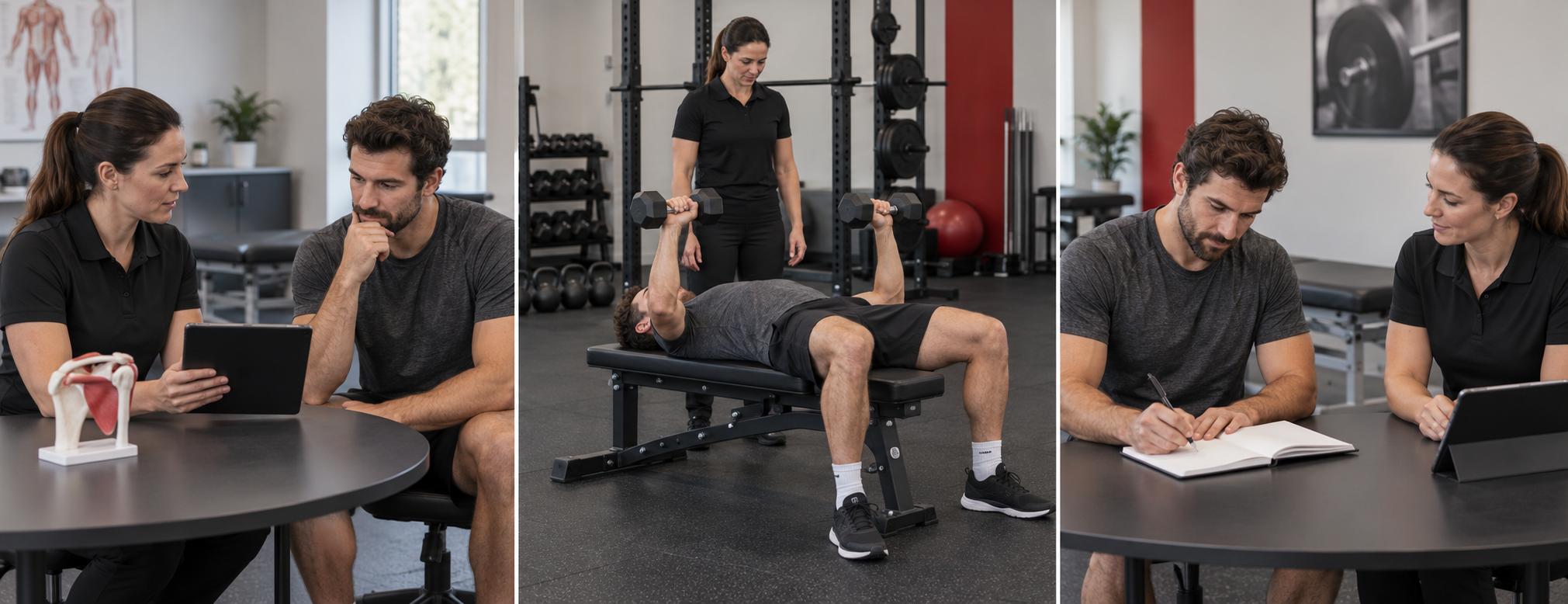
Treating-team boundaries
Repair-specific permission and limits.
Record the planned exposure
Exercise · range · load · repetitions.
Record the response
During the session · later · the following day.
Review the response before changing the dose. Permission, planned exposure and observed response remain separate records.
Illustrated coordination example for the article’s monitoring discussion, not a treatment protocol. The pictured exercise does not prescribe a postoperative stage. No dates, pass scores or universal loading thresholds are implied. Individual decisions remain with the treating team.
Article progression discussion; AAOS (2025), Management of Rotator Cuff Injuries. Guideline.
Progress only when the next exposure is both permitted and tolerated
Clinical permission
Repair-specific restrictions, healing status, motion, symptoms and clinician-defined boundaries.
General capacity
Shoulder and scapular control, pressing tolerance and recovery across ordinary strengthening.
Bench exposure
Stable setup, comfortable range, low load, controlled tempo and a conservative stop rule.
Performance rebuild
Range, load, velocity intent and fatigue return one variable at a time.
Coordinate with the treating team
What to establish, control and monitor
Examples of information to coordinate with the treating team. These are not universal clearance thresholds.
01 · Begin pressing pattern
- What to establish
- Procedure-specific clearance; tolerable active motion and baseline control
- Training variable to control
- Exercise choice, range, tempo, assistance
- Reason to pause or regress
- Unexpected pain, guarding, swelling or loss of function
02 · Add external load
- What to establish
- Repeatable technique and acceptable response to prior stage
- Training variable to control
- Absolute load, sets, frequency, RIR
- Reason to pause or regress
- Symptoms or weakness that do not settle as expected
03 · Add barbell specificity
- What to establish
- Ability to tolerate coupled-hand pressing and planned support
- Training variable to control
- Grip, touch point, pause, depth, surface
- Reason to pause or regress
- Uncontrolled bottom position or loss of upper-back setup
04 · Build performance
- What to establish
- Consistent recovery under submaximal exposure
- Training variable to control
- Intensity, volume, velocity loss, fatigue
- Reason to pause or regress
- Declining mechanics, persistent soreness or clinician concern
Simple records improve the process: exercise, surface, grip, range, load, repetitions, RIR, symptoms during, symptoms later and next-day response. That record is more useful than relying on memory or assuming that one pain-free session represents full readiness.
How to interpret response trends
Interpret those records as a trend, not a pass-or-fail score. A useful comparison holds the exercise, surface and range steady long enough to ask whether the same exposure is becoming more repeatable, better tolerated and easier to recover from. When the response is stable, the treating team can consider advancing one major variable—such as range, load, volume or proximity to failure—while the others remain controlled. When pain, weakness, guarding or next-day loss of function escalates across comparable sessions, adding specificity only makes the signal harder to interpret. This monitoring logic complements clinical examination; it is not a clearance algorithm or a universal symptom threshold.
What a return-to-bench study would need to measure
The largest research gap begins where most rehabilitation reviews end. A useful return-to-bench study would enroll clinically cleared postoperative athletes, report tear and repair characteristics, standardize the staged pressing exposure and follow more than same-session pain. Strength, active motion, three-dimensional scapular and humeral kinematics, bar performance, symptoms later and the next day, adverse events and sustained training participation would all matter. Comparing support surfaces could then test whether the interface changes any measured pathway. Until such work exists, early-versus-delayed rehabilitation evidence cannot be converted into a product recommendation [3][4][5].
Where Equipment Fits in the Return-to-Pressing Process
A return-to-bench plan should specify the surface because surfaces can change torso support, effective range, stability and the athlete’s setup. If an athlete intends to train on a particular bench or pad, late-stage exposure should include it so the return is specific. A change in surface should be treated like a change in range or implement: reduce other variables enough to learn the response.
Independent bench research shows that grip, scapular pose and lateral bar forces change the mechanical task [12][10]. The acute Launch Pad study shows that changing the tested support condition changed pectoralis sEMG, velocity and vertical bar displacement in 10 resistance-trained men [13]. The four- and eight-week trials found greater performance improvement in Launch Pad groups under their supervised protocols [14][15].
Equipment evidence · nonclinical male samples
Strength gains in two separate training studies
Mean changes in bench-press 1RM, with standard deviations printed below the bars.
Four weeks · 1RM change
SD 2.4 kg
SD 4.3 kg
kg · mean; SD printed below each bar · scale starts at zero
Eight weeks · 1RM change
SD 3.4 kg
SD 4.3 kg
kg · mean; SD printed below each bar · scale starts at zero
Performance evidence has a defined population. These studies did not enroll postoperative rehabilitation cohorts or measure healing, pain relief or reinjury.
Performance-mechanical outcomes
Acute activation, velocity and vertical bar displacement, plus a nonsignificant power point estimate; longitudinal 1-RM, repetitions and seated-throw performance in nonclinical male samples.
Postoperative or clinical outcomes
Healing rate, tendon load, pain, reinjury, surgical outcome, clearance timing or superiority during rotator cuff rehabilitation.
Relevance to The Launch Pad®: it is reasonable to evaluate the product as part of a task-specific return after clinical clearance, but its published studies do not validate it as rehabilitation or postoperative treatment.
Relevance to Joint Ops™: selectable surface configurations, shoulder clearance, torso and lumbar support, seat geometry and repeatable indexing are relevant design variables. Joint Ops is in active prototype research, but no published Joint Ops outcome is available. Postoperative, clinical and performance outcomes each require direct testing, and Launch Pad evidence cannot be relabeled as Joint Ops evidence.
Explore the equipment implication →Shoulder Mechanics & Bench Press Surface Design→What the Evidence Shows
Well established
Rotator cuff repair rehabilitation must protect the repair, progressively restore motion and capacity, and be individualized to the procedure and patient.
Supported by multiple studies
Earlier and delayed motion protocols often converge in longer-term outcomes; persistent scapular substitution or dyskinesis can remain after repair; task-specific loading is part of return.
Emerging evidence
Criteria-led progression may be more informative than time alone, but validated return-to-heavy-bench criteria and standardized exercise dosages remain limited.
Mechanistically plausible—requires direct testing
A different bench surface may change a postoperative athlete’s mechanics or tolerance. No published Launch Pad trial establishes healing, pain, reinjury or rehabilitation benefit.
Medical notice: This article is educational and cannot provide surgical clearance, diagnosis or an individualized rehabilitation plan. Follow the restrictions and progression established by your surgeon and rehabilitation clinician. Seek prompt medical evaluation for new trauma, sudden weakness, loss of motion or escalating symptoms.
References
- American Academy of Orthopaedic Surgeons. (2025). Management of rotator cuff injuries: Evidence-based clinical practice guideline. Official guideline. ↩
- Mandaleson A. (2021). Re-tears after rotator cuff repair: Current concepts review. Journal of Clinical Orthopaedics and Trauma, 19, 168–174. doi:10.1016/j.jcot.2021.05.019. ↩
- Matlak S, Andrews A, Looney A, Tepper KB. (2021). Postoperative rehabilitation of rotator cuff repair: A systematic review. Sports Medicine and Arthroscopy Review, 29(2), 119–129. doi:10.1097/JSA.0000000000000310. ↩
- Mazuquin B, Moffatt M, Gill P, Selfe J, Rees J, Drew S, et al. (2021). Effectiveness of early versus delayed rehabilitation following rotator cuff repair: Systematic review and meta-analyses. PLOS ONE, 16(5), e0252137. doi:10.1371/journal.pone.0252137. ↩
- Chen Y, Meng H, Li Y, Zong H, Yu H, Liu H, et al. (2024). The effect of rehabilitation time on functional recovery after arthroscopic rotator cuff repair: A systematic review and meta-analysis. PeerJ, 12, e17395. doi:10.7717/peerj.17395. ↩
- Matter M, Audigé L, Stojanov T, Mueller A, Zumstein MA, Hayoz A, et al. (2026). Return to sport after arthroscopic rotator cuff repair: Epidemiology and prognostic factors in a Swiss multicentre cohort. British Journal of Sports Medicine, 60(2), 116–124. doi:10.1136/bjsports-2025-110358. ↩
- Baumgarten KM, Osborn R, Schweinle WE III, Zens MJ, Helsper EA. (2018). Scapular substitution after rotator cuff repair correlates with postoperative patient outcome. International Journal of Sports Physical Therapy, 13(4), 687–699. doi:10.26603/ijspt20180687. ↩
- Mercurio M, Cofano E, Mancuso C, Paola L, Imbrogno A, Mantovani M, et al. (2025). Persistent scapular dyskinesis after arthroscopic rotator cuff repair: A prospective study. JSES International, 10(2), 101420. doi:10.1016/j.jseint.2025.101420. ↩
- Larsen S, Gomo O, van den Tillaar R. (2021). A biomechanical analysis of wide, medium, and narrow grip width effects on kinematics, horizontal kinetics, and muscle activity on the sticking region in recreationally trained males during 1-RM bench pressing. Frontiers in Sports and Active Living, 2, 637066. doi:10.3389/fspor.2020.637066. ↩
- Noteboom L, Belli I, Hoozemans MJM, Seth A, Veeger HEJ, van der Helm FCT. (2024). Effects of bench press technique variations on musculoskeletal shoulder loads and potential injury risk. Frontiers in Physiology, 15, 1393235. doi:10.3389/fphys.2024.1393235. ↩
- Duffey MJ, Challis JH. (2007). Fatigue effects on bar kinematics during the bench press. Journal of Strength and Conditioning Research, 21(2), 556–560. doi:10.1519/R-19885.1. ↩
- Mausehund L, Werkhausen A, Bartsch J, Krosshaug T. (2022). Understanding bench press biomechanics—the necessity of measuring lateral barbell forces. Journal of Strength and Conditioning Research, 36(10), 2685–2695. doi:10.1519/JSC.0000000000003948. ↩
- Kidwell JA, Yamamoto T, Hetherton KJ, Truneh N, Bright JJ, Blatney AE, et al. (2026). Acute effects of thoracic-spinal elevation via a novel bench press pad on sEMG and barbell kinetics in resistance-trained males. International Journal of Exercise Science, 19(1), 1003. doi:10.70252/IJES2026103. ↩
- Goldman P, Taylor J, Yamamoto T, Blatney AE, Sahni TK, Lechner RJ, et al. (2025). Eccentrically overloaded bench press training: Augmenting strength gains via a novel bench press pad. Scientific Journal of Sport and Performance, 4(4), 480–490. doi:10.55860/JCDL3612. ↩
- Blatney AE, Kidwell JA, Yamamoto T, Goldman P, Hetherton KJ, Dolezal BA. (2026). Effects of an eight week training regimen with a novel bench press pad compared to a traditional bench on upper body strength and performance in collegiate American football players. Scientific Journal of Sport and Performance, 5(1), 10–21. doi:10.55860/RNUB8627. ↩