

“More range of motion” sounds precise but may describe at least five different things. The bar can travel farther while shoulder or elbow excursion changes differently. A lift can satisfy a competition rule yet differ across federations or athletes. A partial can emphasize the lower or upper region. Any useful answer must therefore name the ROM record, the region and the adaptation or performance target.
The analysis below compares acute and longitudinal evidence while holding a strict line between vertical bar displacement and joint excursion. The complete shoulder-mechanics record sits in the shoulder-mechanics article; spinal positioning and force transfer follow in Article 08.
ROM record · define before comparing
ROM Is Not One Measurement
Linear or three-dimensional travel of the bar. Easy to measure; not a joint angle.
Change in shoulder, elbow or spinal angle through a defined phase.
The length state created by several joints and anatomy—not bar height alone.
Initial/lower, middle or final/upper portion of the press.
Start and completion positions required for a valid repetition.
These records are related, but the mapping changes with grip, arch, limb lengths, touch point and bar path. Reporting a 6 cm increase in vertical bar travel does not establish a 6 cm increase in shoulder ROM. Likewise, a partial repetition is not interpretable until its location is stated.
Anatomy context · Name the motion
One press, several movement records
The shoulder, scapula and elbow contribute to the task. Bar travel alone does not separate their contributions.
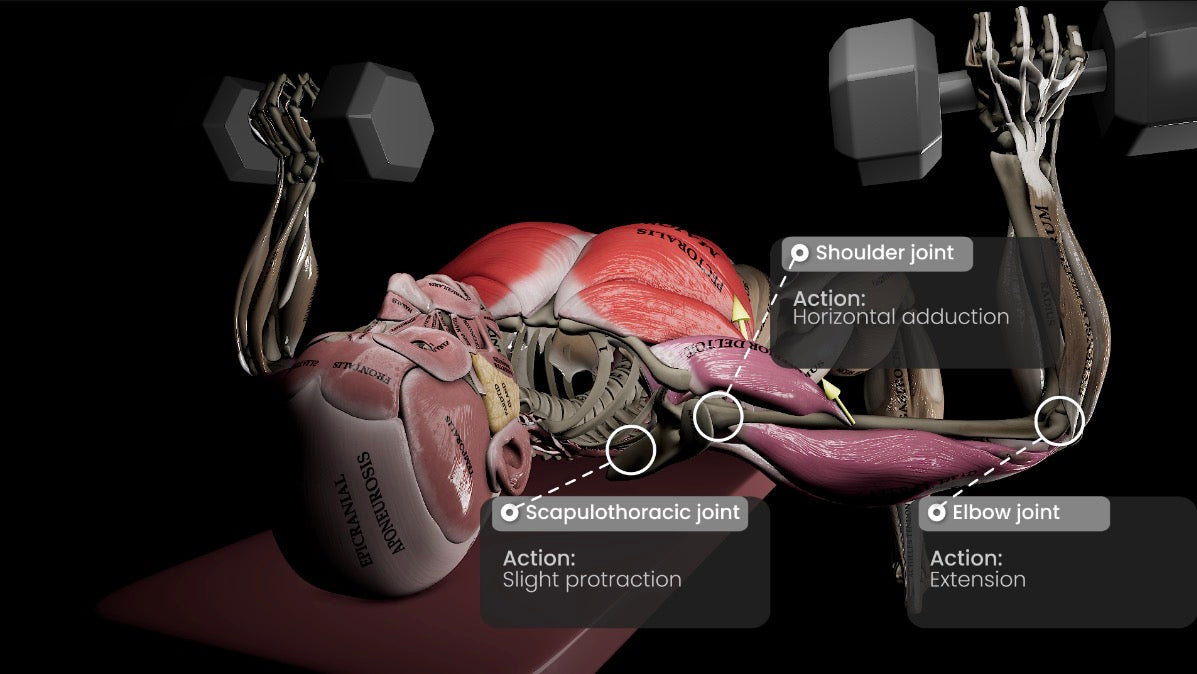
Upper arm relative to scapula
Describe the joint angle and the repetition phase used for comparison.
Scapula relative to thorax
A static view cannot measure scapular excursion through the press.
Forearm relative to upper arm
Report elbow excursion separately from the distance the load travels.
Travel regions · locate the partial
Initial and Final Partials Are Different Training Tasks
AMM Research · Travel regions
Locate the partial before comparing it
01Touch region
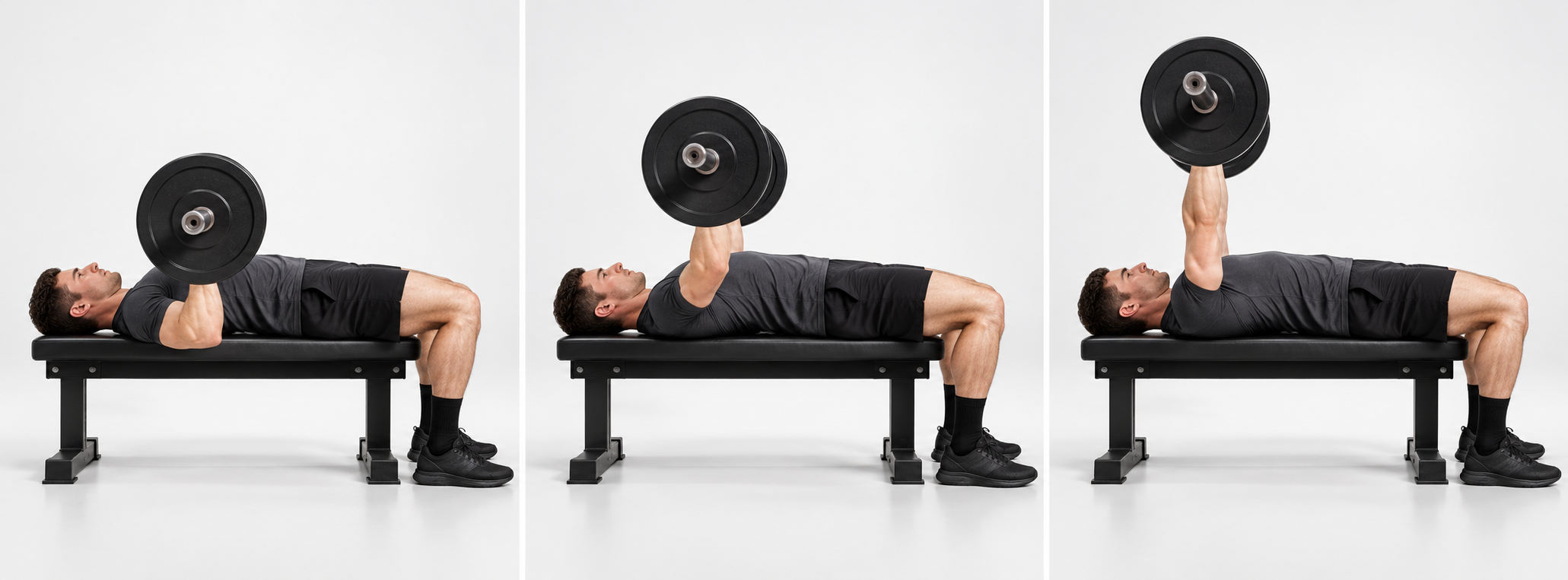
02Middle
03Lockout
Full ROM
Touch region → lockoutLongest defined bar-travel window in a given setup. Load is limited by the weakest region encountered.
Initial / lower partial
Touch region → middleIncludes the bottom and early press. It cannot be replaced conceptually by a top-range overload.
Final / upper partial
Middle → lockoutOften permits more absolute load because the bottom region is omitted; specificity shifts accordingly.
The diagrams describe bar-travel windows, not universal shoulder angles. Martínez-Cava and colleagues tested 42 trained men across full, two-thirds and one-third bench-press ROM. One-repetition maximum increased as the tested ROM shortened, while bar displacement decreased; each condition produced a strong load–velocity relationship (R² = .935–.966).[1] More weight on a shorter ROM is therefore expected task geometry, not evidence that the shorter ROM is globally superior.
Acute testing · Martínez-Cava et al. · 2019
A shorter test changes both the load and the travel
42 trained men · three ROM conditions · condition means from Table 1.
Tested 1RM
kg · mean; SD printed for each condition
Concentric bar displacement
cm · mean; SD printed for each condition
Read the pair together: more load was lifted through less distance. These are acute task comparisons, not training gains.
Evidence timeline · acute is not longitudinal
Acute Geometry and Longitudinal Adaptation Must Be Separated
Full and partial training can both produce gains
Massey and colleagues compared full and partial bench-press training in untrained men and women. These studies helped establish that partial-ROM practice can improve strength, but their populations and protocols limit transfer to trained lifters.[2][3]
Shorter test ROM changes the load–velocity task
The 42-man study above showed higher 1RM with shorter ROM and different bar-displacement/sticking-region records.[1] It was an acute testing study—not a training adaptation experiment.
Full ROM generally favored strength, with heterogeneity
Pallarés and colleagues synthesized 16 studies. Full versus partial ROM favored strength (effect size .56, 95% CI .20–.91; p = .004), with substantial heterogeneity (I² = 77.6%).[4] The hypertrophy estimate also favored full ROM, but it came from four lower-limb studies and should not be presented as bench-specific pectoral evidence.
Effect estimates + 95% confidence intervals
Full-ROM training: strength evidence at two levels
16 studies · p = .004 · I² = 77.6%
4 RCTs · 101 participants · p = .078
Standardized effect size · dashed line = zero
Full-ROM training transferred across all tested ROMs
Fifty men were randomized to full, two-thirds, one-third or control conditions. Training was twice weekly for 10 weeks; only ROM differed among the training programs. The full-ROM group showed the largest gains across the three tested ROMs (effect sizes .52–1.96), while the two-thirds group improved less (.29–.78) and the one-third group least (−.01–.66).[5] Full-ROM gains were reported as 8.8–21.5% across the measured neuromuscular parameters.
Ranges of effect sizes
Reported training effects across measured outcomes
Reported outcome-effect range
Reported outcome-effect range
Reported outcome-effect range
Standardized effect size · dashed line = zero
One failure set did not differentiate swelling or performance
Pedrosa and colleagues used a randomized crossover in 16 resistance-trained men: one set to failure at condition-specific 12RM in initial versus full bench-press ROM. Muscle swelling did not differ by protocol (interaction p = .528; protocol p = .316), nor did 12RM load (p = .662), repetitions (p = 1.000) or volume load (p = .997).[6] This is an acute null result; it cannot determine long-term hypertrophy.
Initial-ROM and full-ROM conditions in a crossover.
Condition-specific 12RM; an acute comparison.
No detected protocol difference in the reported outcomes.
Progressive supramaximal partials matched 1RM gain over a short block
Landram and colleagues randomized 16 resistance-trained men to progressive partial ROM (n = 7) or full ROM (n = 9). The partial group used 105% 1RM and used a 5-inch bar-to-sternum gap in week one, progressing to a 2-inch gap in week four; the full-ROM group used 80–87.5% 1RM. Both groups increased 1RM without a between-group difference, while only the full-ROM group significantly improved selected velocity and concentric-force measures.[7] Different intensities and a four-week duration prevent this result from being read as a simple partial-versus-full verdict.
Protocol comparison · Landram et al. · 2026
The four-week programs differed in depth and load
Bar-to-sternum gap decreased as the block progressed.
Full-ROM training with a strength-oriented progression.
Both groups improved 1RM; the between-group comparison was not significant.
These numbers describe the training protocols, not the size of the strength gains. Study [7].
In the 10-week trained-male trial, full-ROM practice produced the broadest strength transfer across the ROMs tested.
That partials are useless; that every athlete tolerates the same bottom position; or that acute muscle swelling predicts hypertrophy.
The 10-week trial is pivotal because training volume, frequency, progression and rest were held consistent while ROM differed: twice-weekly training across 20 sessions, using 60–80% 1RM, four to five sets, four to eight repetitions and four-minute rests. That isolation strengthens the ROM comparison. It does not eliminate population limits: the participants were men spanning recreational to high training status, and the outcome was strength transfer to the three tested ROMs—not injury, pain or a direct measure of pectoral hypertrophy.
The meta-analysis answers a broader question but combines exercises, populations and partial-ROM definitions. Its strength estimate favored full ROM while heterogeneity remained high. The bench-specific trial is narrower but closer to the pressing task. The evidence should be read in that order: broad direction from synthesis, then protocol-specific transfer from the direct bench experiment.
Dose interpretation · region and timescale
Specificity Has a Region and a Timescale
A full-ROM competition bench press usually requires strength through the bottom, sticking region and lockout. Full-ROM training exposes the complete defined task and, in the 10-week trial, transferred best across test regions. Partials can still be rational when they target a specific phase, permit practice around a temporary constraint, add region-specific volume or overload the top range.
The tradeoff is information: once the bottom is omitted, a successful repetition says less about bottom-position strength. Once the top is omitted, it says less about lockout. If ROM changes because setup or equipment changes, the loading prescription may also need recalibration; the same nominal percentage can represent a different task.
Acute performance and training adaptation also operate on different clocks. A shorter ROM may immediately permit a larger absolute load. That does not guarantee greater long-term transfer outside the trained region. Conversely, a condition that reduces load today may still provide the specific exposure a program is designed to develop. ROM selection should therefore be judged by the adaptation target and later testing, not by the largest number on one session’s bar.
The 2026 progressive-partial trial sharpens that point: a short supramaximal block can raise full-ROM 1RM similarly to a conventional full-ROM block, yet the movement-quality adaptations were not identical. ROM dose includes the region, load, progression and duration together.
Programming bridge · name the reason
Choose ROM by Objective, Then Preserve the Record
Practitioners were manipulating this dose long before it was standardized in trials. Josh Bryant describes boards and partials as ways to train specific regions, while a cambered bar extends the bottom range; he also warns that athlete build and tolerance matter.[8] Dave Tate/elitefts uses floor, board and pin presses as named supplemental movements for different bench problems.[9] Louie Simmons’ Westside manual catalogs board heights, floor presses, pins and grip changes as separate records rather than one generic category of “partial reps.”[10]
That field practice supplies a useful observation and vocabulary, not proof of a universal adaptation. The scientific bridge is to specify the window, load and progression, then test whether the desired region-specific performance transfers to the target lift.
Competition specificity
- Primary ROM choice
- Rule-compliant full ROM in the competition setup
- Useful supplement
- Named lower or upper partial for a defined weak region
- Record that prevents drift
- Touch point, pause, grip, arch, load and bar displacement
General strength
- Primary ROM choice
- Controlled full ROM that is repeatable and tolerable
- Useful supplement
- Partials for added region-specific exposure
- Record that prevents drift
- ROM landmarks, tempo, repetitions and progression
Top-range overload
- Primary ROM choice
- Final/upper partial
- Useful supplement
- Full-ROM work retained elsewhere in the program
- Record that prevents drift
- Pin/board height, start position and absolute load
Bottom-position development
- Primary ROM choice
- Full ROM or initial/lower partial with precise depth
- Useful supplement
- Paused or tempo work
- Record that prevents drift
- Bottom landmark, pause duration and bar path
Temporary symptom modification
- Primary ROM choice
- Individually tolerable, clearly bounded ROM
- Useful supplement
- Gradual exposure when appropriate
- Record that prevents drift
- Symptoms during/after, function and clinical constraints
The headings-only rule for the coach is simple: define, locate, specify, dose and reassess. “Partial ROM” without those fields is not a reproducible intervention.
AMM boundary · measured travel only
The Launch Pad Study Measured Bar Displacement—not Shoulder ROM
Acute crossover · Kidwell et al. · 2026
The recorded outcomes, in their original units
10 trained men · five repetitions · 70% 1RM · means with SD printed below each bar.
Vertical bar displacement
cm · mean; SD printed for each condition
Mean bar velocity
m/s · mean; SD printed for each condition
Peak bar velocity
m/s · mean; SD printed for each condition
Concentric power
W · mean; SD printed for each condition
The transducer recorded bar movement. It did not measure shoulder-joint excursion.
In the randomized crossover by Kidwell and colleagues, 10 resistance-trained men completed five repetitions at 70% of each participant’s established 1RM on a conventional flat bench and with the Launch Pad.[11] Mean vertical bar displacement was 38 ± 7 cm in the flat condition and 44 ± 4 cm with the Launch Pad (p = .005). Mean velocity increased from 0.40 ± .09 to 0.47 ± .09 m/s and peak velocity from 0.57 ± .11 to 0.66 ± .09 m/s (both p < .001). Concentric power did not differ significantly: 249 ± 103 versus 271 ± 93 W (p = .071).
This support condition changed vertical bar travel and velocity during the defined acute task.
The study did not measure shoulder-joint excursion, prove that more ROM is always better or establish a long-term adaptation.
The Athlete-to-Bench Interface owns the complete Launch Pad evidence progression. Joint Ops™ is an active full-bench R&D platform, not a proven ROM intervention. If a selectable surface changes setup or travel, bar displacement, shoulder/elbow/spinal excursion, region exposure, force, velocity and repeatability must be measured separately. No Joint Ops outcome is published, and Launch Pad findings are not transferred to it.
Next concept · Article 08Spinal Positioning & Force Transfer: what changes the task behind the bar path?References
- Martínez-Cava A, Morán-Navarro R, Hernández-Belmonte A, Courel-Ibáñez J, Conesa-Ros E, González-Badillo JJ, et al. (2019). Range of motion and sticking region effects on the bench press load–velocity relationship. Journal of Sports Science & Medicine, 18(4), 645–652. PubMed record. ↩
- Massey CD, Vincent J, Maneval M, Moore M, Johnson JT. (2004). An analysis of full range of motion vs. partial range of motion training in the development of strength in untrained men. Journal of Strength and Conditioning Research, 18(3), 518–521. doi:10.1519/00124278-200408000-00022. ↩
- Massey CD, Vincent J, Maneval M, Johnson JT. (2005). Influence of range of motion in resistance training in women: early phase adaptations. Journal of Strength and Conditioning Research, 19(2), 409–411. doi:10.1519/R-14643.1. ↩
- Pallarés JG, Hernández-Belmonte A, Martínez-Cava A, Vetrovsky T, Steffl M, Courel-Ibáñez J. (2021). Effects of range of motion on resistance training adaptations: a systematic review and meta-analysis. Scandinavian Journal of Medicine & Science in Sports, 31(10), 1866–1881. doi:10.1111/sms.14006. ↩
- Martínez-Cava A, Hernández-Belmonte A, Courel-Ibáñez J, Morán-Navarro R, González-Badillo JJ, Pallarés JG. (2022). Bench press at full range of motion produces greater neuromuscular adaptations than partial executions after prolonged resistance training. Journal of Strength and Conditioning Research, 36(1), 10–15. doi:10.1519/JSC.0000000000003391. ↩
- Pedrosa GF, Rigo MEC, Rodrigues Marques L, da Silva Alves AE, Marques Gomes E, De Conti Luconi A, et al. (2026). Initial vs. full range of motion in the barbell bench press: acute effects on muscle swelling and performance in resistance-trained men. Journal of Bodywork and Movement Therapies, 48, 828–834. doi:10.1016/j.jbmt.2026.07.053. ↩
- Landram MJ, Manturi P, Zipagan M, Gerstle EE. (2026). Progressively increased range of motion confers similar strength improvements but not bar kinematics as full range of motion bench press. Journal of Functional Morphology and Kinesiology, 11(1), 72. doi:10.3390/jfmk11010072. ↩
- Bryant J. (2013). Bench Press: The Science. JoshStrength LLC, pp. 81–86, 117–119. Practitioner source supplied for this review. Related official JoshStrength article. ↩
- Tate D. (2018). Bench weak points. In Workouts & Programs 2018. elitefts, pp. 208–209. Practitioner source supplied for this review. Related official elitefts resource. ↩
- Simmons L. (2009). Westside Barbell Bench Press Manual. Westside Barbell, pp. 15–20. Practitioner source supplied for this review. Official manual page. ↩
- Kidwell JA, Yamamoto T, Hetherton KJ, Truneh N, Bright JJ, Blatney AE, et al. (2026). Acute effects of thoracic-spinal elevation via a novel bench press pad on sEMG and barbell kinetics in resistance-trained males. International Journal of Exercise Science, 19(1), 1003. doi:10.70252/IJES2026103. ↩