

Redefining the Bench Press: From Standardized Lift to Testable System
Broader scientific contextHow an established lift became a testable equipment system
The bench press developed through changes in equipment, rules, and technique. Standardization made results easier to compare. It also gave researchers a reference condition for testing what happens when part of the task changes.
Key Takeaways
The equipment is part of the lift—and part of the evidence.
The history is not one invention date. Floor pressing, handoffs, benches and uprights overlapped before a common contest apparatus emerged.
Standardization made performances comparable; it did not make every other support condition invalid.
Adjustable benches, grip and arch show that a small equipment or technique change can define a different task.
Instrumented biomechanics supplemented visual observation with measurable bar paths, forces, velocities and modeled loads.
The Launch Pad literature is direct evidence for one complete interface under three protocols—not proof for every feature or bench.
Joint Ops is a distinct prototype research program. Its selectable system creates hypotheses, not inherited outcomes.
A documented evolution
The bench press became a controlled system in layers
Strength history is especially vulnerable to a neat “first” that the documents cannot support. Joe Roark’s archival review instead shows overlapping practices: early lifters pressed while supine, contests sometimes required a pullover or used a handoff, and photographs document both plain benches and benches with uprights before the modern commercial form stabilized [1].
Historical record · apparatus, rules and measurement
From getting under the bar to controlling the experimental condition
Supine pressing was a family of tasks
Floor and bench variants coexisted; bar delivery could be a pullover or handoff. “Bench press” did not always identify today’s apparatus or execution.
Historical documentation—not an invention claim.Uprights joined the bench
Roark documented a 1948 photograph of a bench with uprights and a 1953 York advertisement for Jim Park’s bench. These are dated records, not proof that one apparatus was first.
Apparatus made setup more repeatable.Plain benches existed without uprights
Roark documents a 1952 flat, unadjustable, unpadded bench with no integrated uprights. Plain benches and upright-equipped benches overlapped, so bar delivery remained part of many tasks.
Documented example—not a priority claim.A contest lift became an institution
Odd-lift competition gave way to national powerlifting meets, and international federation governance created a common competitive identity.
Rules became part of the task.Published biomechanics was quantifying the lift
High-speed film and later force, EMG and three-dimensional models turned coaching observations into testable movement and loading questions.
Measurement exposed hidden variables.Configuration became programmable
Incline, decline, adjustable backrests, specialty bars and racks made “the bench press” a selectable class of exercises outside competition.
Variation can be prescribed and tested.The support interface entered direct trials
The Launch Pad studies compared a complete elevated/contoured pad condition with a conventional bench in acute and longitudinal protocols.
Interface-level evidence—not feature isolation.Selectable systems require factorial thinking
Integrated surfaces can be indexed and compared, but the number of configurations increases the need for preregistered questions and exact condition reporting.
Joint Ops remains a hypothesis platform.
Jan Todd’s powerlifting history places a “press on floor” or bench press among 1940s odd lifts and identifies the first AAU Senior National Powerlifting Championships in 1965 [2]. The International Powerlifting Federation was founded in 1972 and held its first official World Championships in 1973 [3]. Those milestones did not invent supine pressing; they helped turn a varied practice into a governed sport.
Reference condition
Standardization made the lift comparable
The current IPF rules define a flat, level bench, including a 29–32 cm width and a 42–45 cm height, alongside commands, legal contacts, grip limits and depth requirements [4]. The point is measurement fairness: a valid lift performed on one sanctioned platform should mean substantially the same thing on another.
IPF technical rules · effective 1 March 2026
Three dimensions define the reference apparatus
Across the bench’s padded support surface.
Floor to the top of the uncompressed padded surface.
Minimum bench length; the surface must be flat and level.
A standard bench answers one question very well
“Can this athlete perform the regulated powerlifting bench press?” It does not, by itself, answer which support, angle, grip or range best serves hypertrophy, a sport-specific program, an accessibility need or a mechanism study.
The competition condition is therefore a reference, not a universal control for every research question. Transfer back to that reference must still be measured when a variation is used to build competition performance.
Programmable variation
Once the reference existed, changing the task became informative
Madsen and McLaughlin used high-speed two-dimensional cinematography with 36 lifters—19 experts and 17 novices—in 1984. The experts lifted 79% more, lowered the bar more slowly, used a bar path closer to the shoulders and organized the press differently. Yet the groups did not differ significantly in shoulder torque. That null finding matters: superior performance did not require every proposed mechanical risk marker to move in the expected direction [5].
In 12 nationally and internationally competitive athletes, Saeterbakken and colleagues compared six-repetition maximum performance across flat, incline and decline benches and grip variations. Incline pressing reduced the load that could be lifted, while grip width did not significantly change prime-mover activation in that trained sample [6]. In a separate one-repetition-maximum experiment with 14 experienced men, Larsen and colleagues showed that grip width altered strength, displacement, horizontal force direction and calculated joint moments [7]. Together, the studies show why “grip” or “angle” cannot stand in for a full protocol.
Two studies · different tasks
Angle and grip change what is being tested
Bench angle · tested 6RM
kg · mean; SD printed for each condition
Grip width · tested 1RM
kg · mean; SD printed for each condition
Grip width · descent distance
cm · mean; SD printed for each condition
Read each study within its own protocol. The 6RM and 1RM panels come from different samples; they are not a head-to-head comparison. Descent distance is a bar measurement, not a shoulder-joint angle.
Competitive powerlifters showed virtually identical 1-RM and load–velocity profiles with flat and arched techniques in one study [8].
Another highly trained sample showed a small average 1-RM advantage with an arch, while flatter pressing increased displacement and some velocities [9].
Different samples and procedures can produce different performance effects. Neither study establishes injury reduction.
Support-surface evidence is equally protocol-bound. Koshida and colleagues found lower peak force, power and velocity during dynamic pressing on an intentionally unstable support [10]. Goodman and colleagues found no difference in one-repetition maximum or selected muscle activation between a stable bench and an exercise ball [11]. Those results are not contradictions to be averaged into a slogan. They used different tasks and outcomes, and neither tested conventional pad geometry.
Support-surface studies · read the task with the result
An unstable surface can change different outcomes differently
Acute dynamic performance differed on an unstable support.
Study [10]A different test addressed maximal load and measured activation.
Study [11]Instrumented era
The bench is now an experimental condition, not background furniture
Mausehund and colleagues showed that omitting lateral barbell forces can substantially distort net joint-moment calculations [12]. Noteboom and colleagues then modeled shoulder loading across scapular pose, grip width and shoulder-abduction targets in 10 experienced athletes; several modeled glenohumeral and acromioclavicular force components changed across conditions [13]. These are important mechanics findings, but modeled force is not pain, injury or diagnosis.
AMM Research · Controlled comparison
Make the changed support condition visible
01Flat bench
Conventional support · left
02Launch Pad®
Contoured interface · right
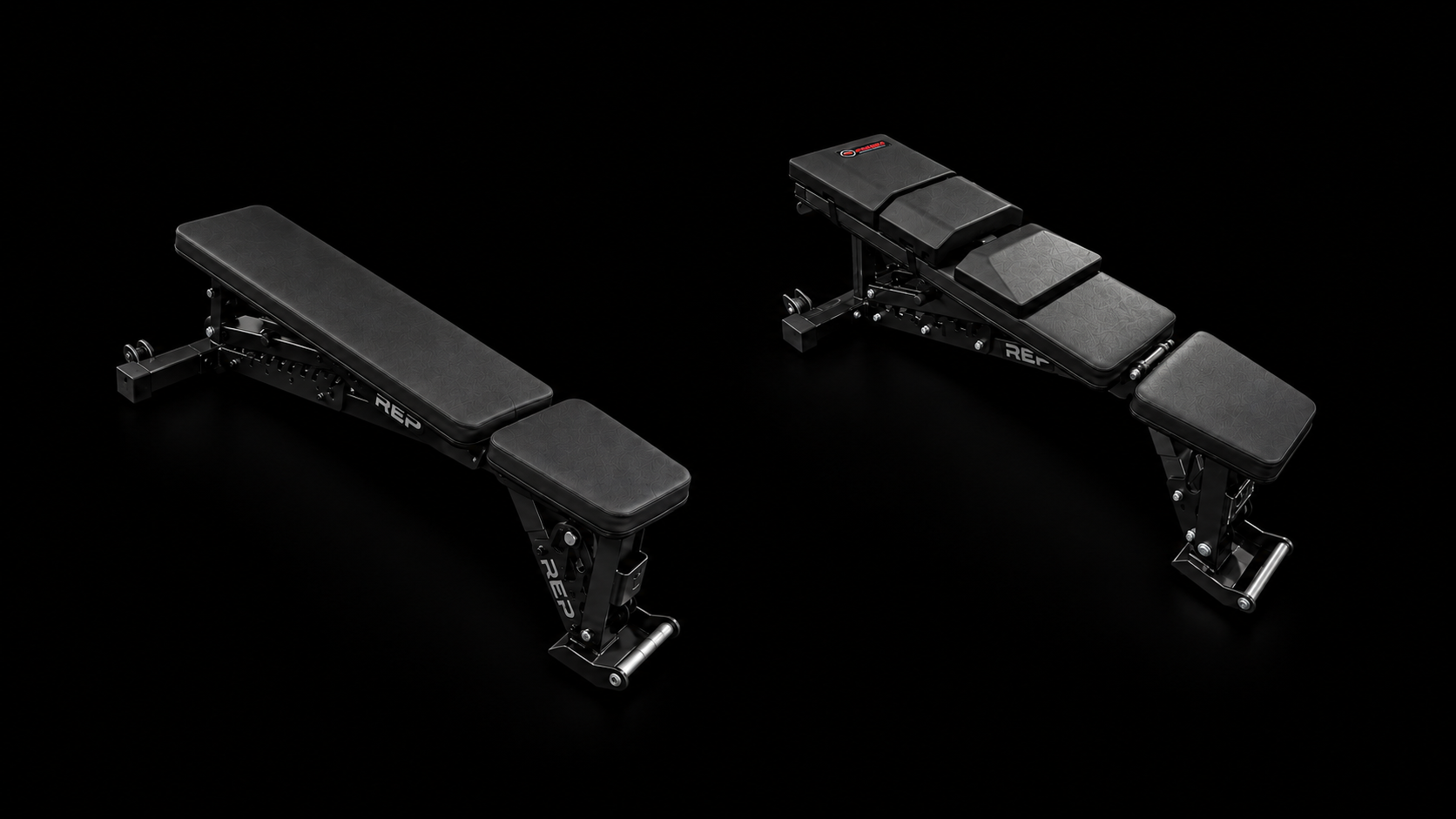
Change the support surface. Hold the comparison together.
- Same athleteAccount for order and familiarization
- Same loadDefine the resistance condition
- Same taskMatch grip, range and execution
- Same measurementsUse the same outcome and method
The conventional flat support is shown on the left; The Launch Pad® is deployed on the bench on the right. These are different bench models. A controlled test should match the base apparatus and setup as closely as possible, alongside athlete, load, task and measurement method. Test order and familiarization also matter.
Article synthesis; see the references below.
Comparison checklist
Minimum specification for a bench-interface experiment
01 · Apparatus
- Record
- Bench dimensions, angle, pad stiffness/contour/cover, rack and bar
- Why it matters
- Defines the physical comparison.
02 · Athlete
- Record
- Body dimensions, sex, training history, familiarization
- Why it matters
- Limits generalization and fit assumptions.
03 · Execution
- Record
- Grip, contacts, arch, touch point, pause, range and intent
- Why it matters
- Separates equipment effects from technique drift.
04 · External mechanics
- Record
- Vertical and lateral forces, bar path, displacement and velocity
- Why it matters
- Captures more of the task than vertical load alone.
05 · Outcome level
- Record
- Acute mechanics, acute performance, longitudinal performance or clinical endpoint
- Why it matters
- Prevents a result from being promoted beyond what was measured.
Direct interface research
What the Launch Pad Research Adds to the Experimental Record
The published Launch Pad studies directly tested the support interface rather than treating the bench as background equipment. The work followed the design question posed by AMM’s co-founder and Launch Pad inventor: if load, grip, range, rack and backrest angle can be changed deliberately, why should the torso-support surface remain unexamined? Across one acute crossover and two randomized training trials, the support condition was experimentally defined while outcomes were measured at acute and longitudinal levels.
These studies were conducted by university research teams independently of Advanced Muscle Mechanics. AMM had no involvement in study design, data collection, analysis, or reporting.
AMM Research · Visual 24Equipment photograph
Make the changed equipment condition visible
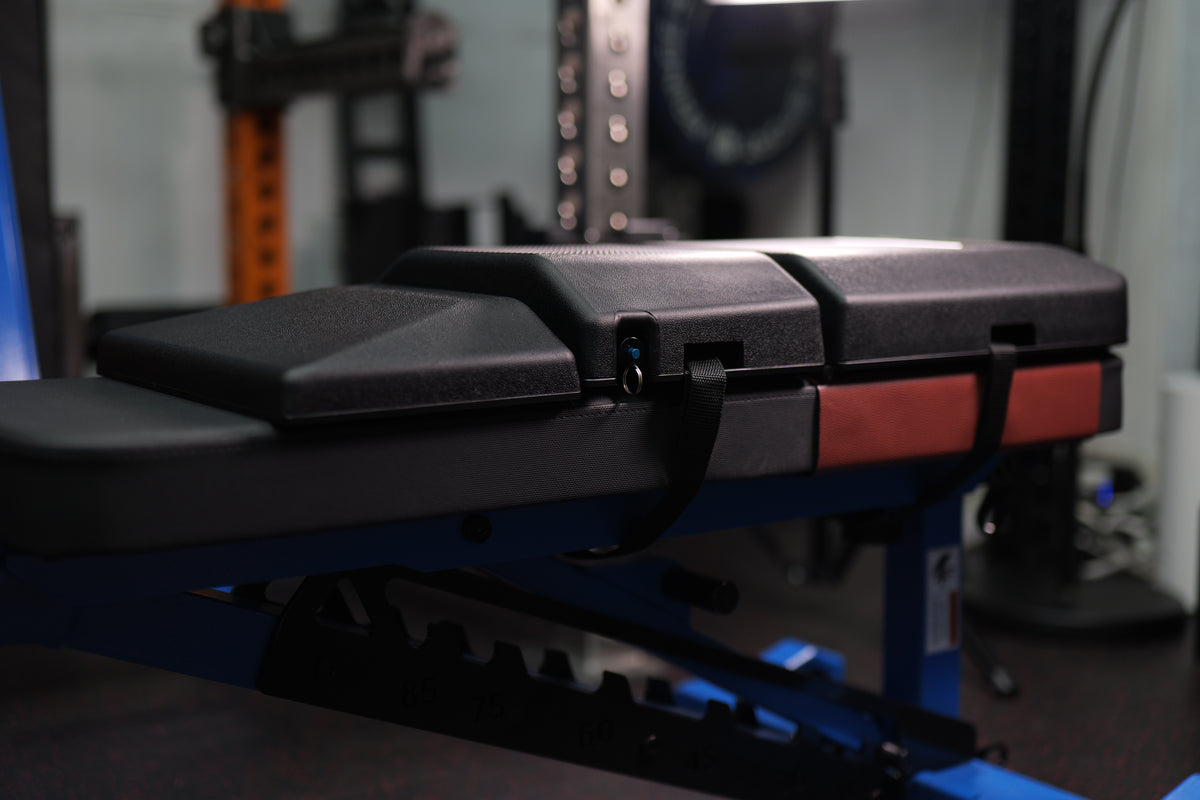
This photograph makes the added support condition visible. It is current equipment photography, not a study photograph or a substitute for the apparatus description in the original papers.
Advanced Muscle Mechanics product-image archive. Original image, unaltered.
Every bar begins at zero. Values remain in the original measurement units.
Standard deviations are printed below each bar; they are not confidence intervals.
Study design and the reported statistical result stay attached to each panel.
Randomized crossover
Kidwell et al. · 2026 · n = 10
Six acute outcomes, shown in their measured units
Randomized crossover · five repetitions at 70% 1RM in each support condition.
Right pectoralis sEMG
% MVC · mean; SD printed for each condition
Left pectoralis sEMG
% MVC · mean; SD printed for each condition
Mean bar velocity
m/s · mean; SD printed for each condition
Peak bar velocity
m/s · mean; SD printed for each condition
Vertical bar displacement
cm · mean; SD printed for each condition
Concentric power
W · mean; SD printed for each condition
d = .23 Study [14].
Read the full study context and reported changes
Ten resistance-trained men performed five repetitions at 70% 1-RM on each surface. The Launch Pad condition increased right and left pectoralis sEMG by 24.4% and 27.1%, mean and peak velocity by 17.5% and 15.8%, and vertical bar displacement by 15.8%. Power was 8.8% higher as a point estimate but was not significant after correction (p = .071) [14].
Four-week randomized trial
Goldman et al. · 2025 · n = 42
Four weeks with the same eccentric-overload program
Change in bench-press 1RM
kg · mean; SD printed for each condition
Read the full study context and reported changes
Forty-two intermediate-trained men completed the same supervised eccentric-overload program for 12 sessions. Average 1-RM gain was 18.4 kg (40.6 lb) with the Launch Pad and 11.1 kg (24.5 lb) conventionally: a 7.3 kg (16.1 lb) between-group difference, about 66% greater average improvement (p < .001) [15].
Eight-week football trial
Blatney et al. · 2026 · n = 30
Eight weeks: strength and two performance tests
Male collegiate football players · 24 supervised sessions · mean changes from baseline.
Change in bench-press 1RM
kg · mean; SD printed for each condition
Change in NFL-225 repetitions
reps · mean; SD printed for each condition
Change in seated medicine-ball throw
m · mean; SD printed for each condition
Read the full study context and reported changes
Thirty male collegiate football players completed 24 supervised sessions. Launch Pad groups improved more in bench 1-RM (19.4 vs 9.7 kg), NFL-225 repetitions (+7 vs +4) and seated medicine-ball throw (+2.7 vs +2.0 m); all reported between-group comparisons were p < .001 [16].
Together, the three studies establish acute interface-dependent differences and two controlled longitudinal performance differences under their tested conditions. The evidence progression makes the support surface a measured experimental variable rather than an assumed constant. Feature isolation, mediation of longitudinal adaptation and clinical outcomes such as pain or injury require separate experiments.
The next experimental question
Joint Ops turns configuration into a research problem
Joint Ops is not the next citation in a Launch Pad proof chain. It is a distinct, selectable system in active prototype research with no published outcomes. The relevant question is whether an indexed configuration changes a prespecified variable relative to another indexed configuration—and whether that change survives familiarization and replication.
A defensible experiment
Hypothesis → variable → comparison → result
Define the configuration, population, task and primary outcome before testing. Report null results and unintended effects with the same precision as positive findings.
A defensible claim
Stop at the measured endpoint
A pressure result supports a pressure statement. A bar-velocity result supports an acute performance statement. Clinical language requires clinical populations and clinical outcomes.
The bench press has endured because it can be standardized without being frozen. Its next useful designs will not win by declaring the flat bench obsolete. They will win by making the changed condition measurable, the comparison fair and the limits visible.
Read the changed condition before judging the result
A bench comparison is only interpretable when the apparatus, athlete, execution and endpoint are all specified.
Scope: This article addresses equipment history, biomechanics and performance research. Clinical outcomes such as injury prevention, pain relief, diagnosis and rehabilitation efficacy require direct clinical evidence.
References
- Roark J. (1990). The Roark Report—The Value of Accuracy. Iron Game History, 1(1), 11. Stark Center PDF. ↩
- Todd J. (2004). “Chaos can have gentle beginnings”: The early history of the quest for drug testing in American powerlifting, 1964–1984. Iron Game History, 8(3), 3–22. Stark Center PDF. ↩
- International Powerlifting Federation. (n.d.). History. Official federation history. ↩
- International Powerlifting Federation. (2026). Technical Rules Book 2026. Official rulebook. ↩
- Madsen N, McLaughlin T. (1984). Kinematic factors influencing performance and injury risk in the bench press exercise. Medicine & Science in Sports & Exercise, 16(4), 376–381. doi:10.1249/00005768-198408000-00010. ↩
- Saeterbakken AH, Mo DA, Scott S, Andersen V. (2017). The effects of bench press variations in competitive athletes on muscle activity and performance. Journal of Human Kinetics, 57, 61–71. doi:10.1515/hukin-2017-0047. ↩
- Larsen S, Gomo O, van den Tillaar R. (2021). A biomechanical analysis of wide, medium, and narrow grip width effects on kinematics, horizontal kinetics, and muscle activity on the sticking region in recreationally trained males during 1-RM bench pressing. Frontiers in Sports and Active Living, 2, 637066. doi:10.3389/fspor.2020.637066. ↩
- García-Ramos A, Pérez-Castilla A, Villar Macias FJ, Latorre-Román PÁ, Párraga JA, García-Pinillos F. (2021). Differences in the one-repetition maximum and load–velocity profile between the flat and arched bench press in competitive powerlifters. Sports Biomechanics, 20(3), 261–273. doi:10.1080/14763141.2018.1544662. ↩
- Bartolomei S, Caroli E, Coloretti V, Rosaci G, Cortesi M, Coratella G. (2024). Flat-back vs. arched-back bench press: Examining the different techniques performed by power athletes. Journal of Strength and Conditioning Research, 38(7), 1200–1205. doi:10.1519/JSC.0000000000004778. ↩
- Koshida S, Urabe Y, Miyashita K, Iwai K, Kagimori A. (2008). Muscular outputs during dynamic bench press under stable versus unstable conditions. Journal of Strength and Conditioning Research, 22(5), 1584–1588. doi:10.1519/JSC.0b013e31817b03a1. ↩
- Goodman CA, Pearce AJ, Nicholes CJ, Gatt BM, Fairweather IH. (2008). No difference in 1RM strength and muscle activation during the barbell chest press on a stable and unstable surface. Journal of Strength and Conditioning Research, 22(1), 88–94. doi:10.1519/JSC.0b013e31815ef6b3. ↩
- Mausehund L, Werkhausen A, Bartsch J, Krosshaug T. (2022). Understanding bench press biomechanics—the necessity of measuring lateral barbell forces. Journal of Strength and Conditioning Research, 36(10), 2685–2695. doi:10.1519/JSC.0000000000003948. ↩
- Noteboom L, Belli I, Hoozemans MJM, Seth A, Veeger HEJ, van der Helm FCT. (2024). Effects of bench press technique variations on musculoskeletal shoulder loads and potential injury risk. Frontiers in Physiology, 15, 1393235. doi:10.3389/fphys.2024.1393235. ↩
- Kidwell JA, Yamamoto T, Hetherton KJ, Truneh N, Bright JJ, Blatney AE, et al. (2026). Acute effects of thoracic-spinal elevation via a novel bench press pad on sEMG and barbell kinetics in resistance-trained males. International Journal of Exercise Science, 19(1), 1003. doi:10.70252/IJES2026103. ↩
- Goldman P, Taylor J, Yamamoto T, Blatney AE, Sahni TK, Lechner RJ, et al. (2025). Eccentrically overloaded bench press training: Augmenting strength gains via a novel bench press pad. Scientific Journal of Sport and Performance, 4(4), 480–490. doi:10.55860/JCDL3612. ↩
- Blatney AE, Kidwell JA, Yamamoto T, Goldman P, Hetherton KJ, Dolezal BA. (2026). Effects of an eight week training regimen with a novel bench press pad compared to a traditional bench on upper body strength and performance in collegiate American football players. Scientific Journal of Sport and Performance, 5(1), 10–21. doi:10.55860/RNUB8627. ↩