

A useful width comparison starts with the person using the bench. How much torso support does the pad provide, where are its edges relative to the shoulder blades, and what changes when the lifter adjusts their setup? Those questions are more informative than calling a pad wide or narrow.
The broader human-centered engineering framework establishes how equipment specifications begin. Here, the investigation narrows to one fit problem: the lateral boundary between athlete and pad. The scapular motion atlas supplies the motion vocabulary. Width may influence that motion, but it cannot serve as its proxy.
Fit variable · geometry before judgment
Why Width Alone Does Not Describe Support
Three records. Three different questions.
Nominal width
Nominal width is a lateral dimension measured at a stated location.
Functional support
Functional support is the contact actually available under a particular torso after upholstery compression and setup.
Edge clearance
Edge clearance is the distance between a body landmark or contact region and the surface boundary.
Those are three different records.
AMM Research · Visual 21Equipment photograph
Nominal width is only one part of the outline
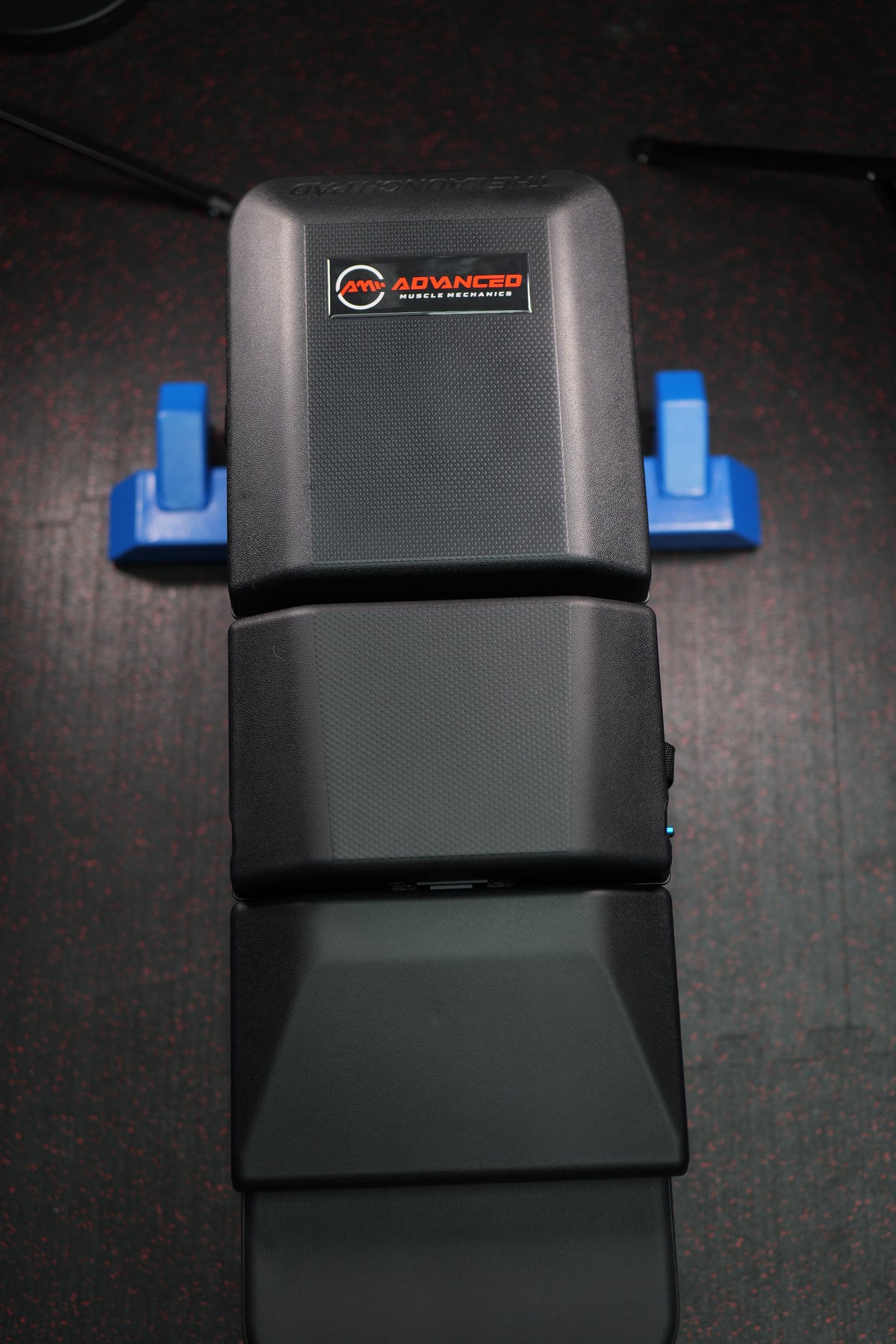
Follow the support along the torso
Record local width, contour and loaded contact at each relevant station.
This top view shows why a single catalog width cannot describe every longitudinal part of a shaped support. It supplies no torso-width comparison, pressure map or preferred width.
Advanced Muscle Mechanics product-image archive. Original image, unaltered.
Record the surface, the person and the task
Geometry record
Width by station along the pad, contour, edge radius, upholstery build and deformation under load.
Person record
Bideltoid or biacromial breadth, posterior torso shape, tissue distribution, sex, body mass and the landmarks selected.
Task record
Scapular setup, grip, arch, bar path, unrack position, competition rules, load and familiarity.
Bideltoid breadth—the maximum horizontal breadth across the lateral deltoids—is not the same as biacromial breadth, which references bony landmarks. The NASA Anthropometric Source Book documents the former as a formal body dimension.[1] Either measure can support a study design, but neither automatically equals the posterior contact width relevant to a bench press.
Rule boundary · legality is not fit
The Competition Rule Defines a Range, Not an Optimum
The 2026 International Powerlifting Federation Technical Rulebook specifies a bench width of 29–32 cm, a length of at least 1.22 m and an uncompressed height of 42–45 cm.[2] It also defines required body contacts during the lift. Those values establish a competition equipment boundary. They do not show that every width inside the range fits every athlete equally, nor do they establish a clinical advantage.
Is the bench legal and is the lift performed within the competition contact requirements?
Where does this athlete contact this surface, how much clearance remains, and do measured mechanics or performance change?
A design may serve a competition task, a general training task, a clinical exercise task or a research task. The intended context has to be named before “better” has any meaning.
Dave Tate’s practitioner account identifies the field problem from the lifter’s side: the bench has a fixed width, while shoulder-blade, upper-back and whole-body positioning are adjusted to create a stable pressing surface.[3] That observation does not validate a particular pad dimension. It turns the coaching workaround into a human-centered question: which body–surface combinations produce adequate support and clearance, and at what mechanical or perceptual cost?
Fit cases · read the lateral boundary
Where the Pad Edges Sit for Different Lifters
The fit examples below are explanatory cases, not population percentiles. They show why a single surface width can create generous, moderate or minimal lateral clearance depending on the body and setup. The red outline represents a posterior torso contact envelope, not a diagnostic landmark.
The same width creates different edge relationships
Contact envelope A

Same nominal pad width
A smaller lateral overhang
Contact envelope B
Same nominal pad width
A larger lateral overhang
Two illustrative contact envelopes on the same nominal pad. The red overlay represents relative geometry; it is not a measured pressure map, an anatomical measurement or a recommended width. Pressure and shoulder motion require direct measurement.
Article synthesis; see the references below.
Surface-dominant envelope
More lateral surface beyond the contact envelopeMay increase support area. It may also bring an edge or upholstery transition into a different relationship with the upper torso. Motion must be measured.
Matched envelope
Moderate lateral clearanceA visually balanced fit is not proof of optimal pressure, stability or scapular kinematics. Those outcomes require direct testing.Body-dominant envelope
Contact approaches or crosses the edgeMay change perceived support or clearance. It does not prove restriction, risk or performance loss.Illustrative fit relationships. The cases describe relative clearance; they are not a ranking of safety or performance.
The silhouette changes again when a lifter retracts, elevates the thorax, changes grip, or shifts relative to the rack. Upholstery compression also changes effective width and edge shape. This is why a top-down photograph can document a condition but cannot establish its internal mechanical effect.
Width also has longitudinal position. The body does not contact one cross-section: the upper thorax, lower thorax and pelvis may lie over different stations, particularly on a tapered or segmented surface. A single catalog number can therefore conceal the local width encountered near the posterior shoulder. Research drawings should report station-by-station dimensions referenced to a reproducible pad origin.
Four ways the boundary can change
More nominal width
Can increase available support area, but may also move the edge into a different shoulder–torso relationship.
Less nominal width
Can increase lateral clearance, but may reduce perceived support or alter stability for some bodies and setups.
Contour or taper
Can change local clearance without applying the same width change to the entire torso or pelvis.
Compression
Can round, flatten or effectively widen the loaded surface; unloaded measurements alone do not capture it.
None of these effects is inherently favorable. The desired balance depends on which endpoint is prioritized and whether the athlete can reproduce the position. That is a fit-envelope problem, not a one-dimensional ranking.
Evidence audit · direct versus adjacent
What the Available Studies Tell Us
In the peer-reviewed literature reviewed for this article through August 2026, we located no bench-press study that isolated pad width as the independent variable and measured scapular kinematics, joint loading, symptoms or performance. This was a targeted literature review, not a registered systematic review. The cited evidence around the question is therefore adjacent, not direct.
Three research perspectives
Body dimensions relate to the task
Caruso and colleagues examined anthropometric predictors of maximal and submaximal bench-press performance, including body mass, total arm length and biacromial width.[4] This supports recording body size in a width study. It does not establish a pad-width prescription.
Standardized anthropometric definitions improve repeatability, but the relevant bench-contact envelope may require additional scanning or pressure/contact mapping rather than one caliper dimension.
Scapular setup & bar travel
In 28 trained men, a retracted versus freer scapular setup changed submaximal upward bar displacement but not velocity, 1RM, repetitions to failure, exertion or discomfort.[5]
p ≤ .024
No significant differences in the other reported strength, effort or discomfort outcomes.
Technique & modeled shoulder loads
In 10 experienced lifters using a light instrumented bar, grip, shoulder abduction and scapular pose altered selected model-estimated shoulder loads.[6]
Neither study manipulated pad width. They show why setup belongs in the protocol, not what width the protocol should select.
The direct gap changes the language. It is reasonable to say that width changes the geometric boundary and may change contact or clearance. It is not currently justified to state that one width “allows natural scapular motion,” “protects the shoulder” or “improves force transfer” across athletes.
Protocol · test the interaction
How to Test Pad Width Fairly
A repeatable person–surface test
A crossover design can answer acute mechanical questions efficiently. It cannot establish adaptation, pain treatment or injury prevention. Those claims require prospective longitudinal outcomes, adequate exposure and clinically meaningful endpoints.
Make the comparison interpretable
Plan the analysis
The primary analysis should be pre-specified.
Test the interaction
Average condition effects may conceal the interaction that matters: a width could be neutral overall but meaningfully different for athletes near one edge of the body–surface ratio.
Show the response
Reporting individual response plots, reliability and familiarization alongside group means would make that result interpretable without declaring every individual change real.
Research boundary · questions before claims
What Changes When the Support Changes
The 2026 Launch Pad crossover study changed a thoracic-support condition and detected differences in pectoralis sEMG, bar velocity and vertical bar displacement in 10 resistance-trained men.[7] It did not isolate pad width, measure scapular kinematics or compare 29 cm with 32 cm. Those results establish that a support intervention can be mechanically non-neutral under a defined protocol; they do not resolve this article’s width question.
Six measured outcomes, side by side
10 resistance-trained men · five repetitions at 70% 1RM · control versus thoracic-support condition.
Right pectoralis sEMG
% MVC · mean ± SD
p < .001 · d = .76
Left pectoralis sEMG
% MVC · mean ± SD
p < .001 · d = .85
Mean bar velocity
m/s · mean ± SD
p < .001 · d = .74
Peak bar velocity
m/s · mean ± SD
p < .001 · d = .98
Vertical bar displacement
cm · mean ± SD
p = .005 · d = 1.02
Concentric power
W · mean ± SD
p = .071 · d = .23
Not statistically significant
Bars show reported means; labels show mean ± standard deviation. Every scale begins at zero. % MVC denotes activity normalized to maximum voluntary contraction. The support condition changed; pad width was not isolated. [7]
AMM’s earlier Inventing The Launch Pad article records how shoulder-clearance and support concerns entered the design process.[8] Its historical role is origin-of-question, not scientific proof. The present fit-envelope model replaces broad language about “restriction” with variables that can be measured.
The practical conclusion is not that width is irrelevant. It is that width should be specified as part of a fit envelope and tested alongside shape, body size, setup and task. Competition legality, visual clearance, comfort, performance and shoulder mechanics are separate endpoints.
Next concept · Article 07Range of Motion & Bench Press Performance: define the traveled region before judging itReferences
- NASA. (1978). Anthropometric Source Book, Volume II: A Handbook of Anthropometric Data. NASA Reference Publication 1024. Official PDF. ↩
- International Powerlifting Federation. (2026). Technical Rules Book, effective March 1, 2026, version 3. Official rulebook. ↩
- Tate D. (2008). EFS Bench Manual. elitefts, p. 12. Practitioner source supplied for this review. Related official elitefts article. ↩
- Caruso JF, Taylor ST, Lutz BM, Olson NM, Mason ML, Borgsmiller JA, et al. (2012). Anthropometry as a predictor of bench press performance done at different loads. Journal of Strength and Conditioning Research, 26(9), 2460–2467. doi:10.1519/JSC.0b013e31823c44bb. ↩
- Piepoli A, Miras-Moreno S, Janicijevic D, Martínez-Amat A, García-Ramos A. (2023). Differences in various strength manifestations between the flat and retracted bench press variants: are they affected by subjects’ experience or strength levels? Journal of Strength and Conditioning Research, 37(12), 2339–2345. doi:10.1519/JSC.0000000000004561. ↩
- Noteboom L, Belli I, Hoozemans MJM, Seth A, Veeger HEJ, van der Helm FCT. (2024). Effects of bench press technique variations on musculoskeletal shoulder loads and potential injury risk. Frontiers in Physiology, 15, 1393235. doi:10.3389/fphys.2024.1393235. ↩
- Kidwell JA, Yamamoto T, Hetherton KJ, Truneh N, Bright JJ, Blatney AE, et al. (2026). Acute effects of thoracic-spinal elevation via a novel bench press pad on sEMG and barbell kinetics in resistance-trained males. International Journal of Exercise Science, 19(1), 1003. doi:10.70252/IJES2026103. ↩
- Advanced Muscle Mechanics. Inventing The Launch Pad. Historical design article, reviewed August 2026. Original AMM article. ↩