

Bench Press Shoulder Pain: Causes and What to Change
Research Hub · Shoulder guide
Bench Press Shoulder Pain: Causes and What to Change
Plain-language guideShoulder pain on the bench press rarely has one cause. It usually comes from how much pressing you are doing compared with what your shoulder is currently ready for, combined with grip, elbow position, fatigue, recovery and the setup the bench lets you hold. This guide explains what the research shows about each of those factors, what shoulder pain can tell you, and what to change first.
On this page
- How common bench-related shoulder problems are
- What shoulder pain can tell you
- What the bench press asks of your shoulder
- Six factors behind most bench-related shoulder pain
- Shoulder problems often linked to pressing
- What to change first
- When the pain keeps coming back
- When to get it checked
- Where The Launch Pad® fits
- Questions lifters ask
This is general training information, not medical advice. If you have sharp pain during a rep, pain that wakes you at night, weakness, numbness or tingling down the arm, or a pop followed by pain or loss of strength, stop pressing and see a doctor or physical therapist.
How to read the labels on this page: Research findings from biomechanics, training or clinical studies. Launch Pad study what the published Launch Pad® studies measured. Proposed a reasonable explanation that has not been directly tested.
How common bench-related shoulder problems are
The shoulder is one of the regions lifters report most often. In a survey of 245 competitive powerlifters, 43.3% said problems affected their routine training, and the shoulder was among the most commonly injured regions along with the lower back and knee (Siewe et al., 2011). An updated systematic review of weightlifting and powerlifting studies found the same recurring trio of shoulder, lower back and knee (Tung et al., 2024).
Emergency-room data show the more serious end. U.S. emergency departments saw an estimated 8,073 weightlifting-related shoulder injuries in 2000 and 14,612 in 2017, an 81% rise, and most patients were men in their 20s with sprains, strains or muscle tears (Pirruccio & Kelly, 2019). Those figures cover all weightlifting, not bench pressing alone, and only the injuries serious enough for an emergency visit. Most sore shoulders never reach a hospital.
What shoulder pain can tell you
Pain is real, and it is useful information. It tells you a task, at that load and in that position, is currently more than the shoulder tolerates. Pinpointing which structure is involved, and whether there is any tissue damage, takes a clinical examination.
Imaging shows why. In 51 men aged 40 to 70 with no shoulder symptoms at all, ultrasound found at least one abnormality in 96% of them, including bursal thickening in 78% and supraspinatus tendinosis in 39% (Girish et al., 2011). A pooled analysis of rotator cuff studies found that abnormalities rise steadily with age whether or not people have symptoms, which makes it hard to say whether a finding is new or is the cause of pain (Teunis et al., 2014). Clinicians increasingly group the common pressing complaints, such as impingement, rotator cuff tendinopathy and some partial tears, under the broader label of rotator cuff related shoulder pain for that reason (Lewis, 2016).
The practical takeaway: two lifters with the same pain can have different problems, and a scan finding is not automatically the explanation. A clinical examination, which looks at how the shoulder moves, what provokes it and what it can still do, is what separates them.
What the bench press asks of your shoulder
During a rep, three things move. The bar travels down and up. Your upper arms swing down past the line of your torso and back. And your shoulder blades glide across your rib cage, tipping, rotating and drawing back as the arms move. The shoulder joint itself is a shallow ball and socket, so it depends heavily on the rotator cuff and the muscles around the shoulder blade to keep the ball centered under load.
Research People with shoulder pain often show different shoulder-blade motion from people without it (Ludewig & Reynolds, 2009). That is an association, and the direction is unclear: altered motion may contribute to pain, or pain may change the motion. An international consensus describes altered shoulder-blade motion (scapular dyskinesis) as a finding, not a diagnosis, because it is also common in people without symptoms (Kibler et al., 2013). In athletes without pain, having it was linked to a 43% higher risk of developing shoulder pain over 9 to 24 months (Hickey et al., 2018). Note that these studies looked mostly at arm raising and overhead athletes, not at lifters lying on a bench.
Proposed On a flat bench, the shoulder blades are pressed between your rib cage and a firm, flat pad while the load is heaviest. It is reasonable to think that this contact changes how freely they can move, and that lifters adapt with an arch, a hard squeeze of the shoulder blades, or a shorter range. The published Launch Pad studies did not measure shoulder-blade motion. Lab experiments that change how the shoulder blades are supported, such as the pool-noodle condition in Noteboom et al. (2024), help investigate the mechanism, but they do not establish the Launch Pad's effect on that motion or on shoulder health. Treat this part as AMM's design rationale rather than a measured fact. For the full explanation, see The Bench Problem.
Six factors behind most bench-related shoulder pain
1. Training demand that rises faster than capacity
Research Across sports, the International Olympic Committee's consensus on training load concluded that rapid changes in load, more than high load itself, are linked with higher injury risk (Soligard et al., 2016). Its evidence comes mainly from team and endurance sports rather than lifting, but the principle carries over. For a lifter, demand is the combination of weight, sets, reps, sessions per week, how close you train to failure, and how much other pressing (overhead, dips, push-ups) sits on top. Capacity is what your shoulder can currently tolerate and recover from. Shoulders tend to complain when demand jumps: a new program, a block of heavy singles, a return after time off, or pressing three days a week instead of two.
Capacity is not only how strong the tissue is. It also includes how well your nervous system controls the shoulder under load: which muscles fire, when they fire, and how accurately you sense where the arm is. The pattern you repeat on the bench is part of what you are training, for better or worse.
Research Altered shoulder-blade motion already appeared above as a marker of higher risk (Hickey et al., 2018). Training control can move risk the other way: in a trial of 660 elite handball players, teams that used a shoulder-focused warm-up program had a 28% lower risk of shoulder problems over the season (Andersson et al., 2017). Neither study involved lifters, but both treat control as part of capacity.
2. Grip width and elbow angle
Research In a musculoskeletal modeling study of 10 experienced athletes, a grip narrower than 1.5 times shoulder width (measured across the bony points of the shoulders) reduced modeled compression at the acromioclavicular (AC) joint. A narrower grip and retracted shoulder blades also reduced the modeled backward shear at the main shoulder joint and the rotator cuff activity needed to control it (Noteboom et al., 2024). Those are model estimates from a small group, not injury outcomes, but they line up with long-standing clinical advice to avoid very wide grips with a sore shoulder (Green & Comfort, 2007; Fees et al., 1998).
Elbow angle matters for a related reason. With the upper arms flared to 90 degrees and the bar low, the shoulder sits in an abducted, externally rotated position. In a case series of 20 weight lifters with anterior shoulder instability, every athlete reported a growing inability to train in that position because of pain (Gross et al., 1993).
3. Shoulder-blade setup and bar path
A stable bench starts with the shoulder blades drawn back and down before the bar leaves the rack, the bar touching around the lower chest, and the forearms close to vertical at the bottom. Touching high on the chest near the collarbones moves the upper arm into a position the shoulder handles less well under load. These are coaching standards rather than tested injury rules, but they match the modeling findings above.
4. Fatigue within a set
Research When 18 recreational lifters pressed to failure at 75% of their max, bar speed fell, the timing of peak speed shifted and the bar path itself changed as reps accumulated (Duffey & Challis, 2007). A tired rep is a different rep. A 2024 review concluded that fatigue and shoulder mechanics are plausible contributors to bench-related shoulder injury but that direct evidence connecting them is still limited (Motlagh & Lipps, 2024). In practice, the last grinding reps of a set to failure are where setup tends to drift.
5. Recovery and exercise selection
Pressing volume adds up across exercises. Bench, incline, overhead press, dips and push-ups all load the front of the shoulder. If the weekly total climbs while pulling work and rest days stay flat, the shoulder often shows it first. Exercise choice also matters on a bad day: dumbbells and a neutral grip let the arm find its own path, and a floor press limits how far the upper arm travels at the bottom (Fees et al., 1998).
6. The surface you press from
The bench is not neutral equipment. Its shape, width, firmness and grip decide where your upper back, shoulder blades and lower back make contact, how easily you can set up the same way each time, and how much room the shoulders have as the arms descend.
Launch Pad study In a randomized crossover study, independent university researchers had 10 resistance-trained men press 70% of their max on a standard flat bench and on The Launch Pad®. On The Launch Pad®, vertical bar travel, which the authors reported as range of motion, averaged 44 cm against 38 cm, chest muscle activation was up to 27% greater and mean bar velocity was 17.5% higher (Kidwell et al., 2026). The study measured the bar and muscle activity. It did not measure shoulder-blade motion, joint loads, pain or injury.
The surface is one factor among six. It changes the conditions you press in. It does not replace sensible loading, good technique or clinical care. For more on how support, stability and setup interact, see The Athlete-to-Bench Interface and Shoulder Mechanics & Bench Press Surface Design.
Shoulder problems often linked to pressing
Only a clinician can tell these apart. This overview is meant to help you describe your symptoms and ask better questions, not to diagnose yourself.
| Problem | What lifters often describe | What the research says |
|---|---|---|
| Rotator cuff related shoulder pain | Ache at the front or side of the shoulder, worse with pressing volume or reaching | An umbrella term covering impingement, cuff tendinopathy and some partial tears. Graduated exercise performs at least as well as surgery for several of these conditions (Lewis, 2016). Causes are likely a mix of load on the tendon and factors within it (Seitz et al., 2011). |
| AC joint pain and distal clavicle osteolysis ("weightlifter's shoulder") | Pain on top of the shoulder, often worst at the bottom of a bench or during dips | Described in athletes who lift weights, with symptoms improving when the aggravating lifts were changed or stopped (Cahill, 1982). In modeling, narrower grips reduced AC compression (Noteboom et al., 2024). |
| Anterior instability | A loose or apprehensive feeling, pain in the bottom position with elbows flared | Reported in weight lifters who could no longer train with the arm out to the side and rotated back (Gross et al., 1993). |
| Labral tears | Deep pain, catching or clicking, sometimes after a specific heavy rep | Diagnosis needs a clinical exam and often imaging. See the post-surgery guide if a repair is recommended. |
What to change first
If your symptoms are mild and none of the warning signs below apply, these are reasonable changes to try one or two at a time, so you can tell what helped.
- Bring the training demand down to a level your shoulder tolerates. Reduce weight, sets or pressing days before you drop the bench completely. The aim is a dose that leaves the shoulder no worse 24 hours later.
- Narrow your grip slightly. Move in a finger-width or two at a time. Many lifters settle just outside shoulder width.
- Tuck the elbows partway. Aim for an upper arm somewhere between your torso and the 90-degree flare.
- Set your shoulder blades before you unrack, and keep them set. Plant your feet and use leg drive so the upper back stays tight against the bench.
- Control the bottom. Lower in one to two seconds and touch without bouncing. If the bottom is the painful part, use a temporary shorter range (see bench press range of motion, explained).
- Stop sets before form breaks down. Leave a rep or two in reserve while the shoulder settles.
- Balance pressing with pulling. Rows and upper-back work help the shoulder handle pressing volume. A common rule of thumb is at least as many pulling sets as pressing sets each week.
- Use variations while you sort it out. Dumbbell, neutral-grip and floor presses keep you training the chest while you find the setup that sits well.
- Look at your bench setup. If you are fighting the pad to hold your position, changing the surface is a legitimate equipment change, in the same way lifters change shoes or bars.
When the pain keeps coming back
Many lifters know this pattern well. The shoulder flares up, you back off or take time away, it settles, you return to your usual bench, and within a few weeks it is back. The cycle often has less to do with bad luck than with the gap between how the shoulder feels and what it is currently ready for.
Rest calms symptoms by removing the demand. It does not rebuild the strength and tolerance that time off takes away, and stopping resistance training reduces strength in a dose-dependent way (Bosquet et al., 2013). Returning straight to your old weights, volume and grip then produces exactly the kind of rapid jump in demand that load research links with problems (Soligard et al., 2016). Your nervous system is the other piece. Pain changes how the shoulder is controlled, and that guarded pattern can stay after the pain settles, even after a successful surgery, unless it is deliberately retrained. Confidence plays a part as well.
We explain this cycle in depth, including how to tell recurring symptoms from a new injury and how the nervous system relearns the lift, in why shoulder pain keeps coming back when you return to bench pressing.
When to get it checked
Training changes help with general irritation. They are not a substitute for a diagnosis. See a doctor or physical therapist if you notice:
- Sharp or stabbing pain during a rep
- Pain that lingers for days, or wakes you at night
- Weakness, such as trouble lifting the arm overhead
- Numbness or tingling down the arm
- A pop followed by pain or loss of strength
- Symptoms that keep returning despite sensible changes to your training
If surgery has been recommended or you are recovering from a procedure, see bench pressing again after shoulder or rotator cuff surgery.
Where The Launch Pad® fits
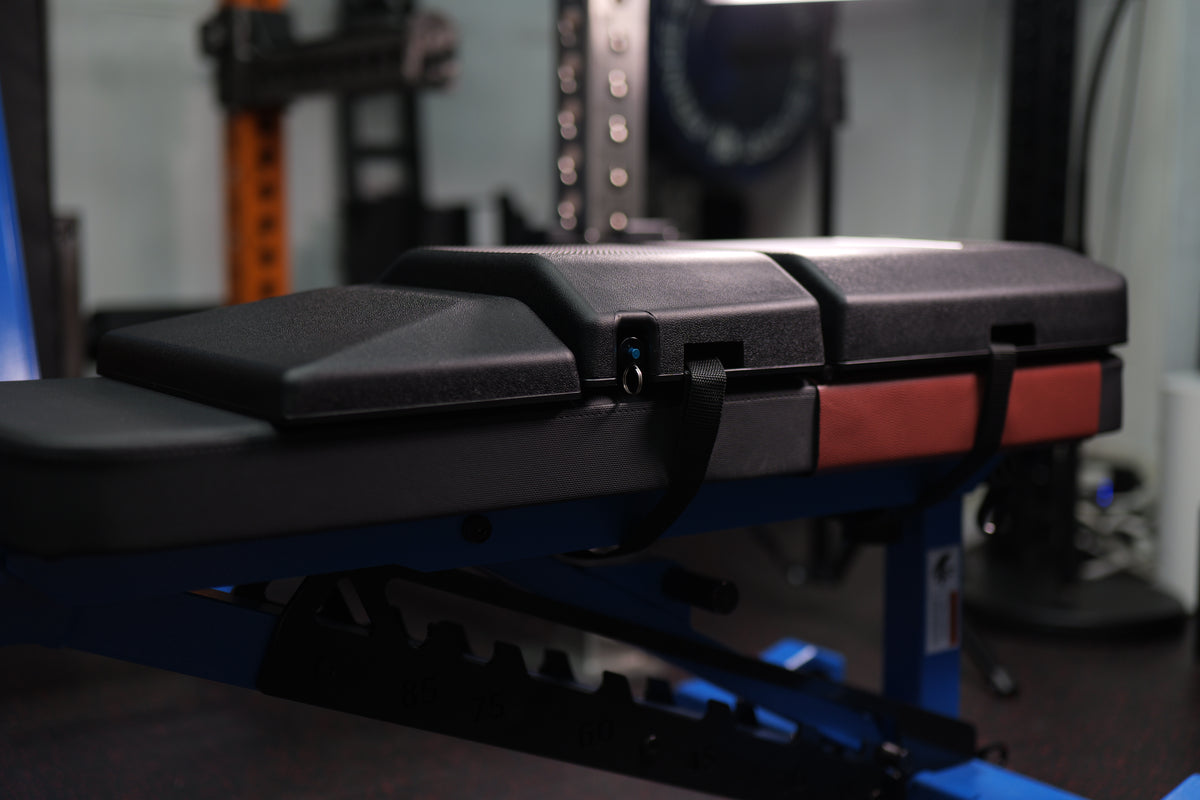
The Launch Pad® replaces the flat contact surface of your bench with molded torso, shoulder-blade and lumbar contours and a lumbar support you can adjust. It straps onto most flat, adjustable and machine benches with two cam straps and no tools. It is training equipment, not a medical device.
Launch Pad study Three peer-reviewed studies by independent university research teams compared it with a standard flat bench in trained men. Beyond the single-set results above, bench press 1-RM rose an average of 18.4 kg (40.6 lb) over four weeks of training on The Launch Pad® against 11.1 kg (24.5 lb) on the flat bench (Goldman et al., 2025). The studies measured performance. They did not study shoulder pain or injury, so they cannot tell you whether it will help a sore shoulder.
See the full research, or compare it with the Thompson Fat Pad®, AbMat® ROM Pad and TorQ Gear ROM BloQ on the bench press pad comparison.
The Launch Pad®
Change the surface you press from.
Every Launch Pad® comes with a 30-day risk-free money-back guarantee.
See The Launch Pad®Questions lifters ask
Is the bench press bad for your shoulders?
No. Many lifters bench for decades without trouble. The shoulder is a mobile joint, though, and the bench asks it to handle heavy load near the end of its range. Most complaints trace back to how much pressing is done, how it is set up and how it is progressed, not to the exercise itself.
Why does my shoulder hurt on the bench but not with push-ups?
The load is usually far higher on the bench, the hands are locked to a bar, and the shoulder blades are pressed against a pad instead of moving freely across your rib cage. Any of those can make the bench the first place a sensitive shoulder complains.
Should I stop benching if my shoulder hurts?
Stop any movement that causes sharp pain, and get it checked. For general achiness, many lifters keep training with lighter weight, a narrower grip, dumbbells or a shorter range while they fix their setup.
Does a wider grip hurt the shoulders?
A very wide grip tends to flare the elbows and, in modeling research, increased compression at the AC joint compared with grips narrower than 1.5 times shoulder width. Most lifters with a sensitive shoulder do better with hands just outside shoulder width.
Is incline or decline easier on the shoulders?
It varies by person. Some lifters find a slight incline or a decline more comfortable, while others prefer flat with a tighter setup. Try each with moderate weight and keep the one your shoulder tolerates best.
Will an MRI tell me what is wrong?
It can help, but findings such as tendon changes and bursal thickening are common in shoulders that do not hurt. A clinician interprets imaging alongside an examination of how your shoulder moves and what provokes it.
Keep reading
References
- Andersson SH, et al. (2017). Preventing overuse shoulder injuries among throwing athletes: a cluster-randomised controlled trial in 660 elite handball players. British Journal of Sports Medicine, 51(14), 1073–1080. doi:10.1136/bjsports-2016-096226
- Bosquet L, et al. (2013). Effect of training cessation on muscular performance: a meta-analysis. Scandinavian Journal of Medicine & Science in Sports, 23(3), e140–e149. doi:10.1111/sms.12047
- Cahill BR. (1982). Osteolysis of the distal part of the clavicle in male athletes. Journal of Bone and Joint Surgery (American), 64(7), 1053–1058.
- Duffey MJ, Challis JH. (2007). Fatigue effects on bar kinematics during the bench press. Journal of Strength and Conditioning Research, 21(2), 556–560. doi:10.1519/R-19885.1
- Fees M, Decker T, Snyder-Mackler L, Axe MJ. (1998). Upper extremity weight-training modifications for the injured athlete: a clinical perspective. American Journal of Sports Medicine, 26(5), 732–742. doi:10.1177/03635465980260052301
- Girish G, et al. (2011). Ultrasound of the shoulder: asymptomatic findings in men. American Journal of Roentgenology, 197(4), W713–W719. doi:10.2214/AJR.11.6971
- Goldman P, et al. (2025). Eccentrically overloaded bench press training: augmenting strength gains via a novel bench press pad. Scientific Journal of Sport and Performance, 4(4), 480–490. doi:10.55860/JCDL3612
- Green CM, Comfort P. (2007). The affect of grip width on bench press performance and risk of injury. Strength and Conditioning Journal, 29(5), 10–14. doi:10.1519/00126548-200710000-00001
- Gross ML, Brenner SL, Esformes I, Sonzogni JJ. (1993). Anterior shoulder instability in weight lifters. American Journal of Sports Medicine, 21(4), 599–603. doi:10.1177/036354659302100419
- Hickey D, et al. (2018). Scapular dyskinesis increases the risk of future shoulder pain by 43% in asymptomatic athletes: a systematic review and meta-analysis. British Journal of Sports Medicine, 52(2), 102–110. doi:10.1136/bjsports-2017-097559
- Kibler WB, et al. (2013). Clinical implications of scapular dyskinesis in shoulder injury: the 2013 consensus statement from the "Scapular Summit." British Journal of Sports Medicine, 47(14), 877–885. doi:10.1136/bjsports-2013-092425
- Kidwell JA, et al. (2026). Acute effects of thoracic-spinal elevation via a novel bench press pad on sEMG and barbell kinetics in resistance-trained males. International Journal of Exercise Science, 19(1). doi:10.70252/IJES2026103
- Lewis J. (2016). Rotator cuff related shoulder pain: assessment, management and uncertainties. Manual Therapy, 23, 57–68. doi:10.1016/j.math.2016.03.009
- Ludewig PM, Reynolds JF. (2009). The association of scapular kinematics and glenohumeral joint pathologies. Journal of Orthopaedic & Sports Physical Therapy, 39(2), 90–104. doi:10.2519/jospt.2009.2808
- Motlagh JG, Lipps DB. (2024). The contribution of muscular fatigue and shoulder biomechanics to shoulder injury incidence during the bench press exercise: a narrative review. Journal of Strength and Conditioning Research, 38(12). doi:10.1519/JSC.0000000000004973
- Noteboom L, et al. (2024). Effects of bench press technique variations on musculoskeletal shoulder loads and potential injury risk. Frontiers in Physiology, 15, 1393235. doi:10.3389/fphys.2024.1393235
- Pirruccio K, Kelly JD. (2019). Weightlifting shoulder injuries presenting to U.S. emergency departments: 2000–2030. International Journal of Sports Medicine, 40(8), 528–534. doi:10.1055/a-0927-6818
- Seitz AL, et al. (2011). Mechanisms of rotator cuff tendinopathy: intrinsic, extrinsic, or both? Clinical Biomechanics, 26(1), 1–12. doi:10.1016/j.clinbiomech.2010.08.001
- Siewe J, et al. (2011). Injuries and overuse syndromes in powerlifting. International Journal of Sports Medicine, 32(9), 703–711. doi:10.1055/s-0031-1277207
- Soligard T, et al. (2016). How much is too much? (Part 1) International Olympic Committee consensus statement on load in sport and risk of injury. British Journal of Sports Medicine, 50(17), 1030–1041. doi:10.1136/bjsports-2016-096581
- Teunis T, et al. (2014). A systematic review and pooled analysis of the prevalence of rotator cuff disease with increasing age. Journal of Shoulder and Elbow Surgery, 23(12), 1913–1921. doi:10.1016/j.jse.2014.08.001
- Tung MJY, et al. (2024). Injuries in weightlifting and powerlifting: an updated systematic review. BMJ Open Sport & Exercise Medicine, 10(4), e001884. doi:10.1136/bmjsem-2023-001884