Shoulder-conscious pressing
The bench should not be competing with your shoulders.
You may have changed grip width, elbow position, warm-ups, mobility, and accessory work. Those variables can matter. But if the bench still crowds the shoulders and upper arms, the support surface itself remains unchanged.
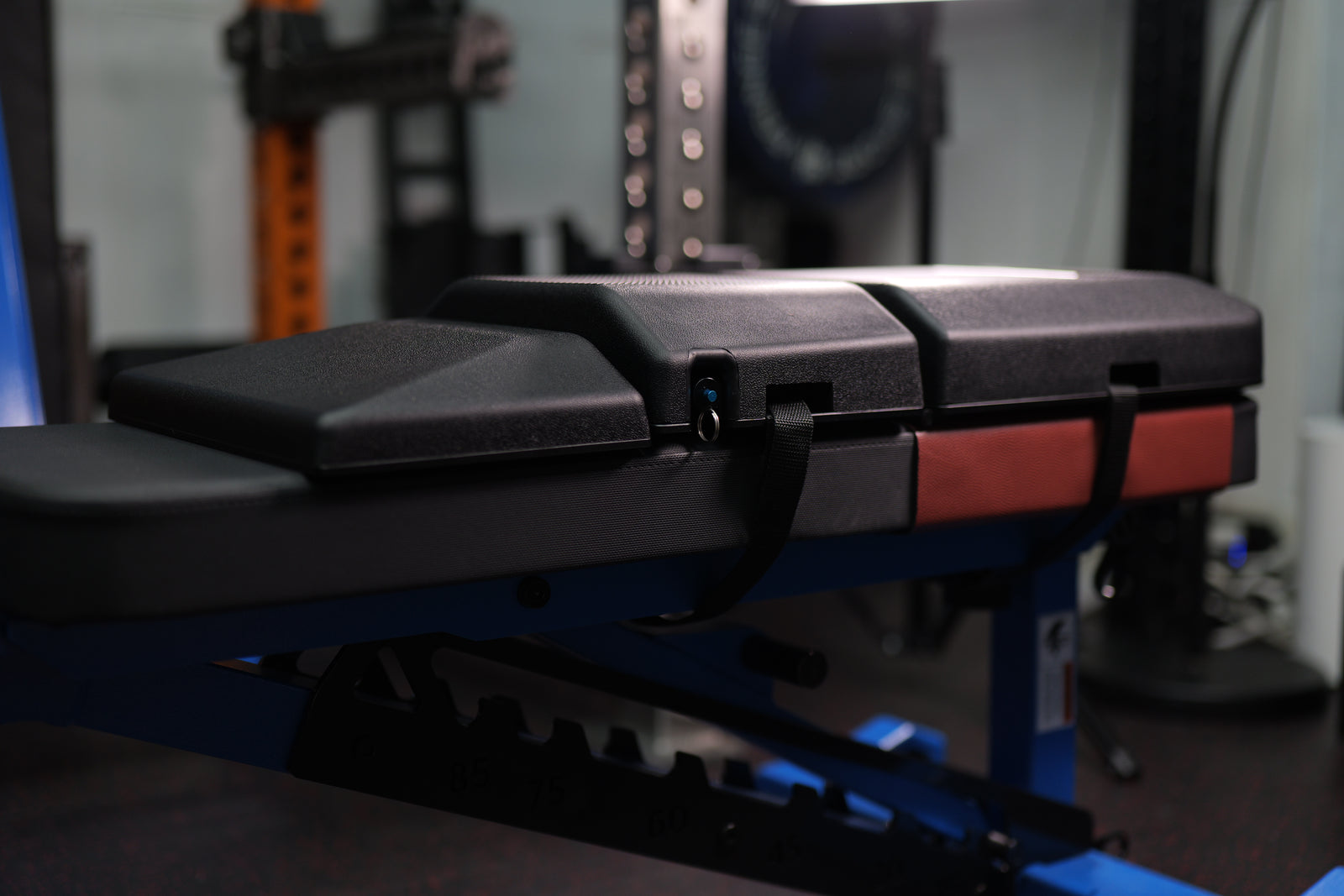
The Launch Pad® uses contoured contact geometry to create more room around the shoulders while adjustable lumbar support and traction help establish a repeatable torso position.
What the evidence can say: the published acute study measured greater pressing range of motion, pectoralis activation, and bar velocity in the Launch Pad® condition. It did not measure pain, injury incidence, or joint forces.
See how the geometry works
Chest stimulus
Let the set end because the pecs are done—not because position broke first.
A crowded bottom position can cause a lifter to shorten depth, shift the shoulders, or lose the torso position built before the first rep. The set may then stop matching the chest-focused movement the lifter intended.
By changing the shoulder and torso contact relationship, The Launch Pad® creates a better opportunity to control the available range while maintaining position.
Published acute finding: right- and left-side pectoralis major activation were reported as 24.4% and 27.1% greater in the Launch Pad® condition under the tested protocol. Activation is not the same outcome as muscle growth.
Review the measured outcomes
Strength and performance
More effort on the same surface is still the same training environment.
A plateau can reflect programming, recovery, technique, skill, body mass, psychology, and many other variables. The surface is not the only answer—but it is one of the few variables most lifters never change.
The Launch Pad® creates a different pressing condition without abandoning the fundamental exercise, making it a complementary option alongside Standard Flat Bench practice.
Why coaches pay attention: in two randomized training studies, both groups trained and improved. The Launch Pad® groups improved more under the reported four- and eight-week protocols.
See the training results
Setup repeatability
Stop rebuilding your position from memory every set.
A small change in hip placement, lumbar contact, shoulder position, head location, or traction can change the entire lift—especially as fatigue rises.
The contoured surface, adjustable lumbar support, molded traction, and visible landmarks give the athlete clearer physical information about where the body belongs before the load leaves the rack.
The practical takeaway: the interface does not replace sound technique. It can reduce setup guesswork and make the athlete-to-bench relationship easier to reproduce.
See fit and setup
Coaches, teams, and facilities
You cannot coach forty different bodies into one identical surface relationship.
Every athlete arrives with different anatomy, training age, mobility, confidence, and pressing history. A coach can cue position, but the equipment still defines the point of contact.
The Launch Pad® provides a portable interface with consistent contact landmarks that can move between compatible stations or be deployed across an entire room without replacing the existing bench fleet.
For decision-makers: evaluate fit, throughput, construction, research, pricing, and athlete response before scaling deployment.
Explore institutional paths
Healthy skepticism
Good. Start skeptical.
Do not buy The Launch Pad® because a product page calls it innovative. Inspect the structure, the mechanism, the patents, the study designs, the limitations, the customer experiences, and the fit with the equipment you already own.
This is an approximately 22-pound rigid interface with an aluminum substructure, adjustable lumbar support, molded traction, securing slots, and a 2,200-pound durability-test reference—not a user-weight or working-load rating, and not a soft foam wedge.
The credibility stack: two issued U.S. patents, three peer-reviewed studies, published limitations, and a 30-day return window governed by the current policy.
Interrogate the product