The Launch Pad® Generation II

Press From a Better Position.

Keep the bench you already own. Add a rigid, contoured Performance Interface™ designed to create more room around the shoulders, make body position easier to repeat, and maintain stable contact under load.

  • Two issued U.S. patents
  • Three peer-reviewed studies
  • Installs in under 60 seconds once familiar
Not a cushion. A rigid, geometry-driven training interface engineered for the athlete-to-bench point of contact.
$510.00 In stock

Fits most compatible flat, adjustable, Olympic, utility, and machine benches. Very wide, short, split-pad, obstructed, or unusually shaped frames can affect fit and strap routing.

In the box: The Launch Pad® Gen II, tactical carrying backpack, two 5-foot cam straps, and one lumbar adjustment pin.

30-day return window. Eligibility, condition, packaging, and refund approval are governed by the current Refund Policy. Individual results vary.

Start With Your Reason

What Are You Trying to Change?

Most people do not begin by searching for a Performance Interface™. They begin with a shoulder that feels crowded, a setup that changes, a chest that never gets the intended work, a stalled press, or a room full of athletes who do not all meet the same bench the same way.

Shoulder-conscious pressing

The bench should not be competing with your shoulders.

You may have changed grip width, elbow position, warm-ups, mobility, and accessory work. Those variables can matter. But if the bench still crowds the shoulders and upper arms, the support surface itself remains unchanged.

The Launch Pad® uses contoured contact geometry to create more room around the shoulders while adjustable lumbar support and traction help establish a repeatable torso position.

What the evidence can say: the published acute study measured greater pressing range of motion, pectoralis activation, and bar velocity in the Launch Pad® condition. It did not measure pain, injury incidence, or joint forces.
See how the geometry works

The Variable Most Lifters Never Change

You Changed the Cues. The Program. The Preparation.

Technique, mobility, specialty bars, exercise selection, and programming can all matter. But each still asks the athlete to perform against the same support surface.

The Launch Pad® changes that surface without changing the fundamental exercise.

The Performance Interface, Engineered

Three Engineering Principles.
One Performance Interface.

The Launch Pad® was engineered as a complete athlete-to-bench system—not a collection of unrelated features. Each principle supports the others so the athlete can establish position, maintain contact, and press from a more intentional foundation.

The Launch Pad contoured contact geometry around the shoulders
01

More Room Around the Shoulders

Human-Centric Contact Geometry

Purposeful contours change where the shoulders and upper arms meet the bench, giving the athlete more clearance to establish a strong pressing position.

Why it matters: less unnecessary interference between the athlete and the bench, more usable pressing space, and a clearer path to a repeatable upper-body position.
Athlete in a gray top holding a loaded barbell near the bottom of a bench press while lying on The Launch Pad®.
02

Find the Same Position Again

Adaptive Body Positioning

Height-adjustable lumbar support establishes a clearer relationship between the hips, lower back, torso, and bench, helping the athlete reproduce the same body-to-surface position from set to set.

Why it matters: less setup guesswork, greater positional consistency, and a more repeatable foundation for sound technical execution.
Rigid high-traction Launch Pad construction under load
03

Stay Planted Under Load

Structural Interface Stability

Rigid construction, an aluminum substructure, molded traction, and securing straps preserve the intended geometry and help the athlete maintain contact as load and fatigue increase.

Why it matters: a more stable platform for force expression and less time spent rebuilding position between repetitions.

The exercise stays familiar. The surface shaping the exercise finally changes.

See what changed in the published studies

Three Studies. Three Questions. One Consistent Signal.

The Rep. The Adaptation. The Transfer.

One randomized crossover study examined immediate mechanics. Two randomized training studies examined what accumulated over four and eight weeks. Each compared The Launch Pad® with a Standard Flat Bench condition under a published protocol.

The purpose is not to promise the same result for every athlete. It is to show that changing the interface repeatedly changed measured parts of the lift and the training response.

01 Immediate biomechanics

The Rep Changed.

10 resistance-trained males · randomized single-blind crossover · 5 repetitions at 70% 1-RM

+24.4% / +27.1%
Right / left pectoralis major activation
+17.5%
Mean bar velocity
+15.8% each
Peak bar velocity and range of motion

Responsible read: the interface changed measurable parts of the press under the tested protocol. Concentric power was numerically higher but did not reach statistical significance (p = .071). Pain, injury incidence, and joint forces were not measured.

Read the published acute study
02 Four-week strength trial

The Adaptation Changed.

42 trained males · randomized controlled trial · 12 supervised eccentric-overload sessions

+18.4 kg
Launch Pad® group 1-RM gain
+11.1 kg
Standard Flat Bench group 1-RM gain
3.85
Reported between-group Hedges’ g

Responsible read: both groups improved under the same supervised eccentric-overload protocol, and both used the same connected adaptive-resistance system. The Launch Pad® group’s average improvement was 7.3 kg greater. These results apply to that specific four-week program—not every bench program or every athlete.

Read the published four-week study
03 Eight-week performance trial

The Performance Changed.

30 male collegiate football players · randomized controlled trial · 24 sessions over 8 weeks

+19.4 vs +9.7 kg
1-RM bench press change · g = 3.99
+7 vs +4
NFL-225 repetition change · g = 3.67
+2.7 vs +2.0 m
Seated medicine-ball throw change · g = 4.10

Responsible read: all three between-group comparisons favored The Launch Pad® (all p < .001). The effect sizes describe this sample under this program; they do not predict any one athlete’s response.

Read the published eight-week study

Both Groups Trained.
Both Groups Improved.
The Compared Variable Was the Interface.

The comparison was not training versus inactivity. The Launch Pad® groups and Standard Flat Bench control groups completed structured training.

The question was whether changing the athlete-to-bench interface influenced what the same kind of work ultimately produced.

That is why the results matter to both serious coaches and everyday lifters.

Read the Evidence at the Depth You Need

Plain-English Takeaway.
Professional-Level Detail.

The key results stay visible. Expand the sections below for study design, statistical meaning, practical interpretation, and limitations.

What Customers Notice After the Switch

The Page Can Explain It.
The First Well-Set Rep Makes It Click.

The excerpts below come from verified buyers and are quoted verbatim from Loox. They describe individual impressions—not guaranteed results or medical, pain, or injury outcomes.

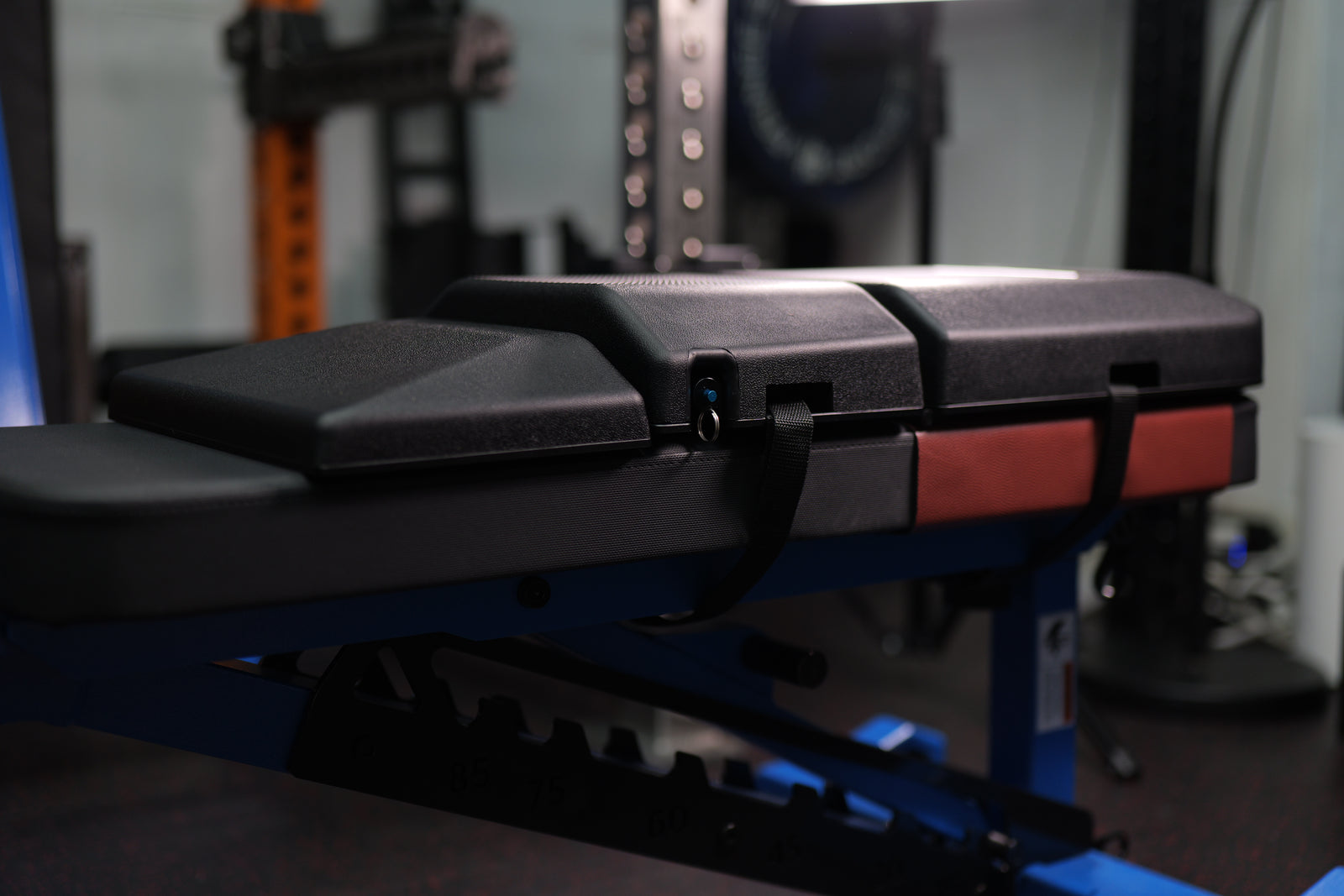
Close-up of the textured upper section of The Launch Pad® on a bench.
★★★★★

“Phenomenal product, absolutely worth it despite the price. I can’t imagine pressing without it now. A must have for your garage gym!”

Ben K. · Verified Buyer
★★★★★

“It allows my scapula to rotate in a pattern that is natural for presses.”

Sean C. · Verified Buyer
★★★★★

“Very easy and quick to set-up and use. Highly recommend!”

Dr. Zach C. · Verified Buyer
★★★★★

“Pricey at first, worth it once you've spent 2 weeks with it.”

Roger A. · Verified Buyer

Different does not automatically mean wrong. A meaningful change in contact geometry can require a few controlled sessions before the new landmarks feel familiar.

See how to start

Average rating and review count are supplied by the live Loox integration.

Your First Three Sessions

Learn the Interface Before You Test It.

A meaningful change in contact geometry should not feel identical to a Standard Flat Bench on rep one. Some lifters feel locked in immediately. Others need several sessions to learn the landmarks, own the available range, and adjust loading.

The Launch Pad positioned and secured on a compatible weight bench
01

Start Conservatively.

Use a load you can control through the available range. Learn the contact points before testing familiar flat-bench numbers.

02

Learn the Landmarks.

Set the interface, strap tension, hips, lumbar support, upper back, and head position before treating the setup as automatic.

03

Judge It After Controlled Exposure.

Evaluate the new pressing environment after several deliberate sessions—not one rushed set performed with your usual load and assumptions.

Position the interface

For barbell pressing, place the top of The Launch Pad® approximately 1–1.5 inches beyond the top of the bench. For dumbbell and compatible machine work, align it flush with the bench top.

Lock it to the bench

Route both straps through the torso slots and under the frame. Remove all slack, lock the cam levers, and confirm the interface cannot shift before loading.

Set the lumbar relationship

Sit in front of the lumbar support with your hips at its edge—never on top of it—then lie back so the support settles into the natural curve of the lower back.

Own the new position

Place your head near the logo, align your eyes under the bar, establish normal lower-body contact, and begin with a conservative load.

Under 60 seconds once familiar. No tools. No drilling. No permanent bench modification.

Standard Flat Bench vs Performance Interface™

Keep the Baseline.
Upgrade the Training Surface.

The choice is not “Standard Flat Bench or Launch Pad forever.” Use the surface that matches the intention of the session.

Training Need Standard Flat Bench The Launch Pad®
Primary role Competition specificity, familiar practice, and standardized testing. Complementary performance-focused pressing surface.
Contact geometry Single planar support surface. Rigid, contoured torso, shoulder, and lumbar support regions.
Body positioning Created and preserved entirely by the athlete. Guided by contact landmarks and height-adjustable lumbar support.
Portability Fixed to the bench. Moves between most compatible benches and machines.
Best use Specific practice, competition preparation, and familiar baseline testing. Strength, hypertrophy, volume, and position-focused pressing.

Use both. Give the Standard Flat Bench the job it does best: specificity. Give The Launch Pad® the job it was engineered for: changing the training interface.

Upgrade My Bench

The Price Objection—Answered Directly

Built as Equipment.
Not Padding.

Compare The Launch Pad® with a piece of foam and it will look expensive. Compare it with a patented, research-backed training interface that moves between compatible benches you already own, and the value proposition changes.

The geometry only matters if the product can preserve it when the weight gets heavy.

Package contents: The Launch Pad®, tactical carrying backpack, two 5-foot cam straps, and lumbar adjustment pin.
01

It Preserves the Geometry.

A rigid high-density body and aluminum substructure are designed to maintain the intended shape under load rather than collapse for comfort.

02

It Moves Between Benches.

One interface can serve most compatible flat, adjustable, Olympic, utility, and machine-based benches instead of being fixed to a single station.

03

It Is Protected and Studied.

Two issued U.S. patents and three peer-reviewed studies support a serious evaluation of both the structural concept and the measured outcomes.

30 × 12.5 × 3 inProduct dimensions
≈22 lbSubstantial, portable construction
2,200 lbDurability-test reference · not a rated working load
AluminumInternal reinforcing substructure
High-density PURigid body designed to hold shape
Integrated slotsBuilt-in channels for secure installation

One Purchase. More Than One Job.

Use the Same Interface Across the Benches You Already Own.

Strength work, hypertrophy, accessory volume, coaching, compatible machines, and portable deployment can all live in the same system.

  • 1 × The Launch Pad® Gen II
  • 1 × Tactical carrying backpack
  • 2 × 5-foot cam straps
  • 1 × Lumbar adjustment pin

$510.00

In stock

Keep your bench. Upgrade the surface. Move the interface wherever you train.

30-day return window governed by the current Refund Policy. Individual results vary.

Teams · Tactical · Facilities · OEM

One Interface.
Two Institutional Paths.

The Launch Pad® can modernize the athlete-to-bench point of contact without forcing an organization to replace an entire bench fleet. For equipment partners, the same design philosophy can extend into licensing, integration, and co-development conversations.

Four adjustable benches fitted with custom-branded versions of The Launch Pad® in front of a wall reading “Work Hard.”
01

Teams · Tactical · Facilities

Upgrade the Bench Fleet You Already Own.

Introduce a consistent Performance Interface™ across compatible stations without drilling, welding, or replacing the benches your program already trusts.

  • Evaluate one unit before scaling deployment
  • Move one interface between stations or equip the room
  • Create clearer torso, lumbar, head, and shoulder contact landmarks
  • Discuss volume pricing and qualified customization
02

OEM · Equipment Partners

Build the Next Generation From the Interface Outward.

The athlete-to-equipment contact condition can become a product-development variable—not an afterthought applied after the frame is complete.

  • Licensing and intellectual-property conversations
  • Product integration and engineering collaboration
  • Co-development of human-centric strength equipment
  • Joint Ops™ and future platform discussions
Preserve the equipment you trust. Upgrade the point where the athlete meets it.
Andrew Harvot, founder and inventor of Advanced Muscle Mechanics, with The Launch Pad

Invented From the Athlete Outward

It Started With a Question the Industry Stopped Asking.

Why was the athlete expected to adapt to the bench instead of the bench being engineered around the athlete?

After more than two decades under the bar, Andrew Harvot began treating the athlete-to-bench point of contact as an engineering problem rather than an unavoidable limitation.

The result progressed from prototypes to The Launch Pad® Gen II, two issued U.S. patents, three peer-reviewed studies, and use across individual, collegiate, tactical, coaching, and facility environments.

The Launch Pad® is the available-now expression of a broader design philosophy: human-centric strength equipment engineered from the athlete outward.

Before You Decide

A Serious Product Should Survive Serious Questions.

You do not have to take the category claim on faith. Review the construction, fit, intended role, evidence, limitations, first-session expectations, and return terms before deciding whether The Launch Pad® belongs in your training.

No. The Launch Pad® is an approximately 22-pound rigid, contoured interface with an aluminum substructure, height-adjustable lumbar support, molded traction, securing slots, and a 2,200-pound durability-test reference—not a user-weight or working-load rating. It is designed to preserve its intended geometry under load—not collapse for comfort.

A cushion softens the same basic surface. A Performance Interface™ changes how the body meets the bench.

Health notice: The Launch Pad® is a performance-training product, not a medical device. It is not intended to diagnose, treat, cure, or prevent disease or injury. Stop or modify training and consult an appropriately qualified professional when pain, injury, neurological symptoms, or other medical concerns are present.
The Launch Pad Generation II Performance Interface installed on a weight bench

The Point of Contact Changes the Starting Position

Your Next Rep Can Start From a Better Surface.

You have invested in the bar, the rack, the program, the coaching, and the work. The point where your body meets the bench deserves the same level of intention.

Keep your bench. Change the interface.

$510.00 In stock

Includes The Launch Pad® Gen II, tactical carrying backpack, two 5-foot cam straps, and one lumbar adjustment pin.

2 issued U.S. patents 3 peer-reviewed studies Under-60-second setup once familiar 30-day return window